


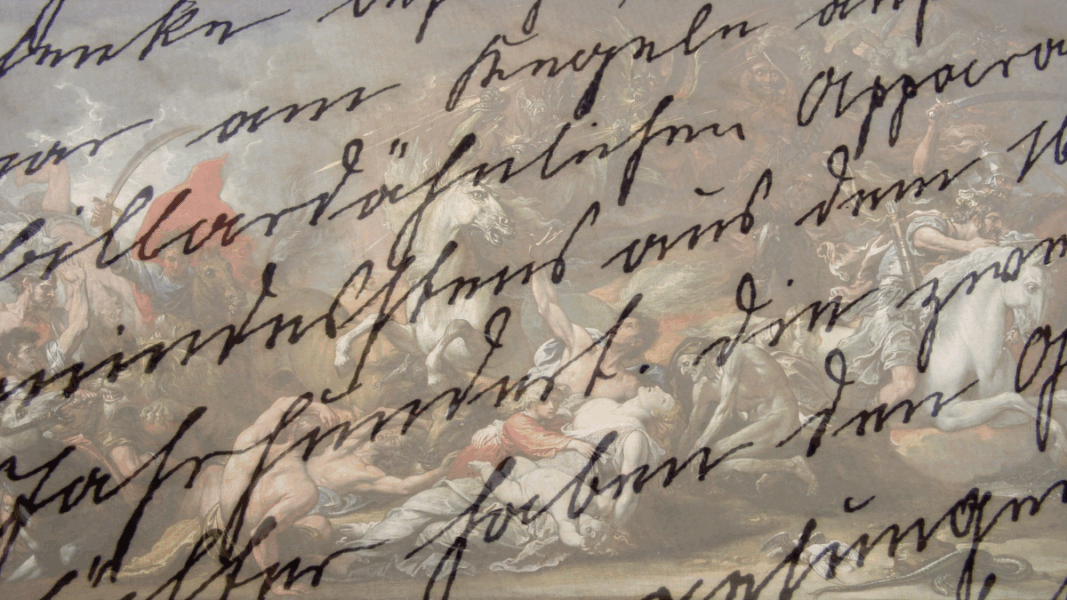
«Death on the Pale Horse» by Benjamin West.
Holiness, you will have to excuse my tedious insistence, but my conscience urges me to address this open letter to you again on the occasion of your message during the Angelus last Sunday, November 2, from which I have extracted the following paragraphs, which I put in italics, and which I comment on below.
Thus the center of God’s concern is manifested: that no one be lost forever, that each one have their place and shine in their singularity.
God may be as concerned as He wishes about that; but the question is: can anyone, in fact, be lost forever, that is: eternally condemned?; if the answer is yes, what good is God’s concern then?; can’t the one who can do all things do what He most wants?; I tried to resolve this matter in the letter I already sent you through this same medium on the question “of the auxiliis”; but I have brought it up again because of the unwavering interest it arouses, and what happens if the answer is no?: I address the consequences further on.
As Benedict XVI wrote, the expression “eternal life” seeks to give a name to this ineradicable longing: not an endless succession, but immersion in the ocean of infinite love, where time, before and after, cease to exist. A fullness of life and joy: that is what we hope for and long for in our being with Christ (cf. Enc. Spe salvi, 12).
I am enormously pleased, that not everything has to be negative, to read these words of yours, for they would suit me perfectly for a digression on a theory that, several years ago, I sent to the dicastery for the doctrine of the faith, and whose response I am still awaiting, that said: well seated, since there’s no point in straining oneself, once I have already racked my brains, and I don’t know if for anything useful; but, as, following Jack the Ripper’s recommendation, it’s better to go in parts, I leave that matter, if the occasion arises, for another open letter, unless the meteorite prevents it.
We know God’s concern not to lose anyone from within, every time death seems to make us lose forever a voice, a face, an entire world. Each person is, in fact, an entire world. Today’s day challenges human memory, so precious and so fragile. Without the memory of Jesus—of his life, death, and resurrection—the immense treasure of each life is exposed to oblivion. In the living memory of Jesus, on the other hand, even those whom no one remembers, even those whom history seems to have erased, appear in their infinite dignity.
How is death going to make us lose someone forever, if we ourselves will not be here forever either?; the only thing that really makes us lose someone forever is condemnation, whether ours or theirs.
Reducing everything to memory sounds as hollow as that hackneyed and lapidary, never better said, phrase: “They will live forever in our hearts”; can the shadowy image that remains in memory be called “life,” which merciless time takes care of distorting implacably?; what then is the glory that remains in memory but pure vanity?; that’s why it was said in the past that a live dog is better than a dead lion, and the name thing is mere coincidence, may God grant you long years.
I hope that the infinite dignity you refer to is not merely natural, like the one that appears in the document Dignitas infinita, which, by the way, remains imperturbably in the catalog of the church’s magisterium, where it fits like a holy Christ with two pistols.
This is the paschal proclamation. That is why Christians have always remembered the deceased in every Eucharist, and to this day ask that their loved ones be mentioned in the eucharistic prayer. From that proclamation arises the hope that no one will be lost.
If Dz 825 anathematizes the thesis that “the justified is obliged to believe with faith that he is among the number of the predestined,” and therefore no one can have certainty of faith about their own salvation, which also excludes certainty of final perseverance, which appears condemned, except for special revelation, in Dz 826, how can one not consider heretical the affirmation that one can hope that no one will be lost, when it is evident that the hope that no one will be lost presupposes certainty of faith that all and each one, persevering until the end, will be saved?
Moreover, Saint Paul says, on the one hand, that “faith is not of all” (2Ts 3:2), and, on the other, that “without faith it is impossible to please God” (Hb 11:6); then how can one say, without contradicting the apostle, that all, including those who do not have faith, nor can they please God because of it, are going to be saved?; how can one also say, contrary to Jesus, who clearly affirmed that not all have stopped being lost, among whom he expressly named the “son of perdition” (Jn 17:12), that no one will be lost?
Finally, if we must hope that no one will be lost, but that all of us will be saved, which, by anchoring us in the certainty of salvation, prevents any real fear of condemnation, how can one avoid the condemnation that Dz 1525 hurls against those who deny that “the fear of hell is in itself good and useful as a supernatural gift and movement inspired by God”?
The gravity of this point is such that it surpasses even the position, already heretical in itself, of Protestantism, which defends the certainty of salvation, but not for all, as is indicated there, but only for believers, which already implies some restriction; the only comparable thing is apocatastasis, which, at least, also recognizes a temporal condemnation, and even so it is, in turn, firmly condemned by Dz 211.
Dz 705 says, referring to heretics: “To all those who think differently and contrary, it condemns, reproves and anathematizes, and declares them alien to the body of Christ, which is the church”; but, of course, who will have the audacity to say that the one who precisely appears as head is not even a member?; great is my anxiety, therefore, although I cannot evade it because of that, for this is what I read in Dz 271 and 274: “If anyone (…) does not reject and anathematize, from soul and mouth, all the most nefarious heretics with all their impious writings to the last iota, (…) let such a one be condemned for ages of ages, and let all the people say: Amen, amen”; it would only be missing that everyone be saved except me, the donkey; can then the insignificant smallness of this priest who has already been removed from the exercise of public ministry rebuke the one who would occupy the highest chair?; but isn’t that exactly what Dz 1105 indicates, which condemns this phrase: “Even if it is evident to you that Peter is a heretic, you are not obliged to denounce him”?; I have no other remedy in conscience, for I do fear hell, and I do not believe I have salvation guaranteed, than, risking everything, to speak plainly even to the morning star, even if recognized as “Peter,” and no matter how inferior I feel in comparison, for the Angelic Doctor already said that, “in the case of a danger threatening the faith, superiors should be reproved even publicly by their subjects, as Saint Paul, being subject to Saint Peter, reproved him publicly” (Summa theologica II-II, q. 33, a. 4, ad 2).
Note: The following open letter expresses the personal opinion of its author. We publish the text for its theological and testimonial interest, exhorting the reader to receive it with discernment and fidelity to the doctrine and Magisterium of the Church.