


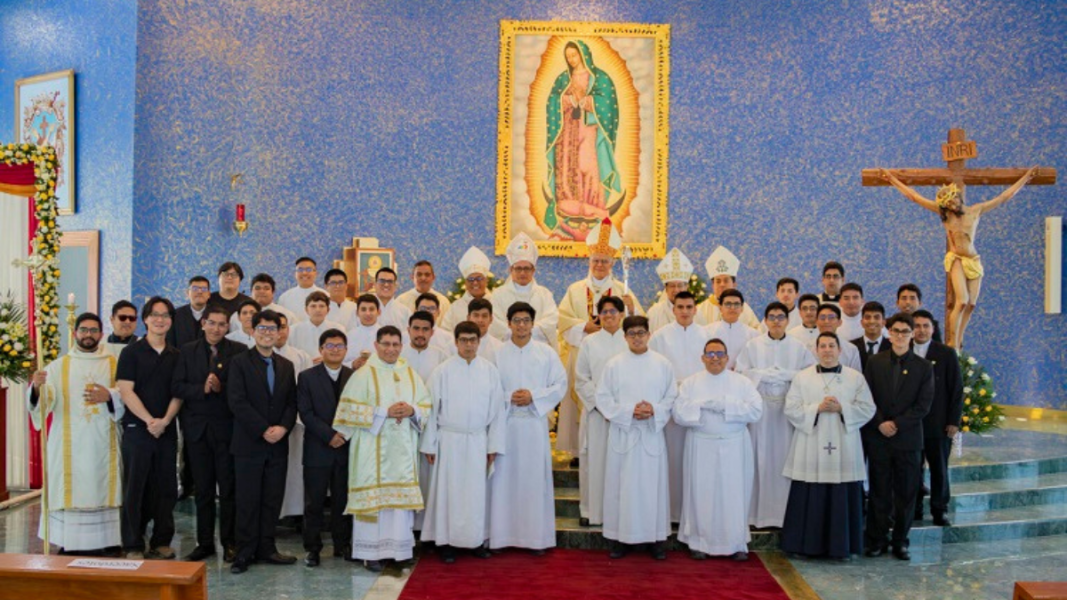
On the occasion of the 400 years of foundation of the Major Archdiocesan Seminary “San Carlos y San Marcelo” of Trujillo, Peru, Pope Leo XIV addressed an extensive pastoral letter in which he recalled his own time at that institution—where he served as a professor and director of studies—and offered a profound reflection on the meaning of the priesthood, formation, and fidelity to the Gospel.
The Pontiff warned that the priesthood cannot be seen as a personal goal or as an escape route, but as “a total gift of existence” and “a call to be configured with Christ in freedom and self-giving”. He invited the seminarians to cultivate prayer, sincerity in discernment, love for theological study, and fraternal life.
“The priest is not made for himself, but for the people of God,” underscores Leo XIV, who also called to “flee from mediocrity, empty activism, and the loneliness of clerical individualism.” The letter culminates with a special blessing to the entire formative community and the families of the seminarians.
We leave below the full text of the Letter from the Holy Father Leo XIV
To the Major Archdiocesan Seminary “San Carlos y San Marcelo” of Trujillo
on the occasion of the 400 years of its foundation
Vatican City, September 17, 2025 – Memorial of St. Robert Bellarmine, bishop and doctor of the Church
Dear sons:
In this year we give thanks to the Lord for the four centuries of history of the Major Archdiocesan Seminary “San Carlos y San Marcelo” of Trujillo, and we recall the passage of countless young men from that Archdiocese, from various jurisdictions of Peru and religious communities who, in those classrooms and chapels, have wanted to respond to the voice of Christ, who called them “to be with Him and to send them to preach” (Mk 3:14). My own footsteps are also part of that house, in which I served as a professor and director of studies.
Your primary task remains the same: to be with the Lord, to let Him form you, to know and love Him, in order to be able to resemble Him. For this reason, the Church has wanted seminaries to exist, places to safeguard this experience and prepare those who will be sent to serve the holy People of God. From that source also spring the attitudes that I wish to share with you now, because they have always been the sure foundation of the ministry of priests.
For this reason, before anything else, it is necessary to let the Lord clarify the motivations and purify the intentions (cf. Rm 12:2). The priesthood cannot be reduced to “reaching Ordination” as if it were an external goal or an easy way out of personal problems. It is not a flight from what one does not want to face, nor a refuge from affective, family, or social difficulties; nor a promotion or a safeguard, but a total gift of existence. Only in freedom is it possible to give oneself: tied to interests or fears, no one gives themselves, for “one is truly free when one is not a slave” (St. Augustine, De civitate Dei, XIV, 11, 1). What is decisive is not “to be ordained,” but to be truly priests.
When it is thought of in worldly terms, the ministry is confused with a personal right, a distributable office; it is transformed into a mere prerogative or a bureaucratic function. In reality, it arises from the Lord’s choice (cf. Mk 3:13), who with special predilection calls certain men to make them participants in His saving ministry, so that they may reproduce in themselves His own image and give constant witness of fidelity and love (cf. Roman Missal, Preface I of the ordinations). He who seeks the priesthood for petty motives is mistaken in the foundation and builds on sand (cf. Mt 7:26-27).
Life in the seminary is a path of interior rectification. One must let the Lord probe the heart and show clearly what moves our decisions. Rectitude of intention means being able to say each day, with simplicity and truth: “Lord, I want to be your priest, not for myself, but for your people.” This transparency is cultivated in frequent confession, in sincere spiritual direction, and in trusting obedience to those who accompany discernment. The Church asks for seminarians with a clean heart, who seek Christ without duplicity and do not let themselves be trapped by selfishness or vanity.
This requires continuous discernment. Sincerity before God and before the formators protects from self-justification and helps to correct in time what is not evangelical. A seminarian who learns to live in this clarity becomes a mature man, free from ambition and human calculation, free to give himself without reservation. In this way, ordination will be the joyful confirmation of a life configured with Christ from the seminary, and the beginning of an authentic path.
The heart of the seminarian is formed in personal dealings with Jesus. Prayer is not an accessory exercise; in it one learns to recognize His voice and to let oneself be led by Him. He who does not pray does not know the Master; and he who does not know Him cannot truly love Him or be configured with Him. The time dedicated to prayer is the most fruitful investment of life, because there the Lord molds feelings, purifies desires, and strengthens the vocation. He who speaks little with God cannot speak of God! Christ allows Himself to be found in a privileged way in Sacred Scripture. It is necessary to approach it with reverence, with a spirit of faith, seeking the Friend who reveals Himself in its pages.
There, he who will be a priest discovers how Christ thinks, how He looks at the world, how He is moved by the poor, and little by little clothes himself in His same criteria and attitudes. “We need to look at Jesus, at the compassion with which He sees our wounded humanity, at the gratuity with which He has offered His life for us on the cross” (Francis, Letter to the priests of the Diocese of Rome, August 5, 2023).
The Church has always recognized that the encounter with the Lord needs to take root in the intelligence and become doctrine. For this reason, study is an indispensable path so that faith may become solid, reasoned, and capable of enlightening others. He who is formed to be a priest does not dedicate time to the academic for mere erudition, but out of fidelity to his vocation. Intellectual work, especially the theological, is a form of love and service, necessary for the mission, always in full communion with the Magisterium. Without serious study there is no true pastoral care, because the ministry consists in leading men to know and love Christ and, in Him, to find salvation (cf. Pius XI, Encyclical Letter Ad Catholici Sacerdotii, 44-46). It is said that a formator asked St. Alberto Hurtado what he should specialize in, and the saint replied: “Specialize in Jesus Christ!” That is the surest orientation: to make study a means to unite oneself more to the Lord and to announce Him with clarity.
Prayer and the search for truth are not parallel paths, but a single path that leads to the Master. A piety without doctrine becomes fragile sentimentalism; a doctrine without prayer becomes sterile and cold. Cultivate both with balance and passion, knowing that only in this way will they be able to authentically announce what they live and live coherently what they announce. When the intelligence opens to revealed truth and the heart is enkindled in prayer, formation becomes fruitful and prepares for a solid and luminous priesthood.
Spiritual and intellectual life are indispensable, but both are oriented toward the altar, the place where priestly identity is built and revealed in fullness (cf. St. John XXIII, Encyclical Letter Sacerdotii Nostri Primordia, II). There, in the Holy Sacrifice, the priest learns to offer his life, as Christ on the cross. By being nourished by the Eucharist he discovers the unity between ministry and sacrifice (cf. St. Paul VI, Encyclical Letter Mysterium Fidei, 4), and understands that his vocation consists in being a victim together with Christ (cf. Rm 12:1). Thus, when the cross is assumed as an inseparable part of life, the Eucharist ceases to be seen only as a rite and becomes the true center of existence.
Union with Christ in the Eucharistic Sacrifice is prolonged in priestly paternity, which does not beget according to the flesh, but according to the Spirit (cf. 1 Cor 4:14-15). To be a father is not something that is done, but something that one is. A true father does not live for himself, but for his own: he rejoices when his children grow, suffers when they are lost, waits when they stray (cf. 1 Thess 2:11-12). So also the priest carries the entire people in his heart, intercedes for it, accompanies it in its struggles, and sustains it in faith (cf. 2 Cor 7:4). Priestly paternity consists in making the face of the Father transparent, so that whoever meets the priest intuits the love of God.
Such paternity is expressed in attitudes of self-giving: celibacy as undivided love for Christ and His Church, obedience as trust in God’s will, evangelical poverty as availability for all (cf. Second Vatican Council, Presbyterorum Ordinis, 15-17), and mercy and strength that accompany wounds and sustain in pain. In them the priest is recognized as a true father, capable of guiding his spiritual children toward Christ with firmness and love. There is no half paternity, nor half priesthood.
You, candidates for the priesthood, are called to flee from mediocrity, amid very concrete dangers: worldliness that dissolves the supernatural vision of reality, activism that exhausts, digital dispersion that robs interiority, ideologies that divert from the Gospel and, no less serious, the loneliness of one who pretends to live without the presbytery and without his bishop. An isolated priest is vulnerable. Fraternity and priestly communion are intrinsic to the vocation. The Church needs holy pastors who give themselves together, not solitary officials; only in this way can they be credible witnesses of the communion they preach.
Dear sons, in conclusion I want to assure you that you have a place in the heart of the Successor of Peter. The seminary is an immense and demanding gift, but you are never alone on this path. God, the saints, and the entire Church walk with you, and in a special way your bishop and your formators, who help you to grow “until Christ be formed in you” (Gal 4:19). Receive from them guidance and correction as gestures of love. Also remember the wisdom of St. Toribio de Mogrovejo, so dear in Trujillo, who loved to say: “Time is not ours, it is very brief, and God will take strict account of us for the way we have employed it” (cf. C. García Irigoyen, St. Toribio, Lima 1908, 141). Therefore, make the most of each day as an unrepeatable treasure.
May the Virgin Mary and St. Joseph, the first formators of the Supreme and Eternal Priest, sustain you all in the joy of knowing yourselves loved and called. With these sentiments, as a sign of closeness, I impart from the heart the implored Apostolic Blessing upon the entire community of that dear Seminary and their families.
Vatican City, September 17, 2025
Memorial of St. Robert Bellarmine, bishop and doctor of the Church
LEO PP. XIV
Note: Although the letter was officially published on November 5, 2025 by the Holy See Press Office, the text is dated September 17, 2025, liturgical memorial of St. Robert Bellarmine, bishop and doctor of the Church. It is customary for pontifical documents to be signed in advance and made public weeks later, after their sending and official registration.