


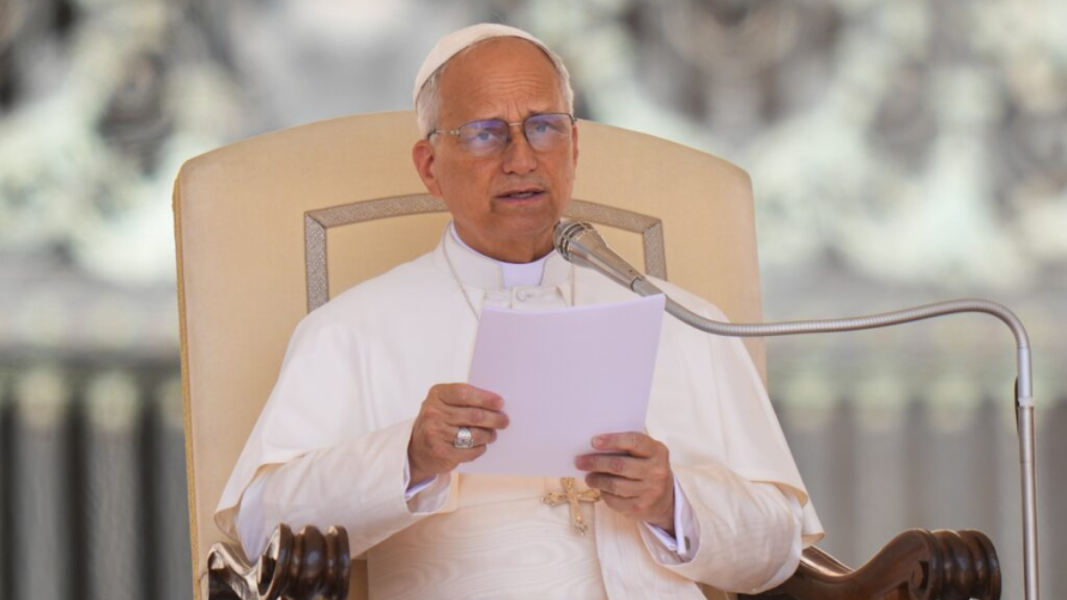
On the morning of this Wednesday, November 5, León XIV presided over the General Audience in St. Peter’s Square, where he greeted thousands of pilgrims from Italy and various parts of the world. In the context of the Jubilee Year 2025, the Holy Father resumed his series of catecheses dedicated to the theme “Jesus Christ, our hope”, focusing this time on “The Resurrection of Christ and the difficulties of the current world: Easter gives hope to everyday life”.
During his address, the Pope emphasized that the Resurrection “is not a fact of the past, but the heart of Christian life,” and invited the faithful to discover in paschal hope a response to suffering, evil, and the confusion of the present. After his catechesis, León XIV offered greetings in several languages and concluded the gathering with the prayer of the Our Father and the Apostolic Blessing.
We leave below the full text of the catechesis of Pope León XIV
Dear brothers and sisters, good morning! And welcome to all.
Jesus’ Easter is not an event that belongs to a distant past, archived in tradition like so many other episodes of human history. The Church teaches us to make a living memory of the Resurrection every year on Easter Sunday, and every day in the Eucharistic celebration, where the promise of the risen Lord is fully realized:
“Behold, I am with you always, until the end of the age” (Mt 28:20).
For this reason, the paschal mystery constitutes the center of Christian life, around which all other events revolve. We can say, without sentimentality, that every day is Easter.
In what way?
Every day we experience different realities: pain, sadness, suffering, but also joy, serenity, and wonder. In all of this, the human heart yearns for fullness, a deep happiness.
The great philosopher of the 20th century, Saint Teresa Benedicta of the Cross—Edith Stein—, who delved into the mystery of the human person, recalled this dynamism of continuous seeking fulfillment.
“The human being— she wrote—always yearns to receive again the gift of being, in order to attain what the moment gives and at the same time takes away.”
We are immersed in limitation, but driven to overcome it.
The paschal proclamation is the most beautiful, joyful, and disconcerting news that has resounded in history: the Gospel par excellence, which proclaims the victory of love over sin and of life over death. It is the only one capable of quenching the thirst for meaning that unsettles our mind and heart.
The human being lives drawn to a “beyond” that constantly calls; nothing limited satisfies. We long for the infinite and the eternal. And yet, the experience of death—anticipated by pain, losses, failures—seems to contradict that desire.
As St. Francis of Assisi sings: “From death no living man can escape”.
But everything changed that morning when the women went to the tomb to anoint the Lord’s body and found it empty. The question that the Magi asked upon arriving in Jerusalem—“Where is the king of the Jews who has been born?” (Mt 2:1-2)—found its definitive answer in the words of the young man dressed in white:
“You are looking for Jesus the Nazarene, the crucified. He is not here. He has been raised” (Mk 16:6).
From that dawn until today, Jesus bears a new title: the Living One, as He Himself presents in the Apocalypse:
“I am the First and the Last, the Living One. I was dead, but now I am alive forever and ever” (Rev 1:17-18).
In Him we find the polar star that guides our life, often plunged into chaos or struck by evil, misunderstanding, or suffering. Meditating on the Resurrection is discovering the answer to the longing for meaning that beats in the human heart.
In the face of our fragility, the paschal proclamation heals, consoles, and rekindles hope, also in the face of the challenges that threaten today’s world.
From the light of Easter, the Way of the Cross is transformed into the Way of Light: pain opens to joy.
We need to savor the joy that follows suffering, to retrace once again—in the light of the Risen One—the steps that precede glory.
Easter does not eliminate the cross, but overcomes it in the prodigious duel that changed human history. Our time too, marked by so many crosses, cries out for the dawn of paschal hope.
The Resurrection of Christ is not an idea or a theory, but the founding event of faith.
The Risen One, through the Holy Spirit, constantly reminds us of it, so that we may be His witnesses even where history seems to have no horizon.
Paschal hope does not disappoint. To truly believe in Easter, in the path of each day, means allowing it to revolutionize our life: to be transformed in order to transform the world with the humble and courageous strength of Christian hope.