


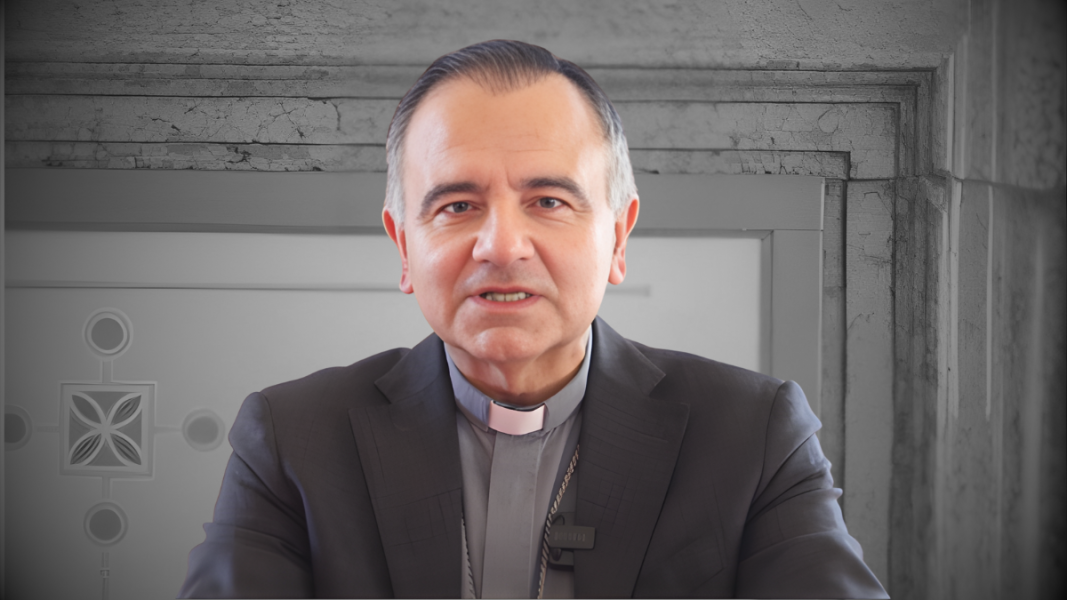
In the midst of the synodal process that marks the life of the Italian Church, Archbishop Erio Castellucci, president of the National Committee of the Synodal Way, has become one of the most visible voices of the new pastoral direction promoted by the Italian Episcopal Conference (CEI).
Prelate of the diocese of Modena-Nonantola and vice president of the CEI, Castellucci is one of the prelates closest to Pope Francis’s pastoral approach, and one of the main promoters of the idea that synodality is not an event, but “a permanent style of Church”.
In a recent interview granted to the SIR Agency, the official communication organ of the CEI, the archbishop addressed the most controversial topics of the process: «homoaffectivity», the role of women, lay co-responsibility, and structural reforms.
His tone was dialogical and pastoral, but his statements—formulated with calculated ambiguity—reveal the theological and ecclesial drift that is currently traversing the Church in Italy: a pastoral approach that emancipates itself from doctrine and a Church that seems more concerned with not upsetting the world than with evangelizing it.
The synodal path must remain in the Church
Castellucci describes the four years of the synodal process as “intense and beautiful years”, because “evangelical beauty does not coincide with harmony, but with gift and dedication”. He adds that the goal now is “to root this synodal style in permanent modalities”, renewing structures, bodies, and ministries.
The insistence on “style” and “modalities” reveals a reversal of priorities: faith becomes methodology, and communion an administrative process. Castellucci does not mention the need to renew sacramental life, nor to deepen the faith of the faithful.
Instead, the focus is on form: “synodality is not a phase, but a stable style”, he states.
The risk of this language is evident: replacing mission with method. Synodality, understood in this way, ceases to be a means to walk toward Christ and becomes a self-referential structure, where “walking together” becomes an end in itself.
«Recognize» without approving: ambiguity about homoaffectivity
Asked about the treatment of homosexuality in the synodal document, Castellucci responds:
“Recognition does not mean moral legitimation, but respect for the person. Accompanying means walking together, welcoming without simplifications, as Pope Francis asks.”
Although the archbishop formally distinguishes between “recognize” and “legitimize”, the way he formulates it dissolves the boundary between respect and moral approval. By not mentioning the Catechism’s teaching—which qualifies homosexual acts as “intrinsically disordered” and calls for welcoming people “with respect, compassion, and sensitivity” (CCC 2357–2358)—his language leaves room for interpretations that normalize homosexual practice.
The allusion to Amoris laetitia (“as already happened with divorced and remarried people”) reinforces that line of pastoral ambiguity: an endless gradualness, an accompaniment that does not necessarily lead to conversion.
The risk is that “recognize” becomes a euphemism for validate, and “accompany” a form of institutionalized pastoral tolerance.
«Participate» in civil days: between witness and confusion
The prelate clarifies that the synodal text mentions “participation in days promoted by civil society”, but not the “Pride”. He says:
“Reference is made to days already present in the civil calendar—such as those against homotransphobia or against abuses—in which some dioceses promote moments of prayer or reflection. The purpose is not to adhere to ideologies, but to witness respect and safeguard human dignity.”
The intention seems good, but the context is equivocal. These “civil days” are promoted by organizations that advance an anthropology contrary to the Gospel. Participating institutionally, even “with prayer”, grants symbolic support to ideological discourses that identify Christian doctrine with “discrimination”.
Castellucci omits warning of this risk and takes for granted that the Church can “be present without adhering”. But in today’s culture, neutral presence does not exist: silence in the face of error amounts to consenting to it.
Human dignity is not safeguarded by adapting the Gospel to the world’s slogans, but by proclaiming the truth that liberates, even when it discomforts.
Women and laity: confusion of roles
At another point, Castellucci states:
“We must renew the bodies of participation, promote lay ministries, and attribute to women a more defined and significant role in ecclesial life.”
The approach sounds inclusive, but lacks a doctrinal distinction between the ministerial priesthood and the common priesthood. By presenting “lay ministries” as a form of structural protagonism, the bishop reduces the lay vocation to its function within the Church, forgetting that its essential mission is in the world, not in diocesan offices.
In the name of co-responsibility, a kind of «lay clericalism» is promoted: everyone participates, but no one evangelizes.
The true role of women is not defined by a position in an assembly, but by their witness of faith, fidelity, and spiritual motherhood, as St. John Paul II taught in Mulieris dignitatem.
Without a clear reference to doctrine, Castellucci’s discourse adds to the horizontal narrative that measures ecclesial value by visibility, not by holiness.
Co-responsibility: management that supplants the mission
For the archbishop, the key word for the future is «co-responsibility»:
“Co-responsibility has emerged as the key to giving continuity to the shared process. Without strengthening it, it will be difficult to initiate a true reform of Christian initiation.”
In practice, Castellucci conceives co-responsibility as a model of ecclesial co-management, based on teams, committees, and diocesan plans. He speaks of “guidelines”, “delegates”, and “permanent synodal referents”.
But communion is not created with structures, but with holiness.
If co-responsibility is reduced to a mechanism of formal participation, the Church runs the risk of functioning like a consensus NGO, without inner fire or transcendent mission.
True co-responsibility is participating in Christ’s cross, not in an endless assembly.
A Church that speaks of itself
Castellucci’s discourse reflects a Church obsessed with speaking of itself, of its processes, its methods, and its votes.
He says that “we must not fear delicate topics”, but his proposal is to address them with “gradualness and accompaniment”, not with doctrinal clarity.
The result is a Church that dialogues, but is disarmed; present in forums, but absent in culture.
The Synodal Way can be a grace if it leads to Christ, but it becomes a mirage if it turns pastoral care into ideology.
Fidelity does not consist in adapting to the world, but in keeping alive the truth that saves.
Italy—and the whole Church—does not need a more sympathetic pastoral approach, but bishops who speak with parrhesia:
«Yes, yes; no, no.»