


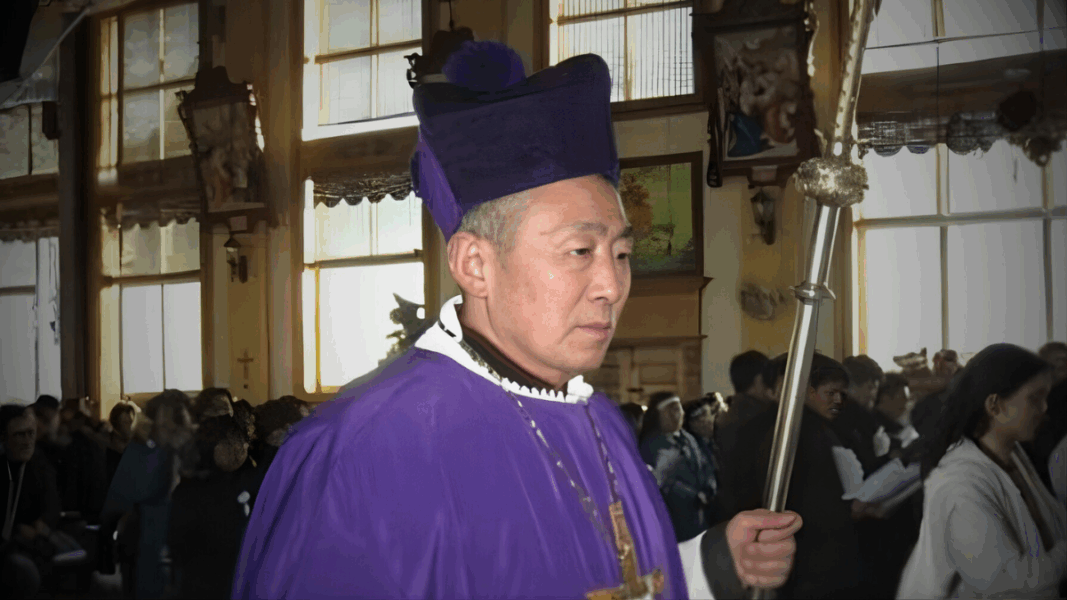
On October 29, 2025, Msgr. Giulio Jia Zhiguo, bishop of Zhengding in China’s Hebei province, passed away. He was 90 years old. His entire life was a testimony of fidelity to Rome and resistance to the Chinese communist regime, which imprisoned him repeatedly and kept him under nearly permanent confinement for decades. However, his death has gone practically unnoticed in the official Vatican media. No note, no remembrance, not a single word in his memory.
The silence has been absolute, and not a few observers—like the Vatican analyst Specola—interpret it as a gesture of diplomatic prudence toward Beijing, a silence that, in light of history, is painful.
When diplomacy is silent and testimony speaks
Cardinal Pietro Parolin, the Vatican’s Secretary of State, has repeatedly insisted that the secret agreement between the Holy See and the Chinese government is in “continuity” with the line of St. John Paul II and Benedict XVI. However, the facts seem to contradict that discourse.
When Msgr. Jia was arrested once again by communist authorities in 2009, the Vatican—then under the pontificate of Benedict XVI—protested publicly, stating that such an action “created obstacles for constructive dialogue” that the Church was trying to maintain with Chinese authorities. Today, however, in the face of his death, a silence reigns that seems dictated by diplomatic convenience, not by evangelical charity.
The memory that is not convenient to remember
25 years ago, on October 1, 2000, St. John Paul II canonized 120 Chinese martyrs, men and women who gave their lives to confess Christ. It was a brave and prophetic gesture: the Pope chose precisely the National Day of the People’s Republic of China to remind the world that the truth of the Gospel is not negotiable.
That act cost tensions with Beijing, but it honored the martyrs and the persecuted Church. Today, however, the anniversary of that canonization has passed in complete silence, just as the death of Msgr. Jia has been ignored. The contrast is painful: a Church that once dared to proclaim the faith aloud now prefers to remain silent so as not to discomfort political power.
The price of silence
The omission is not only communicative: it is moral. To remain silent before the death of a bishop who suffered imprisonment, surveillance, and isolation for half a century out of fidelity to Christ and the Pope is an error that wounds the Church’s credibility.
Martyrs are not obstacles to dialogue, but its foundation. Diplomacy can be prudent, but it can never be at the expense of the testimony of saints and confessors of the faith.
St. John Paul II did not fear offending Beijing; he preferred to honor the martyrs. Benedict XVI raised his voice in defense of the persecuted. Today, however, Rome’s silence in the face of the death of a faithful bishop recalls a dangerous temptation: sacrificing the truth in the name of diplomacy.
The voice that pacts must not silence
The death of Msgr. Jia Zhiguo is not just that of a bishop, but of a symbol of unwavering fidelity. His life was a Gospel lived under persecution; his death, a silent reproach to the indifference of the world and part of the Church.
Agreements and strategies with civil power may have their value, but no pact justifies forgetting the martyrs. The Church that remains silent before its witnesses loses its prophetic voice. And the diplomacy that remains silent before the suffering of its children ends up emptying itself of soul.
On October 29, 2025, the Church in China lost one of its most faithful shepherds. Rome, on the other hand, lost an opportunity to remind the world that faith is worth more than any treaty. And the faithful of Hebei continue to repeat the words of their bishop: “The freedom of the Christian does not depend on walls, but on fidelity to Christ.”