


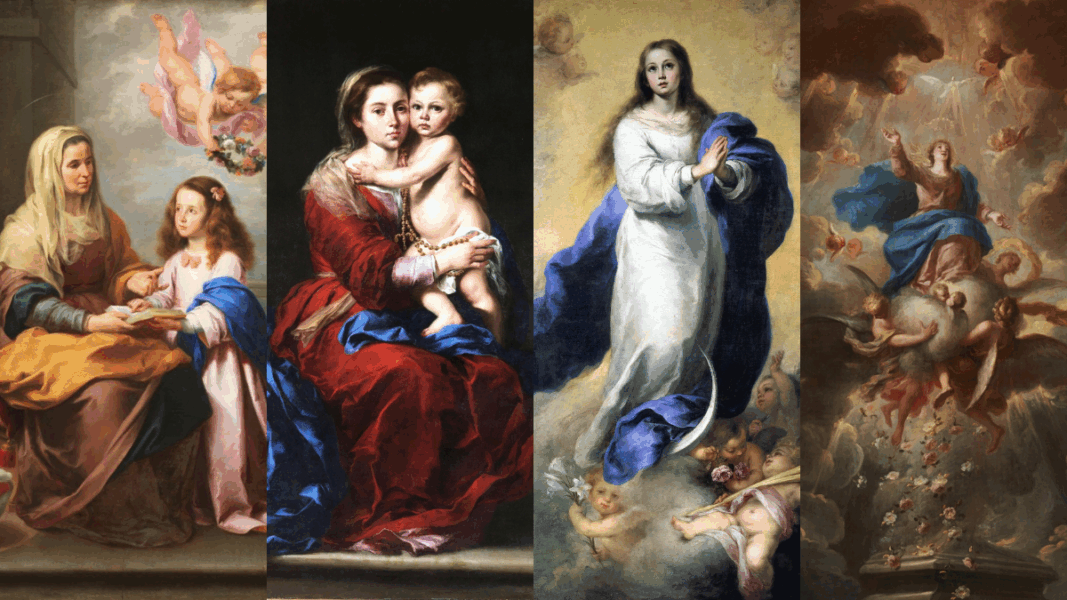
From the early centuries, the Church has recognized in the Most Holy Virgin Mary not only the Mother of the Lord, but the perfect model of what it means to be fully human in the light of grace.
She is the creature in whom God manifested with the greatest splendor the redemptive power of Christ. Therefore, theology, liturgy, and popular piety converge around four great truths solemnly defined by the Church: the Marian dogmas.
These dogmas—the Divine Motherhood, the Perpetual Virginity, the Immaculate Conception, and the Assumption into Heaven—are not mere devotional honors. They are affirmations of faith that protect the core of the Christian mystery: the Incarnation of the Word, the redemption of man, and the hope of eternal life. Each one illuminates the face of Christ and reveals what the human being is called to be when fully open to the grace of God.
Mary, Mother of God: the heart of the Incarnation
The first Marian dogma was solemnly defined at the Council of Ephesus (431), in the midst of one of the most serious crises of Christological faith. Some denied that Mary could be called Theotokos—»the one who gives birth to God»—maintaining that she was only the mother of the man Jesus, not of the eternal Word. The Church responded with luminous clarity:
«If anyone does not confess that Emmanuel is truly God, and that therefore the Most Holy Virgin is the Mother of God, let him be anathema.»
Proclaiming Mary as Mother of God does not exalt her above Christ, but confesses the unity of his divine person. The Son born of Mary is not a man adopted by God, but God himself made flesh in her virginal womb.
This title is the center of all Mariology, because in it heaven and earth, the divine and the human, are united. Mary is truly the Mother of God because in her womb the mystery of the Incarnation takes place: the eternal enters time, the infinite becomes small.
Therefore, venerating her as Theotokos is adoring the mystery of Christ himself, the God who wanted to have a Mother.
The Perpetual Virginity: sign of total consecration
The Church has always confessed that Mary was a virgin before, during, and after childbirth. Thus affirmed the Fathers, the ancient councils, and the liturgy which, from the early centuries, invokes her as aeiparthenos, «ever Virgin.»
The perpetual virginity is not a symbolic idea nor a mere trait of moral purity: it is the visible sign of Mary’s absolute surrender to God. Her body was not an instrument of human desire, but a temple of the Holy Spirit. In her, virginity is not a negation of motherhood, but its highest perfection, because from her virginal womb was born the Author of life himself.
Saint Ambrose said that «virginity was crowned by fruitfulness.» In Mary, what seems humanly impossible becomes reality: she is a mother without losing her integrity, a spouse without knowing man, because the eternal Spouse—the Holy Spirit—fecundated her purity.
The perpetual virginity of Mary therefore expresses a total availability to the will of God. It is the image of the faithful Church, which keeps its faith intact and offers it fruitfully to the world.
The Immaculate Conception: the anticipated triumph of redemption
On December 8, 1854, Pope Pius IX, in the bull Ineffabilis Deus, solemnly defined that «the Blessed Virgin Mary, from the first instant of her conception, was preserved immune from all stain of original sin, by singular grace and privilege of God Almighty, in view of the merits of Jesus Christ.»
This dogma does not place Mary outside of redemption, but at the very heart of it. The Virgin was redeemed in a preventive and perfect way: the fruit of Christ’s cross was applied to her soul from the first instant of her existence.
It was necessary that the Mother of the Redeemer not be under the dominion of sin for even a single moment. In her, grace found no resistance: she was the creature completely open to the action of God.
From the early centuries, Christians intuited this truth when they greeted Mary as «all pure» (Panaghía). Her Immaculate Conception reveals that Christ’s redemption is not only forgiveness, but also preservation and fullness of grace.
When the Virgin appeared in Lourdes in 1858 and pronounced her name—»I am the Immaculate Conception»—heaven confirmed the truth proclaimed by the Church: Mary is the dawn of the new world, where sin no longer has dominion.
The Assumption of Mary: the glorious destiny of redeemed humanity
The last of the great Marian dogmas was proclaimed by Pius XII in 1950, in the constitution Munificentissimus Deus.
The Church solemnly taught that «the Immaculate Mother of God, the ever Virgin Mary, having completed the course of her earthly life, was assumed body and soul into heavenly glory.»
This mystery, believed from the early centuries and celebrated in the Eastern liturgy as the Dormition of Mary, expresses the total participation of the Virgin in Christ’s victory over death.
She, preserved from sin, could not know the corruption of the tomb. Her body, which was the temple of the Word, could not be reduced to dust.
The Assumption is not an isolated privilege: it is the confirmation of Christ’s promise for all the faithful. In Mary is fulfilled ahead of time what we await at the end of time: the resurrection of the body and eternal life.
Therefore, looking at the glorified Virgin is looking at our own destiny. Where Mary is, there the Church awaits us, there redeemed humanity is headed.
The harmony of the four dogmas
The four Marian dogmas are not separate pieces, but a harmonious whole that reveals God’s plan for humanity.
– Mary is Mother of God, because her Son is the Savior of the world.
– She is ever Virgin, because her motherhood is the work of the Holy Spirit.
– She is Immaculate, because she had to be a pure vessel for the Incarnate Word.
– And she is assumed into heaven, because she fully participates in the triumph of her Son.
Each dogma illuminates the others and all converge in Christ.
Whoever loves Mary does not turn his gaze away from the Lord, but contemplates him with her same eyes. She is the mirror in which the Church recognizes itself and the anticipation of what it will be when redemption reaches its fullness.
Mary, sign of the victory of grace
Mary is not a secondary figure in the history of salvation: she is the visible sign of God’s fidelity. In her, the Creator’s eternal plan is fulfilled without obstacles.
Her purity is not isolation, but communion; her humility is not weakness, but the strength of divine love; her glory is not privilege, but promise.
In the Marian dogmas, the Church does not elevate Mary above us, but shows us the first of the redeemed, the one who already lives what we all hope to attain.
Contemplating her is remembering that Christianity is not an idea, but a new life; not a cold morality, but a story of grace.
She is the human face of hope. And while the world is dazzled by the ephemeral, the Church repeats with joy:
«Blessed are you who believed, for what the Lord has said to you will be fulfilled.»