


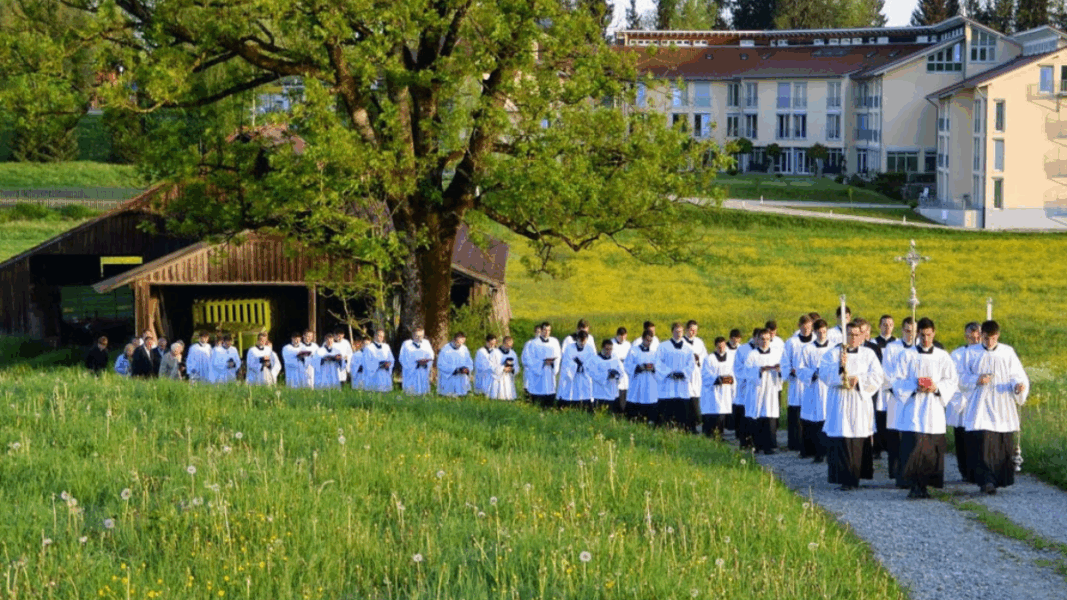
The Priestly Fraternity of Saint Peter (FSSP) has published its annual statistics, and the numbers speak for themselves: 579 members, 387 priests, 30 deacons, and 162 seminarians. In an era when the shortage of vocations strikes the universal Church, the steady growth of this traditional fraternity presents itself as a sign of vitality that challenges the rest of the Catholic world.
A community that flourishes in fidelity
Founded in 1988 by priests who remained faithful to the Pope, the FSSP is today an ecclesial reality spread across the five continents. Its charism is simple and deeply Catholic: to form priests at the service of the traditional liturgy and the perennial doctrine of the Church, within full communion with Rome.
Far from fading away, this community has maintained sustained growth that belies narratives that “traditional Catholicism” belongs to the past. Its average age of 39 years demonstrates it: young priests, with solid formation, centered on the liturgy and sacramental life.
The numbers of a silent phenomenon
- Total members: 579, of which 394 are incardinated.
- 387 priests exercise active ministry in 151 dioceses, with 251 Mass centers and 48 personal parishes.
- 30 deacons and 162 seminarians, a figure that ensures generational continuity.
- Average age: 39 years. Deceased: 16.
Behind these figures lies a living pastoral reality: full seminaries, committed faithful, and a growing demand for the traditional Mass worldwide. The most striking data is the youth of the clergy: while in many European diocesan seminaries vocations are reduced to one or two per year, the FSSP’s seminaries continue to ordain large and steady groups.
Vocations born from the altar
The cause of the FSSP’s growth should not be sought in advertising strategies or passing fads. The answer is liturgical and spiritual: vocations are born where the Mass is celebrated with reverence, where the full faith is taught, and where the priest is aware of his sacred identity.
In a time when some ecclesial environments seem to dilute the priestly mission into sociological tasks, the FSSP offers a clear model: the priest as mediator between God and men, configured with Christ the Priest and Victim. And that clarity—which is also beauty—attracts young people who seek authenticity and transcendence.
The strength of tradition in communion
The FSSP does not live on the margins of the Church; on the contrary, its fidelity to the Pope and the bishops is explicit and constant. Its existence proves that the traditional form of the Roman rite is not an obstacle to communion, but a legitimate path within the liturgical diversity of the Church.
In a context where some voices continue to look with suspicion at communities linked to the traditional liturgy, the fruits of the FSSP are impossible to ignore: more vocations, more apostolate, more spiritual life. As Benedict XVI wrote, “what was sacred for generations remains great and sacred today as well.”
A lesson for the entire Church
The phenomenon of the FSSP is not isolated: other traditional communities show the same vitality. But its success raises a profound question: why do vocations flourish where liturgical and doctrinal fidelity is maintained? The answer, perhaps, does not require sociological studies, but interior conversion.
Where the truth is preached without complexes, where the Mass is celebrated as a sacrifice and not as an assembly, and where priestly holiness is presented as a goal and not as an exception, God continues to call.