


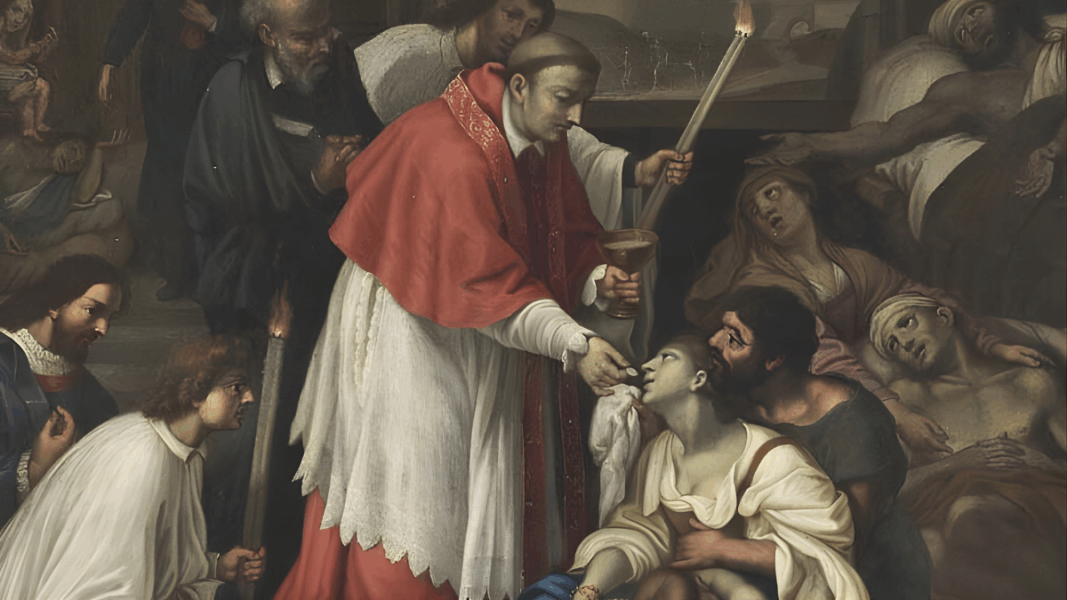
Today, November 4, the Church celebrates the liturgical memory of San Carlos Borromeo, one of the great reformers of the 16th century and model of the true Catholic pastor.
In a time of doctrinal, moral, and disciplinary crisis, when Protestantism was fragmenting Europe and internal corruption was undermining ecclesial authority, this young Milanese cardinal knew how to turn reform into an act of sanctity and heroic fidelity to the Gospel.
Five centuries later, in the midst of new turbulences and an ecclesial climate marked by confusion, his figure shines again with prophetic force: the Church is not renewed with debates or structures, but with conversion and the cross.
A bishop born for difficult times
Carlos Borromeo was born in 1538 into a noble family from Arona, in northern Italy. From a young age, he showed deep piety and precocious intelligence. He studied canon law at the University of Pavia, and at 22 years old he was called to Rome by his uncle, Pope Pius IV (Giovanni Angelo Medici), who appointed him cardinal and Secretary of State.
It was a turbulent time: Martin Luther had begun his rebellion just two decades earlier, and much of Europe was plunged into schism and religious wars. The Church needed urgent reform, not dictated by princes or humanists, but from within, from the heart of its pastors.
Borromeo actively participated in the final phase of the Council of Trent (1562-1563), where he stood out for his doctrinal clarity and his push for the creation of diocesan seminaries. He did not seek compromises with the errors of Protestantism, but rather to purify the Church to make it more faithful to Christ.
Upon the death of his brother, he inherited the family lordship and, now free from his civil obligations, was ordained a priest in 1563 and consecrated Archbishop of Milan the following year. He was only 25 years old.
Trent made flesh: reform from the altar
When he arrived in Milan, the diocese had been without a resident bishop for more than eighty years. The clergy was lax, many parishes lacked catechesis, and Christian life was languishing.
Saint Charles then began a radical renewal: he visited all the parishes, reformed the monasteries, imposed mandatory residence for priests, and demanded that divine worship be celebrated with dignity.
In 1564 he founded the Major Seminary of Milan, following the directives of Trent, and shortly afterward established minor seminaries to train young men called to the priesthood. His conviction was firm:
“The ignorant priest is the greatest enemy of the Church.”
He reorganized parish catechesis, promoted Christian doctrine schools, and published a diocesan catechism that served as a model for all of Italy.
His zeal for the liturgy led him to restore the Ambrosian rite, which is still celebrated in his diocese, and to insist on the reverence of worship, convinced that the beauty and order of the altar are a reflection of the faith of the heart.
He suffered resistance from part of the lax clergy and powerful families, and even was the victim of an assassination attempt in 1569, when a member of a rebellious order shot at him while he was praying. The bullet grazed him, but he survived and forgave the attacker.
The pastor who did not flee the plague
In 1576, a terrible plague—the so-called plague of San Carlos—devastated the city of Milan. The Spanish governor and many nobles abandoned the city.
Borromeo, on the other hand, remained with his people. He sold all his possessions to aid the sick, organized medical care, turned churches into makeshift hospitals, and took charge of feeding thousands of families.
During the hardest months, he walked the streets barefoot, with a rope around his neck as a sign of penance, carrying the Blessed Sacrament to bless the dying. The chronicles tell that he led processions with bleeding feet, singing psalms and prayers for the end of the epidemic.
When some reproached him for risking his life, he responded firmly:
“The pastor does not abandon his flock when the wolf prowls.”
From those years came his fame for holiness. He was not an office reformer, but a pastor willing to die for his people. His witness recalled that of the great saints of the early centuries, when bishops were the first to aid, console, and offer hope.
True reform in the face of false reforms
Saint Charles Borromeo did not invent a “new Church”; he reformed the one Christ had founded.
For him, reform did not consist in “updating” the doctrine or adapting it to the spirit of the time, but in returning to the evangelical roots with purity and firmness.
He often said:
“The Church cannot be reformed if we do not first reform ourselves.”
That phrase encapsulates the core of all authentic renewal.
His example is today an antidote to the contemporary temptation to confuse conversion with consensus.
While some contemporary ecclesiastics promote “synodal processes” or “new participatory structures,” Saint Charles would remind us that no assembly replaces personal holiness, nor does any document replace fidelity to revealed truth.
His life demonstrates that the Church is not strengthened by dialoguing with the world, but by reforming its pastors and its people in faith, prayer, and penance.
The legacy of a saint for times of confusion
Saint Charles Borromeo died in 1584, at the age of 46, exhausted by work, penances, and illnesses.
On his deathbed, he asked not to be called “eminence,” but “sinner.”
He was canonized in 1610 by Pope Paul V, and his figure became a symbol of the ideal bishop: learned, austere, prayerful, and dedicated.
Today, when voices abound calling to “reform” the Church without mentioning sin or conversion, his example rises as a luminous warning: there is no true reform without holiness, nor holiness without sacrifice.
His life reminds pastors of all times that charity without truth becomes sentimentalism, and truth without charity, sterile hardness.
Saint Charles united both: he taught with clarity, corrected with firmness, and loved with tenderness.
His message for the 21st century is simple and urgent:
“We do not need to invent a new Church, but to be saints in the one that has always existed.”