


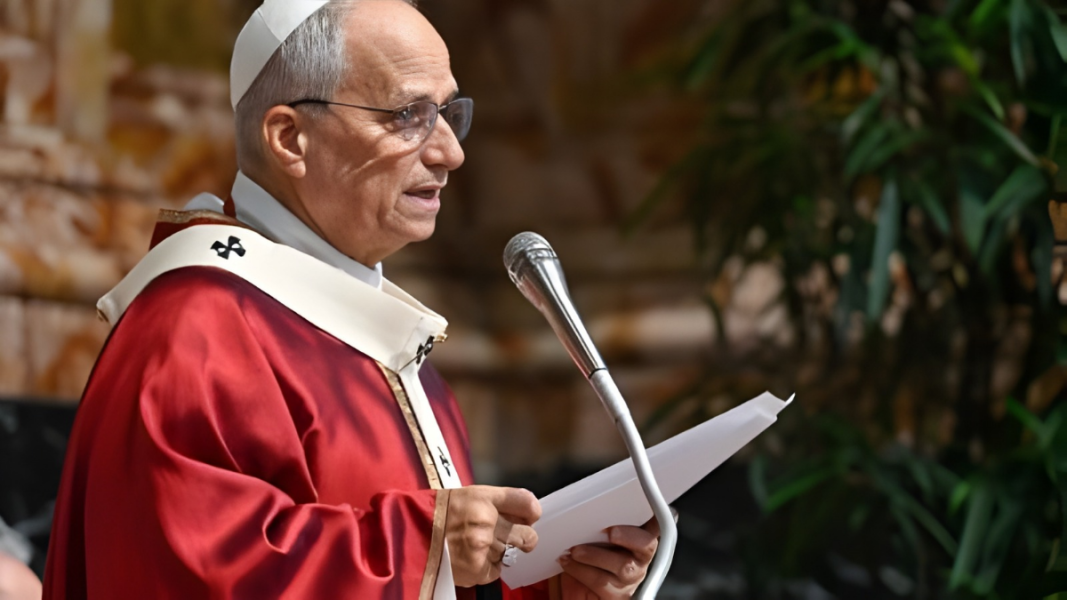
In a solemn ceremony held on this November 3, 2025 in the Basilica of St. Peter, Pope Leo XIV presided over the Holy Mass in suffrage for Pope Francis and for the deceased cardinals and bishops during the last year.
It was his first All Souls’ Mass as pontiff, within the framework of the Holy Year of Hope, and his message focused on the victory of Christ over death. Leo XIV recalled that Christian hope “is not based on human wisdom or on the justice of the law, but on a fact: the Crucified One has risen.”
The Pope explained that, thanks to the love of Christ, death “is no longer an enemy, but a sister,” because it has been transformed by the cross and the resurrection. Cemeteries, he said, “are not cities of the dead, but dormitories where the faithful await the resurrection.”
Leo XIV dedicated words of special gratitude to Pope Francis, whom he defined as a shepherd who “lived, witnessed, and taught the Paschal hope.” He invited the faithful to maintain that same faith: a hope that does not deny pain, but illuminates it with the certainty of eternal life.
He concluded by recalling the psalm: “Hope in God: I will still praise him, my salvation and my God”, as an exhortation to live in trust in the promise of the resurrection.
We now present the complete homily of Pope Leo XIV
Dearest brother cardinals and bishops,
dear brothers and sisters:
Today we renew the beautiful custom, on the occasion of the Commemoration of All the Faithful Departed, of celebrating the Eucharist in suffrage for the cardinals and bishops who have left us during the year just ended, and we offer it with great affection for the chosen soul of Pope Francis, who passed away after having opened the Holy Door and imparted the Paschal blessing to Rome and the world. Thanks to the Jubilee, this celebration—for me, the first—acquires a particular flavor: the flavor of Christian hope.
The Word of God that we have heard enlightens us. First of all, it does so with a great biblical image that, we might say, summarizes the meaning of this entire Holy Year: the Lucan account of the disciples of Emmaus (Lk 24:13-35). In it is plastically represented the pilgrimage of hope, which passes through the encounter with the Risen Christ. The starting point is the experience of death, and in its harshest form: the violent death that kills the innocent and leaves the human heart discouraged, downcast, and without faith. How many people—how many “little ones”—even in our days suffer the trauma of that dreadful death, deformed by sin. For that death we cannot and must not say “laudato si’,” because God the Father does not want it, and He sent His Son into the world to free us from it. It is written: Christ had to suffer these things to enter into His glory (cf. Lk 24:26) and give us eternal life.
He alone can take upon Himself and within Himself that corrupted death without being corrupted by it. He alone has words of eternal life (cf. Jn 6:68)—we confess this with emotion here, near the tomb of St. Peter—and those words have the power to rekindle faith and hope in our hearts (cf. v. 32).
When Jesus takes the bread in His hands—the same hands that were nailed to the cross—He pronounces the blessing, breaks it, and offers it, the eyes of the disciples are opened, faith blossoms in their hearts, and with faith, a new hope. It is no longer the hope they had before and which they had lost. It is a new reality, a gift, a grace from the Risen One: it is Paschal hope.
Just as the life of the Risen Jesus is no longer the one from before, but an absolutely new life, created by the Father with the power of the Spirit, in the same way Christian hope is not human hope, neither that of the Greeks nor that of the Jews; it is not founded on the wisdom of philosophers nor on the justice that comes from the law, but solely on the fact that the Crucified One has risen and has appeared to Simon (cf. Lk 24:34), to the women, and to the other disciples. It is a hope that does not look to the earthly horizon, but beyond; it looks to God, toward that height and depth from which the Sun has arisen to enlighten those who dwell in darkness and the shadow of death (cf. Lk 1:78-79).
Then yes, we can sing: “Praised be You, my Lord, through our sister bodily death.”
The love of Christ crucified and risen has transfigured death: from enemy He has made it sister, He has tamed it.
And in the face of it “we are not grieving as others do who have no hope” (1 Thess 4:13).
We are sorrowful, certainly, when a loved one leaves us. We are scandalized when a human being, especially a child, a little one, a fragile one, is torn from this world by an illness or, worse still, by the violence of men. As Christians, we are called to carry with Christ the weight of those crosses. But we are not grieving as those who have no hope, because not even the most tragic death can prevent our Lord from receiving our soul in His arms and transforming our mortal body—even the most disfigured one—into the image of His glorious body (cf. Phil 3:21).
For this reason, Christians do not call places of burial “necropolises,” that is, “cities of the dead,” but “cemeteries,” which literally means “dormitories,” places where one rests in expectation of the resurrection. As the psalmist prophesies: “In peace I will both lie down and sleep, for You alone, O Lord, make me dwell in safety” (Ps 4:9).
Dearest ones, the beloved Pope Francis and the brother cardinals and bishops for whom we offer the Eucharistic sacrifice today have lived, witnessed, and taught this new, Paschal hope. The Lord called them and constituted them shepherds in His Church, and with their ministry they—using the language of the book of Daniel—“led many to righteousness” (cf. Dn 12:3), that is, they guided them along the path of the Gospel with the wisdom that comes from Christ, who has become for us wisdom, righteousness, sanctification, and redemption (cf. 1 Cor 1:30).
May their souls be purified of every stain and shine like stars in the sky (cf. Dn 12:3).
And may their spiritual breath reach us, still pilgrims on earth, in the silence of prayer:
“Hope in God: I will still praise him, my salvation and my God” (Ps 42:6.12).