


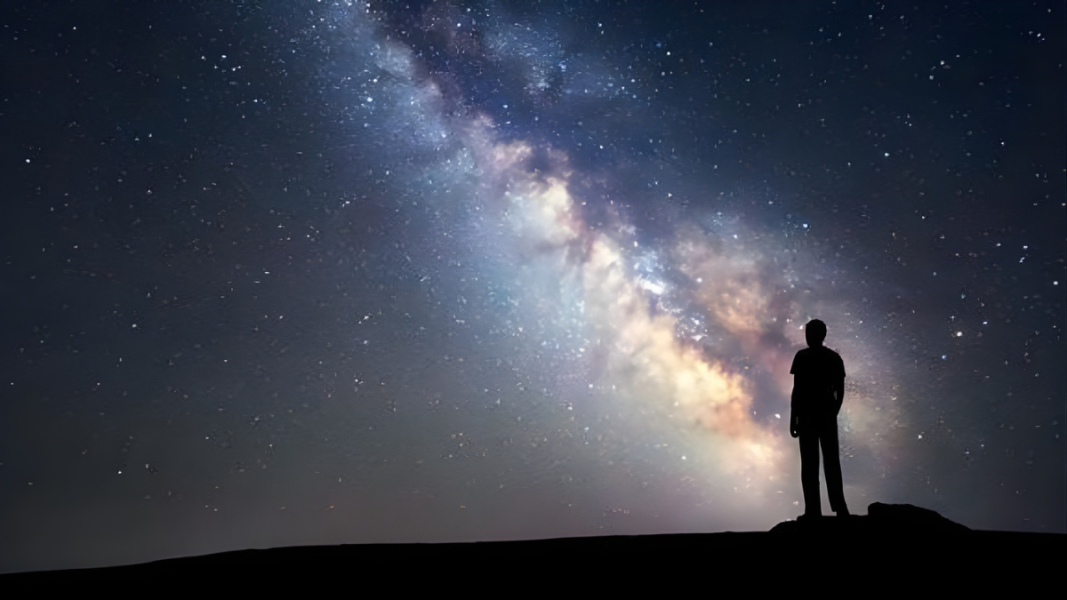
For a long time, thinking that the universe has existed for billions of years before humans caused me spiritual vertigo and doubts of faith. If we are truly the center of creation —I thought—, why so much time before? What is the point of such an immense universe? The YouTuber @javinotengoniidea raises this same doubt to Abel de Jesús, former Discalced Carmelite and Catholic communicator, in a highly recommended interview, in which they discussed personal topics, faith, and the Church. A friend of the interviewer has doubts about the existence of God due to the purpose of the dinosaurs: What sense do some reptiles have wandering the planet for millions of years?
As I have experienced a similar unease, I find it interesting to share the explanation that not only helped me dispel doubts, but has served me to persevere in faith: The universe cannot be understood from the human experience, but from its source code, mathematics. In that language, what seems an absurd excess reveals itself as a perfect proportion.
Time is not that long
A simple example. If the speaker at the Bernabeu who announces the lineup and substitutes over the loudspeaker decides not to start with the goalkeeper and continue with the defenders… but to give the names of the players in all possible order combinations, the time it would take to finish (assuming he dedicates one minute to each lineup) would be almost 100 million times the age of the universe. You would have to multiply by 100 million the 13.800 million years that have passed since the Big Bang for the speaker to finish reading the different lineups. On a human scale, the time seems endless; on a mathematical scale, it doesn’t fit within the permutations of a simple lineup. That’s why time does not measure the greatness of God, but the limits of our perception.
Space is not that big
Space too, which overwhelms with its vastness, is relativized when viewed with numbers and not just with mortal eyes. A human fingernail, around half a gram, contains on the order of 1022 atoms. That figure is similar to the total number of stars in the observable universe, estimated between 1022 and 1024. In other words: in a single human fingernail there are as many atoms as there are stars in the universe. A human hair contains more units of matter than galaxies exist. The infinitely small encloses a vastness comparable to that of the infinitely large. The universe is not excess: it is symmetry and the human being is at the exact axis of it.
The center was not in the place, but in the measure
For centuries it was believed that Earth was the geographic center of the universe. Today it is known that it is not, but that does not imply that humanity has lost its central place. The center was not a coordinate, but a proportion. The human body contains on the order of 1027 atoms, a figure comparable to the sum of stars and planets in the observable universe. The human scale is situated between the infinitely small and the infinitely vast: it is not the center of space, but it is the center of meaning, the consciousness that allows the universe to know itself.
There are more possible orders in a simple deck of 59 cards than atoms in the entire observable universe. In the palm of a hand fits a figure that overflows the cosmos. That is the real scale of the mystery: the infinite is not far away, but contained in the closest, in what I can hold. The dimensions of the universe should not overwhelm us, but console us. If the infinite can be compressed into a deck of cards, how could God, being infinite, not look at each specific person? From the Garden of Gethsemane to the Tomb, it is absolutely viable that Christ thought personally of you. It was not a general gesture of love, it was a precise thought within the eternal calculation, a unique permutation in the mind of the one who holds all possible combinations of the universe in the palm of his hand.