


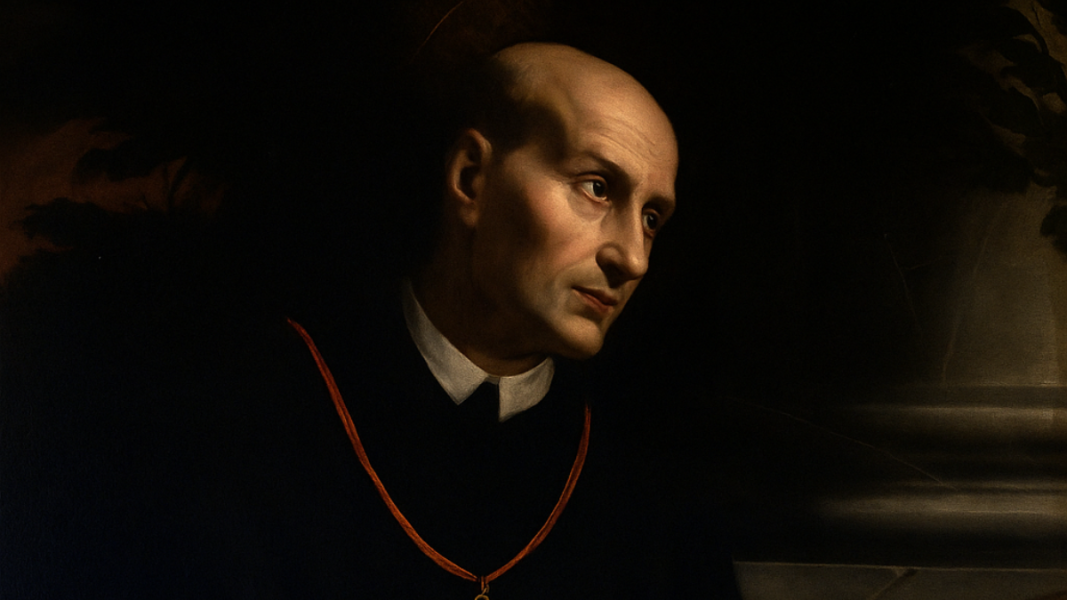
In the Catholic liturgy, November 2 is dedicated to the commemoration of the faithful departed, one of the deepest expressions of Christian charity. But few remember that this date, now universal in the Church, has its origin in the monastic reform of the 11th century and in a man of faith: San Odilón de Cluny.
The abbot who took mercy beyond the walls of the monastery
San Odilón, fifth abbot of Cluny, lived between the years 962 and 1049, in an era marked by wars, famines, and superstitions. Amid a turbulent world, the Cluniac monasteries became beacons of prayer and Christian culture. Odilón understood that the monk’s mission did not end with divine praise, but also had to embrace the souls suffering in purgatory.
In the year 998, the holy abbot instituted in all the monasteries dependent on Cluny a special day of prayer, fasting, and Mass for the dead. He arranged for it to be celebrated on November 2, immediately after the feast of All Saints, to unite the triumph of the blessed with the purification of those who still awaited the vision of God. It was a deeply theological initiative: the communion of saints was lived not as an abstract concept, but as a concrete reality of spiritual charity.
A practice that spread throughout the Church
The Cluniac custom spread rapidly across Europe thanks to the moral and spiritual influence of Cluny. The monasteries adopted the celebration, and the faithful began to offer suffrages for their departed. In the 13th century, Rome officially recognized it, incorporating it into the universal liturgical calendar.
In this way, what began as an inspired intuition of a Benedictine monk became a feast of the universal Church, where hope triumphs over fear and faith over oblivion. The Day of the Dead is not a day of sadness, but an act of trust in divine mercy, a proclamation that death does not have the last word.
A lesson for our time
In a culture that flees from death and disguises pain with euphemisms, the legacy of San Odilón reminds us that Christian charity includes praying for the dead. Prayer for the souls in purgatory is not an ancient custom or a pious symbol, but a spiritual work of mercy that unites the Church militant with the Church suffering.
Today, when many reduce faith to mere emotion or social activism, the memory of San Odilón invites us to rediscover the supernatural meaning of life and the continuity of love beyond the grave. Every Mass, every rosary offered for a departed soul, is an act of hope in the resurrection.
Cluny and eternity
The Cluniac spirit, centered on the liturgy and the communion of saints, remains alive in every altar where the Holy Sacrifice is offered. San Odilón de Cluny teaches us that true Christian reform begins in the soul and is measured by charity. His legacy, humble and grand at the same time, endures every November 2 when the entire Church prays: “Requiem aeternam dona eis, Domine, et lux perpetua luceat eis.”