


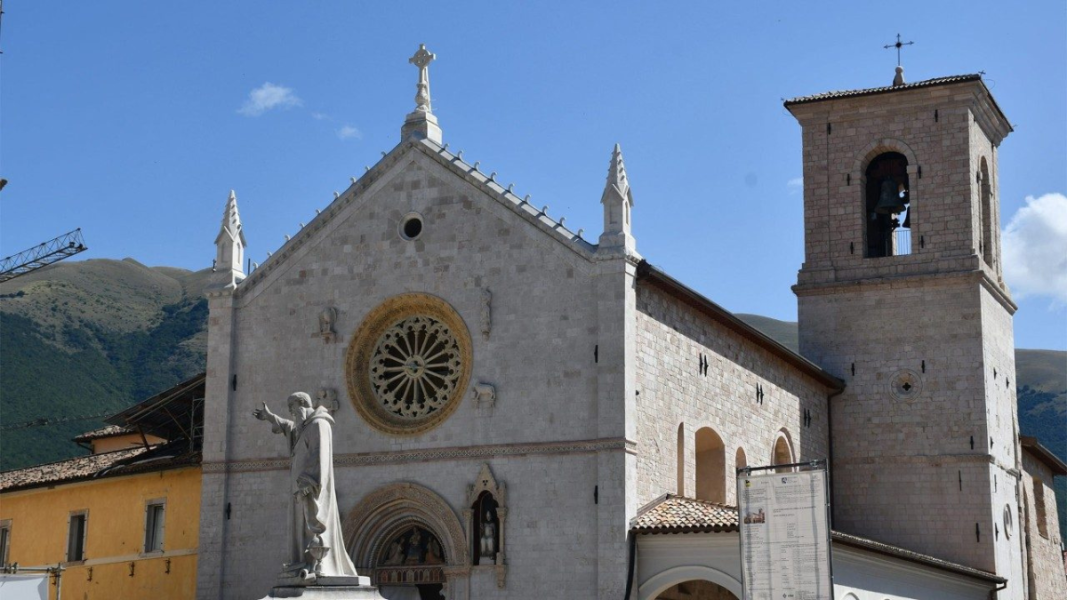
The Basilica of Saint Benedict, cradle of Europe’s patron saint, reopened its doors for worship after having been severely damaged by the October 2016 earthquake. According to Vatican News, the dedication and reopening ceremony took place on October 31 and was accompanied by a message from Pope Leo XIV, signed by the Cardinal Secretary of State, Pietro Parolin.
In the text, the Pontiff shared the “common joy” for the restoration of a temple “so dear” to the local community, describing the event as a tangible sign of a profound religious renewal. The Pope expressed his gratitude to all those who collaborated in the reconstruction—institutions, workers, and benefactors—emphasizing that the work has been “deeply felt and awaited” not only in Umbria, but also throughout Italy and in other countries.
“The beating heart of Benedictine spirituality”
The Basilica, a historic and spiritual symbol of the monastic tradition, represents, according to the pontifical message, “the beating heart of Benedictine spirituality”. For the diocese of Spoleto-Norcia, its reconstruction marks the end of a long period of “exile” and the beginning of a new stage of community life.
During the homily, the Archbishop of Spoleto-Norcia and President of the Umbrian Episcopal Conference, Mons. Renato Boccardo, stated that “the doors of the Basilica open today to welcome all who come here to draw light and strength for the path of Christian life.”
However, he warned that the beauty of the building “is not enough on its own to make it a house of God among the houses of men”, if it is not sustained by a living and supportive community, capable of building “a more welcoming and merciful society.”
Saint Benedict, light in times of ruin
Mons. Boccardo evoked the figure of Saint Benedict, patron saint of Europe, as “light in a time of ruin,” quoting the words of Saint Gregory the Great. He recalled that, just as in the 6th century—when Europe was shaken by invasions, dynastic struggles, and the collapse of institutions—the continent today also suffers from ideological and moral wounds that have undermined its soul: the loss of religious sense, ethical relativism, wars, the arms race, the resurgence of antisemitism, and the temptation to build walls instead of bridges.
The prelate warned that these fragilities also extend to the political sphere, marked by “unstable governments, ideological polarization, the growth of populism and nationalism, and the loss of trust in democratic institutions.”
The “return to Saint Benedict”: prophecy and not nostalgia
In this context, the archbishop proposed a “return to Saint Benedict”, not as a gesture of nostalgia but as a prophetic call. The founder of Western monasticism knew how to gather diverse brothers in charity, building a fraternity based not on precarious balances, but on interior conversion and the transformation of hearts.
“True peace is not signed, it is lived,” the prelate recalled, emphasizing that the reopening of the Basilica is a call to build a “house for all,” founded on the common good, wisdom, and the eternal, beyond calculation or technique.
Europe and “Benedictine solidarity”
Boccardo insisted that solidarity among peoples cannot be reduced to diplomatic strategy or an economic instrument, but must be based on the sincere search for truth and goodness. Only that inner strength— he added—can prevent politics, finance, and culture from bending to partisan interests.
“Without a soul—the archbishop recalled—Europe runs the risk of reducing itself to a mere functional aggregation of economic and technical interests, without true spiritual cohesion.”
Celebration with ecclesial and civil presence
The Holy Mass was concelebrated by sixteen bishops and Benedictine abbots from Italy, including Cardinal Gualtiero Bassetti, emeritus Archbishop of Perugia-Città della Pieve, and the Primate Abbot of the Benedictine Confederation, Jeremias Schröder.
Representatives of civil institutions also attended: the Italian Minister of Agriculture and Food Sovereignty, Francesco Lollobrigida, and the Vice-President of the European Parliament, Antonella Sberna, representing the Italian Government and Europe.
A sign of hope for the continent
The reopening of the Basilica of Saint Benedict is not only an architectural or local event, but a symbol of hope for Europe, invited to rediscover its spiritual roots. As Pope Leo XIV emphasized, the restored temple is a testimony of living faith and religious rebirth, which reminds the continent of its Christian vocation and its need for a soul.