


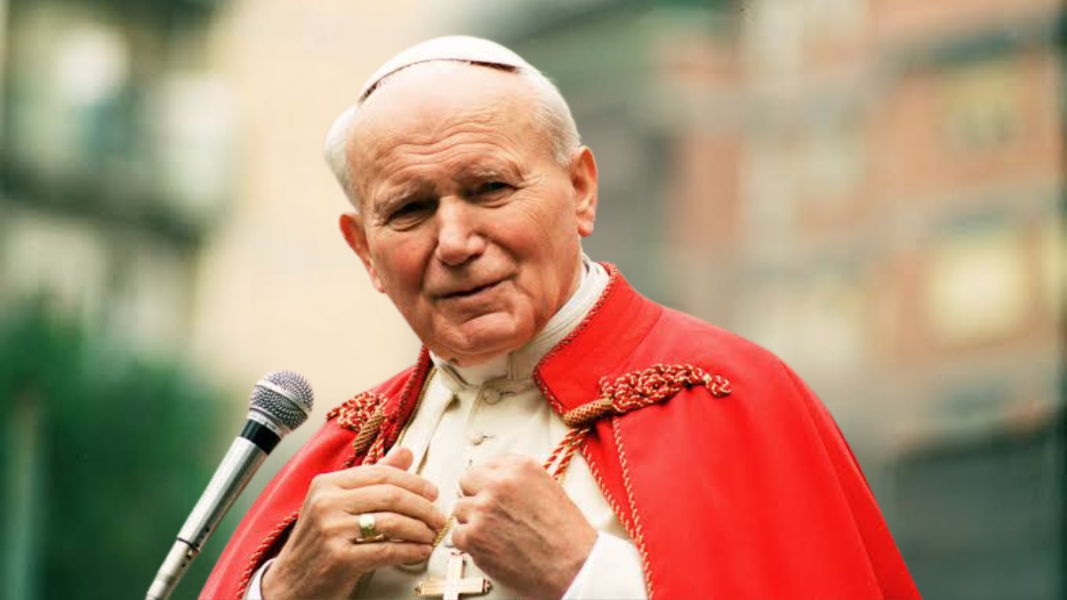
In the framework of his general audiences, Pope Saint John Paul II dedicated a catechesis on August 4, 1999, to explaining the authentic meaning of purgatory. In the context of the Day of the Dead, this teaching takes on renewed value: it invites us to reflect on divine mercy, the need for conversion, and the certain hope of eternal life.
Purification: the path to beatitude
John Paul II recalled that man, after his definitive choice for or against God, faces an alternative: eternal life or definitive separation. However, those who die in grace but are not yet fully purified need a process of interior purification before accessing the beatific vision. This process is what the Church calls purgatory.
“The path to full beatitude requires purification,” the Pope explained, citing the Catechism of the Catholic Church (nn. 1030-1032). It is not a punishment, but an expression of merciful love that prepares the soul for perfect communion with God.
Biblical foundation of purification
The Polish Pope recalled that Sacred Scripture offers numerous indications of this truth of faith. In the Old Testament, what is destined for God must be perfect, without blemish or defect. This integrity symbolizes the need for a pure heart to enter the divine presence.
Saint Paul, in his first letter to the Corinthians, alludes directly to this spiritual purification: “He who suffers loss will be saved, but as one who passes through fire” (1 Cor 3:15). John Paul II highlighted that this passage shows how fire symbolizes the love of God that purifies and transforms, not a physical torment, but a healing action that frees the soul from every remnant of sin or attachment to evil.
Christ, the intercessor and purifier
The Holy Father emphasized that all purification finds its meaning in Christ. He is the high priest and, at the same time, the victim of expiation for the sins of the world. “Jesus will fully reveal himself at the end of our life, offering his mercy, but also manifesting his justice,” he affirmed.
In this way, purgatory is not an added punishment, but the expression of that merciful justice, which wants to present us pure before God, transformed by charity, “the bond of perfection” (Col 3:14).
Purgatory is not a place, but a state of the soul
John Paul II specified that purgatory should not be understood as a physical space, but as a state of existence (cf. CIC 1030-1032). “Those who, after death, live in a state of purification are already in the love of Christ, which frees them from the residues of imperfection,” he taught.
The Pope clarified that this purification does not constitute a “second chance” after death: the eternal destiny is decided in this life. Rather, purgatory is the conclusion of the conversion process begun on earth, when the soul, already saved, allows itself to be fully purified to enter into glory.
A constant teaching of the Church
The doctrine of purgatory has been reaffirmed in numerous councils—from Florence and Trent to Vatican II—as an expression of God’s love that perfects. The Pope cited the constitution Lumen gentium (n. 48), recalling that “we do not know the day or the hour” and that we must live vigilantly, in grace, prepared to enter with Christ into the eternal wedding feast.
In this light, purgatory appears not as a fearsome punishment, but as a manifestation of Christian hope: the soul that dies in friendship with God is already saved, and the fire of his love purifies it until it is worthy to contemplate his face.
A communion of love that transcends time
Finally, John Paul II highlighted an essential and often forgotten aspect: the communal dimension of purgatory. “Those who are in a state of purification are united both to the blessed and to us, who walk in this world,” he explained.
The Pope recalled that the bonds of the Mystical Body of Christ are not broken by death. The souls in purgatory benefit from the prayers, suffrages, and works of charity offered by the faithful on earth. In the same way, those souls, once purified, intercede for those who still pilgrimage.
“Purification— he taught— takes place in the essential bond that unites those who live in the present time with those who already enjoy eternal beatitude.” In this communion of love, the mystery of the Church is realized: one single family, on earth, in heaven, and in purgatory.
Remembering the dead: an act of hope
On this November 2, the teaching of Saint John Paul II on purgatory resonates strongly. Remembering the dead is not a gesture of sadness, but of faith. The prayers, indulgences, and works offered for them are concrete expressions of supernatural charity.
Purgatory reminds us that no one is saved alone, that salvation is communion, and that the love of Christ does not stop even at the boundary of death. In the words of the Pope himself, “purification is the fire of God’s love that transforms the soul so that it may fully participate in his glory.”