


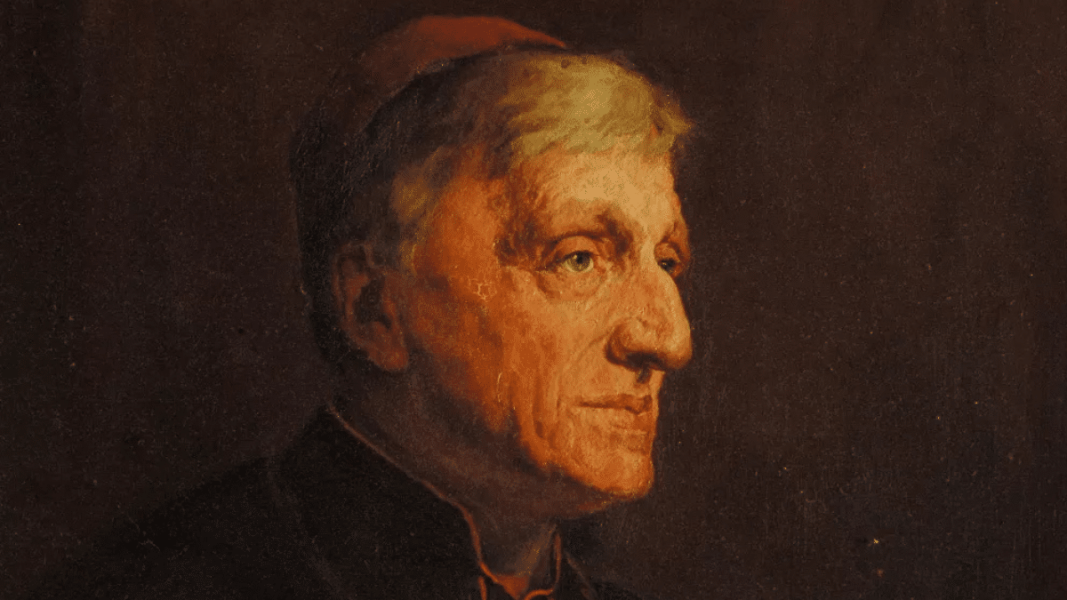
St. John Henry Newman was, above all, an educator of the soul. He was not so in an academic sense nor as a classroom pedagogue, but as a master of conscience. In an era marked by positivism, when faith and reason seemed doomed to divorce, Newman understood that the most urgent task of education was to reconcile the mind with the truth and the intellect with faith.
For him, teaching did not consist in transmitting information, but in forming a right judgment, an inner gaze capable of recognizing reality as it is. At bottom, his thought stems from a deeply Christian conviction: truth is not invented, it is discovered. And the educated soul is the one that opens itself to that truth, not the one that pretends to shape it to its convenience.
The ideal of Catholic education
Newman defended a vision of education very different from the one that dominates classrooms today. He did not aspire to form soulless specialists or to produce measurable results, but to cultivate complete men and women, whose knowledge served the good, justice, and faith.
For him, a university should be a community of living thought, where human reason develops under the light of God. In his vision, education without reference to faith becomes a mechanism without moral direction, and faith without intellectual formation runs the risk of becoming sentimental or weak. Hence his insistence that true education must integrate both dimensions: the rational pursuit of truth and docility to divine revelation.
In this balance between intellect and faith lies the greatness of his proposal. Newman did not fear modern knowledge; on the contrary, he considered it a legitimate path to God when exercised with rectitude of conscience. His thought anticipated, in a certain way, the teaching of the Second Vatican Council on the dignity of conscience and the unity of knowledge.
The heart of Christian teaching
For Newman, the center of education is not in books or systems, but in the heart that seeks the truth. The task of the Christian teacher consists in guiding the student toward interior formation, where reason and grace dialogue.
To educate, in this sense, is not just to instruct: it is to lead the soul toward the fullness of its vocation. Each person, according to Newman, is called to a living relationship with God, and the role of education is to prepare that interior freedom that allows one to recognize and love the truth.
In a culture that tends to fragment knowledge and reduce learning to utility, Newman offers an essential lesson: only one who knows the truth can live in fullness. For this reason, his thought is directed not only to academics, but to all those who teach, form, or communicate the faith.
The relevance of Newman today
Today, when education suffers the assault of relativism, pragmatism, and ideology, Newman’s voice resonates with prophetic force. His vision invites us to rebuild the transcendent meaning of knowledge, to restore to the school and the university their spiritual dimension.
In a world that confuses freedom with indifference, Newman reminds us that to educate is to orient freedom toward the good. In an era that idolizes information, he teaches that to know without loving the truth is a form of darkness.
Newman’s thought does not propose a closed or clerical education, but one that is profoundly human and theological, where reason is respected but illuminated by faith. His model does not seek to impose, but to convince; not to uniformize, but to liberate. In short, his proposal is a call to form people capable of thinking with rigor and believing with coherence.
A master for new times
St. John Henry Newman did not teach abstract theories, but a Christian way of thinking. His legacy does not belong to the past, but to the future of the Church. If today we speak of a global educational crisis, he offers the antidote: to return to educating the mind and heart in the truth.
The Church, by recognizing his thought as a guide, does not make an academic gesture, but a pastoral one: it reminds us that there is no true evangelization without education, nor authentic education without reference to God. Newman taught that human intelligence finds its fullness not when it accumulates knowledge, but when it is ordered toward the Truth.