


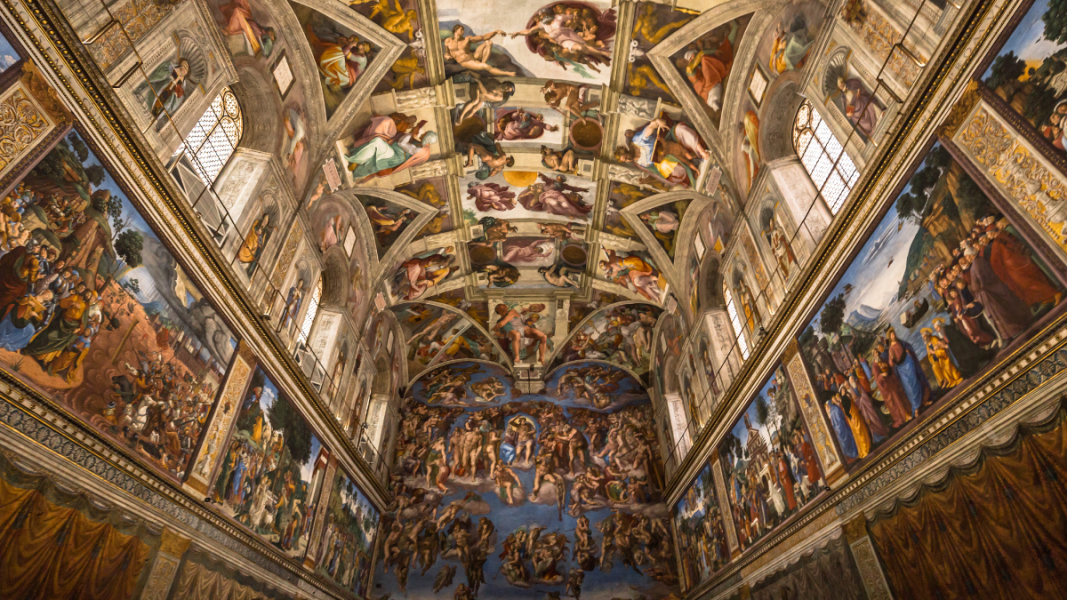
On November 1, 1512, the solemnity of All Saints, humanity beheld for the first time the vault of the Sistine Chapel, painted by Michelangelo Buonarroti. That day, in the heart of the Vatican, one of the most sublime works of human genius was opened to the public and, at the same time, one of the most eloquent testimonies of Christian faith expressed in art.
Pope Julius II had entrusted Michelangelo, a sculptor by vocation more than a painter, with the task of decorating the ceiling of the papal chapel. For four years—between 1508 and 1512—the Florentine artist worked almost in solitude, suspended on scaffolding, facing fatigue, discomfort, and the magnitude of the undertaking. The result was an unprecedented visual symphony: more than 300 figures that narrate the story of Creation, the fall of man, and the promise of Redemption.
The Renaissance in the Service of Faith
The Sistine vault represents the culminating point of the Renaissance, when Western art achieved a perfect synthesis between classical beauty and Christian truth. Michelangelo knew how to unite the idealized anatomy of the Greco-Roman world with the theology of salvation, showing man not as a mere body, but as a creature made in the image of God.
The central fresco, “The Creation of Adam,” is perhaps the most famous image in universal art. In that suspended instant between the finger of God and that of man, the entire Christian vision of the world is summarized: man receives his life, his dignity, and his destiny directly from the Creator. There is no autonomy without dependence on God, nor freedom without the divine breath.
Beauty that Evangelizes
More than five centuries later, the Sistine Chapel remains a place of prayer, contemplation, and the election of the successors of Peter. Every conclave takes place under those same frescoes that proclaim the greatness of God and the fragility of man. It is not just a museum, but a sacred space where beauty becomes a path to truth.
In an era that seems to forget the transcendent meaning of art, Michelangelo’s vault reminds us that authentic beauty does not arise from the artist’s ego, but from the desire to glorify the Creator. The Christian Renaissance was not mere aesthetics, but theology in color, a painted catechism that still today speaks to the reason and the soul.