


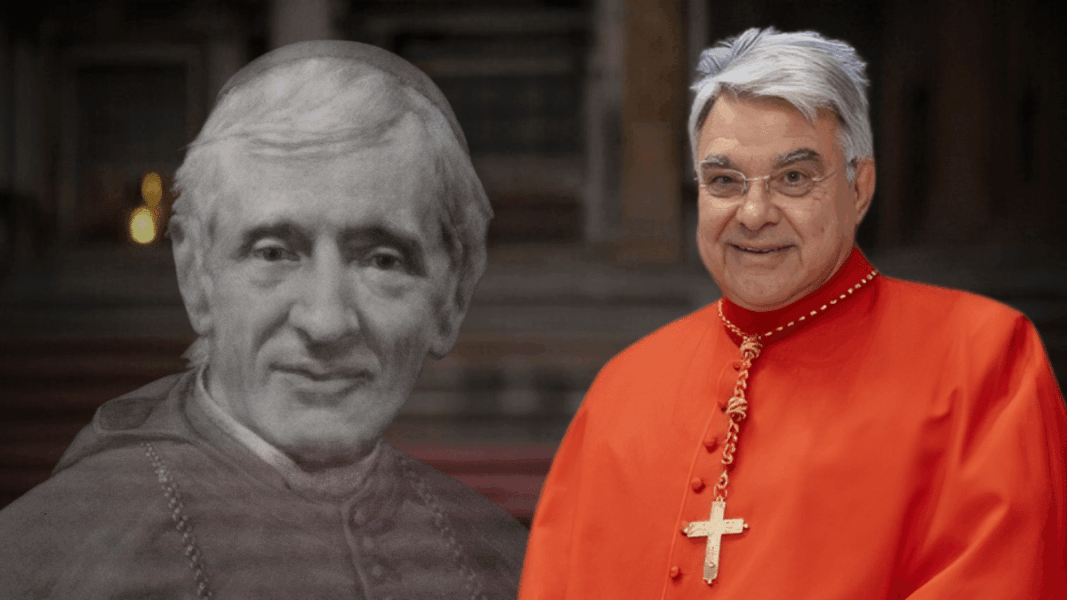
At the Pontifical Gregorian University in Rome, Cardinal Marcello Semeraro, prefect of the Dicastery for the Causes of the Saints, delivered on October 31, 2025 the opening speech of the symposium “Saint John Henry Newman, Doctor of the Universal Church. His Relevance Today”, organized on the eve of the solemn act in which Pope Leo XIV will proclaim Newman Doctor of the Church on November 1.
The cardinal recalled that the process began in 2021, when the Episcopal Conference of England and Wales presented the official petition for this recognition, to which those of Scotland and Ireland soon joined, along with the spiritual family of L’Opera and the Confederation of the Oratory of Saint Philip Neri. Subsequently, adhesions were received from the entire Catholic world.
Significantly, Semeraro highlighted that the initiative also had the fraternal support of the archbishops of Canterbury and York, the two highest authorities of the Church of England, who notified their adhesion to Pope Francis, thereby recognizing the spiritual and theological greatness of the English blessed who converted to Catholicism.
A process continued under two pontificates
With the consent of Pope Francis, the Dicastery initiated the canonical procedure, consulting the Dicastery for the Doctrine of the Faith on Newman’s eminent doctrine. Its prefect, Cardinal Víctor Manuel Fernández, stated at that time:
“There is no doubt about the excellence and relevance of the work of this great Catholic thinker”.
The Dicastery’s work was completed, and the plenary of cardinals and bishops was convened for July 1, 2025. However, the death of Pope Francis briefly halted the process. After the election of Pope Leo XIV, the meeting took place as planned, and on July 31, 2025, the new Pontiff confirmed the positive judgment granting Newman the title of Doctor of the Universal Church.
In the audience on September 28, the Pope publicly announced the date of the ceremony, declaring:
“I will confer the title of Doctor of the Church on Saint John Henry Newman, who contributed decisively to the development of theology and to the understanding of the doctrinal progress of Christianity”.
“Not conversion, but journey”: Newman’s spiritual key
In his address, Cardinal Semeraro explained the profound meaning of Newman’s inner life, specifying that his passage to Catholicism was not a rupture, but a fulfillment:
“I prefer to speak of a ‘passage’ to the Catholic Church, rather than ‘conversion’, because Newman never stopped seeking the truth; his entry was the fulfillment of that search”.
He quoted Newman himself, who wrote:
“Since 1845 I have never doubted, not for a single instant, that it was my duty to join this Catholic Church which, in my conscience, I recognized as divine”.
The cardinal evoked the words of Joseph Ratzinger in 1990, when he said that in Newman “thought and life are intertwined until they become inseparable” and that his work The Development of Christian Doctrine reflects “a conversion never concluded”, that is, a continuous journey toward the truth.
He also recalled the appreciation of Paul VI, who defined Newman as an “autobiographical” author, whose fidelity to the truth led him to renounce his Anglican membership not out of rejection, but to bring his faith to the fullness of the Catholic Church.
A testimony of search and fidelity
Semeraro concluded by highlighting that Newman’s figure—priest, theologian, and saint—represents a luminous synthesis of reason and faith:
“Newman is great because, to reach absolute Truth, he renounced what was most valuable to him: his Church of origin. He did not do so to separate from it, but to realize it in fullness”.
With these words, the prefect invited the symposium participants to follow Newman’s example, “a man of upright conscience and unwavering fidelity to the light received”.
We leave below the speech by Cardinal Semeraro delivered at the symposium «Saint John Henry Newman, Doctor of the Universal Church. His Relevance Today»:
I sincerely congratulate this initiative, held precisely on the eve of the proclamation of Saint John Henry Newman as Doctor of the Universal Church: an event initiated in early 2021 with the acceptance of the petitions from the Episcopal Conference of England and Wales, to which the Episcopal Conferences of Scotland and Ireland, the spiritual family L’Opera, and the Confederation of the Oratory of Saint Philip Neri subsequently joined. To them were soon added many other petitions from the entire Catholic Church. Significantly, to the initiative of the Church of England and Wales was associated the fraternal support, notified to Pope Francis, of the two highest authorities of the Church of England, namely, the archbishops of Canterbury and York.
As a consequence, with the consent and mandate of Pope Francis, the Dicastery for the Causes of the Saints initiated the canonically provided procedure, beginning with the due consultation of the Dicastery for the Doctrine of the Faith regarding the vote on the eminens doctrina. On this matter, the Prefect of that Dicastery, Cardinal Víctor Manuel Fernández, expressed a judgment that begins as follows: “There is no doubt about the excellence and relevance of the work of this great Catholic thinker…”. The work of the Dicastery for the Causes of the Saints was already completed, and the Plenary of the Lords Cardinals and Bishops was already convened for July 1, 2025, when the death of Pope Francis intervened. With the consent of the new Successor of Peter, the meeting took place regularly; thus, in the audience he granted me on the following July 31, Leo XIV confirmed the affirmative opinion of that Plenary Session of cardinals and bishops regarding the granting of the title of Doctor of the Universal Church to Saint J. H. Newman; subsequently, on Sunday, September 28, the Pope announced that the rite would be celebrated on November 1, 2025. He said: “I will confer the title of Doctor of the Church on Saint John Henry Newman, who contributed decisively to the renewal of theology and to the understanding of Christian doctrine in its development”.
I have gladly accepted the invitation extended to me to preside over the first session of this Symposium and the request to add a few brief introductory words. I will do so by alluding to a single issue, namely, the choice—in regard to the classic petitio that I will direct to the Holy Father tomorrow—of calling “passage” to the Catholic Church what is usually indicated as his “conversion”. Newman, in fact, will write: “Since 1845 I have not wavered, not even for a single instant, in the conviction that it was my precise duty to adhere (to join), as I then did, to this Catholic Church which, in my own conscience, I felt to be divine” (Postscript to the Letter to the Duke of Norfolk).
It is obviously not this the place to develop the entire issue; I will try only to indicate some of my points of reference. The first is the conviction that with his Essay on the Development of Christian Doctrine Newman did not leave us merely a theological principle, but also delivered his personal experience of an arrival ex umbris in veritatem. This idea was suggested to me at the time by the words with which J. Ratzinger, on April 28, 1990, intervening to conclude the Symposium for the centenary of Newman’s death, said that in him thought and life interpenetrated and determined each other reciprocally, so that in that Essay we could find not only his theology but also his personal experience “of a conversion never concluded”. For his part, in dialogue with Jean Guitton, Paul VI will say that “Newman is an autobiographical author”.
In his intervention, Ratzinger will use the word “conversion”, but from the whole it is well understood that he did not mean the abandonment of a previous path to undertake another new and different one. This does not imply that shadows and storms were absent from Newman’s path. How can one not recall, for example, what—in the phase of the Sicilian crisis—he, almost delirious, repeated to his faithful servant and friend Gennaro: “I have not sinned against the light” (My illness in Sicily – December 28, 1834: I have not sinned against the light)? How can one not hear again this phrase, along with what, lucidly, he will write at the beginning of chapter V of his Apologia: “At the moment of my conversion I had no consciousness of any intellectual or moral change that occurred in my mind… but it seemed to me to return to port after a stormy voyage”?
I have recalled the colloquy of Paul VI with J. Guitton. I conclude, then, with this affirmation of his taken from the same source: “Newman is great. To reach his Truth, that is, absolute Truth, integral Truth, Newman, in the fullness of his life, renounced what is worth more than life: he renounced the Church of England, and not to separate from it, but to realize it. He said that he did not cease to believe what he had believed, but that he believed it even more: that he had brought the Anglican faith to its fullness” (Dialogues with Paul VI, Milan 1967, 162).
Thanking you again, I wish you all from the heart a good work.
Pontifical Gregorian University – Rome, October 31, 2025
Cardinal Marcello Semeraro