


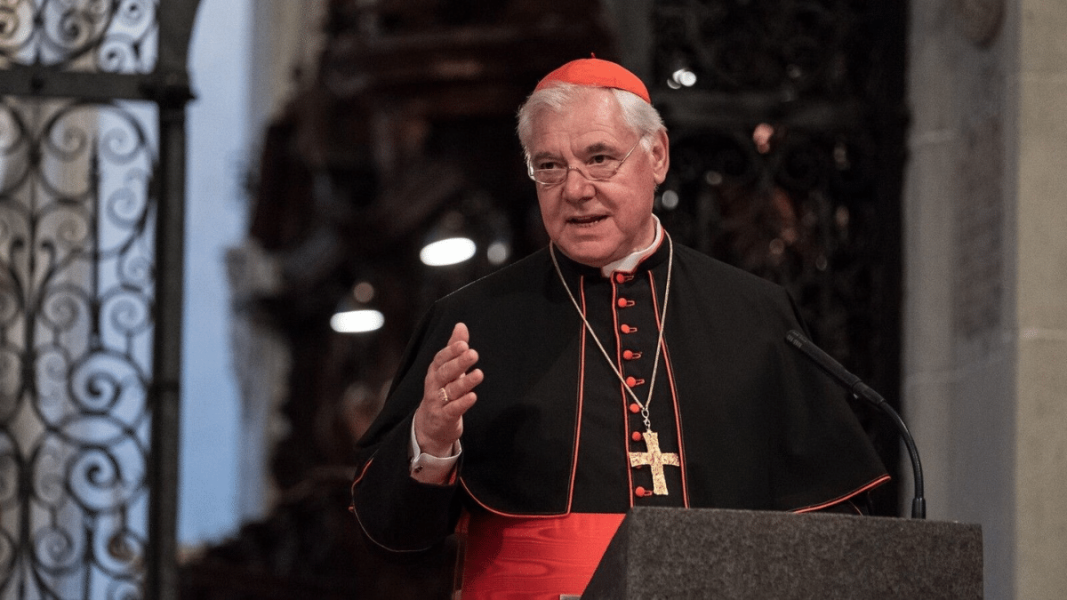
The cardinal Gerhard Ludwig Müller, former prefect of the Congregation for the Doctrine of the Faith, warned that the current division within the Church does not come from tradition, but from progressivism, an ideology that—according to him—is emptying the faith of its doctrinal content.
In an interview with Raymond Arroyo on the program The World Over on EWTN, Müller responded to recent words from Pope Leo XIV, who spoke of a “harmful tension between tradition and novelty.” The German cardinal replied that the true ecclesial fracture does not arise from those who love tradition, but from those who despise it in the name of a supposed advancement.
“Progressivism is the ideology that is dividing the Church”
The cardinal denounced that within certain ecclesial sectors a reinterpretation of moral doctrine is being promoted, especially on issues such as marriage and sexuality, under the excuse of an “inclusive pastoral care.” He cited, as an example, the blessing of homosexual couples allowed by the document Fiducia supplicans, which he described as a “moral compromise” incompatible with revealed truth.
For Müller, this drift represents the true ecclesial rupture: “What divides the Church is not the traditional Mass nor the faithful who love it, but those who relativize the sacraments and apostolic teachings.” He recalled that the Catholic tradition is not an obstacle to progress, but one of the three inseparable pillars of the faith along with Scripture and the Magisterium.
A “superfluous struggle” against the traditional Mass
Asked about the hostility toward the Tridentine Mass, Müller maintained that there is no solid theological basis for the restrictions imposed by Rome. As he explained, those seeking to limit the celebration of the traditional rite “rely only on authority, without offering a valid theological reason.”
The cardinal lamented that the liturgy has become an ideological battlefield, when worship should be the space where the entire Church unites in adoration of God.
In this context, Müller categorically rejected the statements of Cardinal Blase Cupich, Archbishop of Chicago, who recently stated that the traditional Mass is “a spectacle.” The German cardinal described those words as “unfounded and offensive”, recalling that for centuries popes, bishops, and saints celebrated the same rite with reverence and faith. “It cannot be said— he affirmed—that the Church’s pastors who offered this liturgy were interested in a spectacle. That claim has no theological basis.”
Read also: Cardinal Cupich calls the traditional Mass a “spectacle”
Müller added that such a view degrades the sacred sense of the liturgy and betrays the continuity of the faith, as it turns worship into a matter of taste or fashion, and not the central act of adoration of the living God. For the cardinal, Cupich’s criticisms “seek headlines more than expressing a serious doctrinal reflection.”
A Church at risk of relativism
During the interview, Müller also commented on the recent interreligious celebrations promoted in the Vatican on the anniversary of Nostra Aetate, which included Eastern-origin music and dances. The cardinal warned about the danger of a false ecumenism that erases doctrinal differences and gives the impression that “all religions are equal.”
Müller warned that relativism is gaining ground within the Church, especially when symbolic gestures are adopted—such as the installation of a carpet for Muslim prayer in the Vatican Library—that confuse the faithful. Such gestures, he said, are interpreted by Islam as a sign of cultural and religious submission.
“The problem is not dialogue with other religions, but the loss of awareness of our faith,” he affirmed. “When a Church stops confessing that Christ is the only Savior, it begins to dissolve into the dominant culture.”
The defense of truth against ideology
Müller insisted that Catholicism cannot be reduced to a political current or a cultural sensitivity. In the face of “theological progressivism,” he championed fidelity to the apostolic faith as the only guarantee of unity.
According to the cardinal, those who present themselves as renewers are, in reality, those who impose an ideological thinking foreign to the Gospel. “True progress in the Church— he emphasized—does not consist in inventing a new doctrine, but in living more fully the truth received.”