


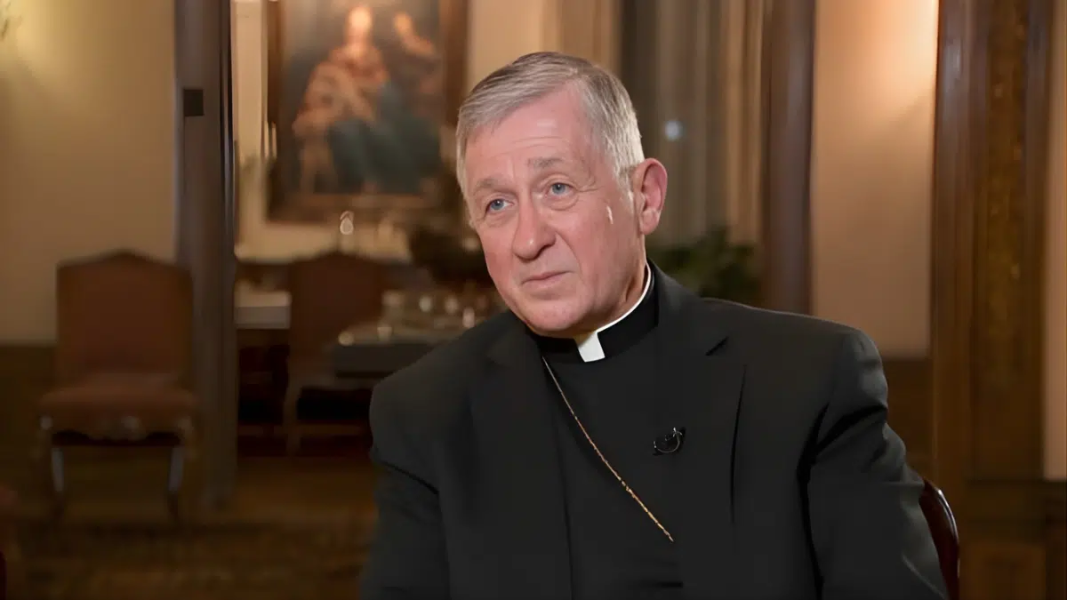
Cardinal Blase Cupich, Archbishop of Chicago, has once again positioned himself at the center of the liturgical debate by describing the Traditional Latin Mass as “more of a spectacle than active participation by all the baptized.” The statements, reported by The Catholic Herald, are part of a reflection on the conciliar constitution Sacrosanctum Concilium, a key document of the Second Vatican Council on the sacred liturgy.
According to Cupich, the post-conciliar reforms sought to “purify the liturgy” of adaptations accumulated “over time,” especially those elements that, in his view, came from “imperial and royal courts”. Such modifications—he argues—would have turned worship into a more aesthetic than participatory experience, and thus, far from the original intention of the rite.
“The liturgy must reflect the Church as servant of the Lord, not of worldly power,” emphasized the American prelate.
From Worship to Liturgical Activism
For Cupich, the criterion of authenticity in the Eucharist does not lie in the form or solemnity of the rite, but in its social dimension: the degree of “solidarity with the poor” that the community manifests. He even goes so far as to affirm that the Mass is “the place of solidarity with the poor in a fractured world”, reinterpreting the liturgy as an expression of humanitarian commitment rather than as a redemptive sacrifice.
These assertions reflect a pastoral reading of the Mass influenced by the so-called option for the poor, promoted after the Council. Cupich cites John XXIII and Cardinal Lercaro to argue that Vatican II marked a turning point in the ecclesial understanding of the poor as the center of God’s salvific plan. According to him, liturgical reform was necessary to better express that “Church of the poor.”
However, this vision—which equates the authenticity of worship with its social dimension—has been harshly questioned by theologians and faithful attached to the Roman liturgical tradition, who remind us that the liturgy is above all worship of God and not a platform for social action. The Eucharist, as taught by the Fathers and the Magisterium, is “the sacrifice of praise, propitiation, and thanksgiving,” not a gesture of sociological identity.
The Post-Conciliar Liturgical Wound
Cupich’s words come at a time of growing tension. Since the motu proprio Traditionis Custodes (2021), which restricts the Traditional Mass, numerous faithful and priests have experienced a new marginalization within the Church, precisely because of their attachment to the liturgical form that for centuries nourished Catholic faith.
The Archbishop of Chicago’s reference to the Traditional Mass as a “spectacle” has been seen by many as an unfair disqualification toward a growing community, characterized—as even their critics acknowledge—by its devotion, silence, and reverence. Defenders of the Tridentine liturgy recall that this form of the rite was never abrogated and that its beauty has led many young people to rediscover the faith.
While Cupich claims the simplicity and sobriety of the Novus Ordo as a sign of the servant Church, Cardinal Raymond Burke was celebrating in those same days a solemn pontifical Mass in St. Peter’s Basilica, attended by clerics and faithful from around the world. Two images, two visions: a Church that looks to its liturgical roots and another that seeks to reformulate its identity in a modern key.
Returning to the Sense of the Sacred
The Mass, as the Catechism teaches, “is the sacrifice of Christ himself, the actualization of Calvary under the sacramental species.” No authentic liturgical form can be reduced to a “spectacle,” for its essence does not lie in external aesthetics, but in the mystery of the real presence and the offering of the divine Victim. Purifying the liturgy does not mean impoverishing it or stripping it of its sacred language, but restoring its orientation toward God.
The controversy reignited by Cupich’s words highlights an unhealed wound: that of the sense of the sacred in Catholic worship. Against those who see tradition as an obstacle to “active participation,” the number of faithful who find in the Traditional Mass precisely the fullest participation: the silent adoration of the Mystery is growing.
The art and solemnity of the rite are not courtly luxuries, but theological language of the transcendent. And as long as there are hearts that understand that kneeling before the altar is not a spectacle, but living faith, the Mass will continue to be—as its title proclaims—an authentic treasure of the faith.