


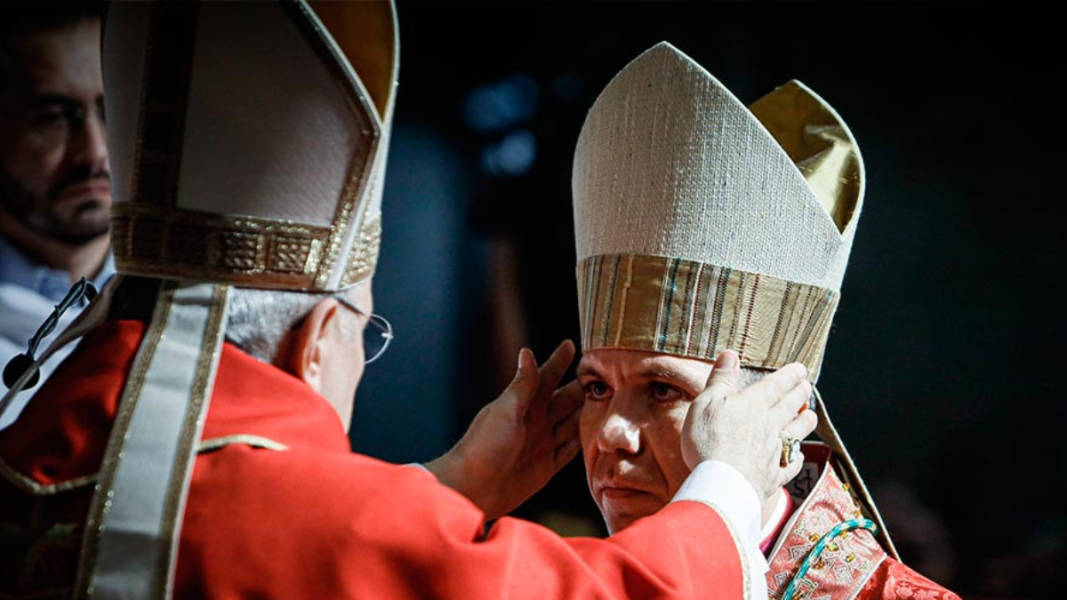
The episcopal co-prince of Andorra, Mons. Josep Lluís Serrano-Pentinat, has reappeared as one of the decisive names in the resolution of the Vatican financial scandal linked to the Sloane Avenue building in London, considered the most serious case of economic management in the Holy See during the last decade. A case in which the Cardinal Giovanni Angelo Becciu is involved—and accused.
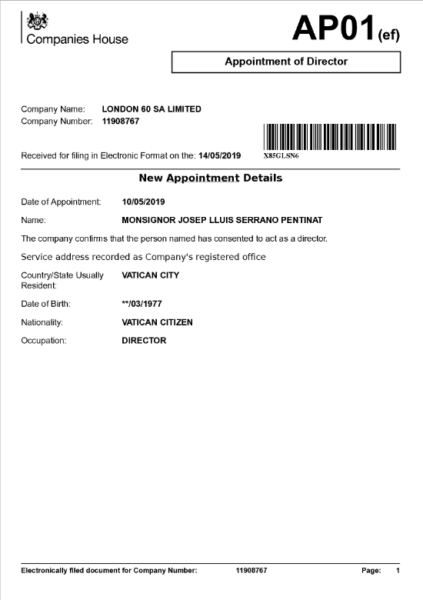
A report from the media outlet Le Veu Lliure, revealed that between May and August 2019, Serrano-Pentinat served as director of London 60 SA, the company that managed the London property in the heart of Chelsea and which was under investigation for alleged fraud, embezzlement, and abuse of power. His appointment, requested from Rome, occurred at the most delicate moment of the process.
A career diplomat at the service of the Holy See
Ordained as a priest and trained in the Vatican’s diplomatic service, Serrano-Pentinat joined the Secretariat of State in 2012. He carried out his work in the nunciatures of Mozambique, Nicaragua, and Brazil before joining, in 2019, the Section for General Affairs in Rome. His international experience and administrative profile explain why he was appointed to temporarily assume the direction of the London company.
During the three months he held the position, he supervised financial operations and established control and transparency protocols to avoid further losses. His intervention, according to sources close to the Vatican, made it possible to avoid greater economic damage and prepare for the orderly liquidation of the asset.
The epicenter of a historic case
The company London 60 SA had been created by the Secretariat of State to manage a real estate investment that ended up entangled in speculative maneuvers through offshore funds and external managers. Vatican prosecutors demonstrated that the resources came in part from donations intended for charitable purposes, diverted to high-risk operations through a network of intermediaries led by Raffaele Mincione and Gianluigi Torzi.
The case revealed the vulnerability of the Vatican’s internal mechanisms. High-ranking officials, such as the then substitute of the Secretariat of State, Msgr. Edgar Peña Parra, signed agreements under incomplete information that gave Torzi real control of the property. The subsequent investigation showed how even superiors, including Cardinal Parolin, had been deliberately kept in the dark.
From crisis to definitive closure
After years of litigation and audits, the Vatican sold the London building in July 2022 for 186 million pounds. Finally, London 60 SA was dissolved on October 7, 2025, marking the end of a chapter that tested the financial credibility of the Holy See.
The final reports acknowledge that the technical and prudent management of Serrano-Pentinat contributed to restoring order and avoiding an even greater loss. His role demonstrated that the intervention of experienced diplomatic and ecclesiastical officials can be decisive in situations of institutional risk.
A co-prince with international projection
The dissolution of London 60 SA does not erase the scandal, but it leaves evidence that transparency and personal responsibility can pave the way for moral restoration within the Vatican. A reminder that the administration of the Church’s assets must be governed by the same principle that guides its mission: serving the truth and the common good, not power or profit.
For the Principality of Andorra, the figure of the episcopal co-prince thus acquires broader relevance. Serrano-Pentinat, in addition to his religious and political role in the country, has shown capacity for management and ethical solvency in highly complex scenarios, which leaves us expectant regarding the progress of the abortion law that is under negotiation with Vatican mediation.