


For the first time in recent history, young adults in the United States are attending church more frequently than their parents and grandparents. This is shown by a new report from the Barna Group, as part of its “State of the Church” initiative, which indicates that Generation Z and Millennials have surpassed Boomers and Elders in regular participation in religious services.
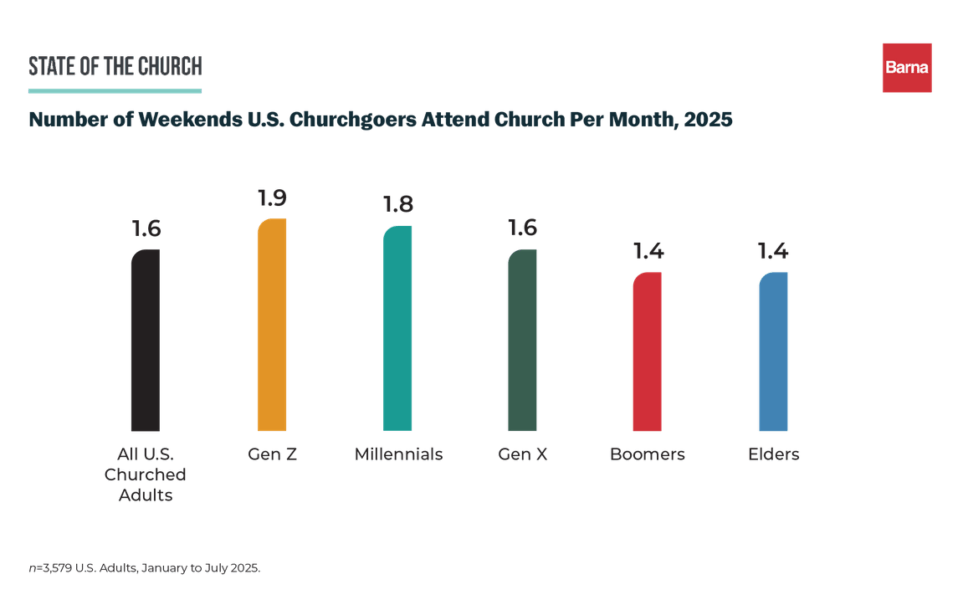
The report notes that members of Generation Z attend church an average of 1.9 weekends per month, while Millennials do so 1.8 times, figures that represent a sustained increase since the pandemic and the highest levels recorded for young adults since Barna began measuring generational participation. In contrast, Boomers currently attend 1.4 times per month, and Generation X slightly surpasses them with 1.6.
Daniel Copeland, Barna’s vice president of research, highlighted the unusual nature of this trend:
“It’s not typical for young people to be the most consistent in attendance. This is good news for church leaders and a sign that a spiritual renewal is brewing among the young.”
The decline in participation among older generations is notable. In the year 2000, the so-called “Elders” attended Mass about 2.3 times per month and Boomers twice, but their attendance has dropped significantly and remains below pre-pandemic levels.
David Kinnaman, Barna’s executive director, interpreted this change as a reflection of broader transformations within American Christianity:
“Congregational life has become more fragile and less gray than it was a decade ago. But the arrival of new generations represents a huge pastoral opportunity.”
However, Kinnaman warned that increased attendance does not automatically equate to deeper discipleship:
“Attending church does not guarantee a fully lived life of faith. The challenge remains to form hearts and minds to live the Gospel beyond the temple.”
The overall average among all adults who attend church is 1.6 times per month, that is, less than half of the weekends. Even so, the Barna Group, with more than 132,000 interviews conducted over 25 years, considers that this trend could redefine the future of Christianity if it persists.
The report also finds echoes outside the United States. In Northern Ireland, a survey by the Iona Institute shows a similar phenomenon: Generation Z youth exhibit greater religious commitment and firmer faith than their parents, which some experts describe as a “silent renaissance.”
In a time when many had written off youth to secularism, the data reveals the opposite: a generation that is returning to the temple with questions, convictions, and hope, opening the possibility of an authentic spiritual renewal for the Church.