


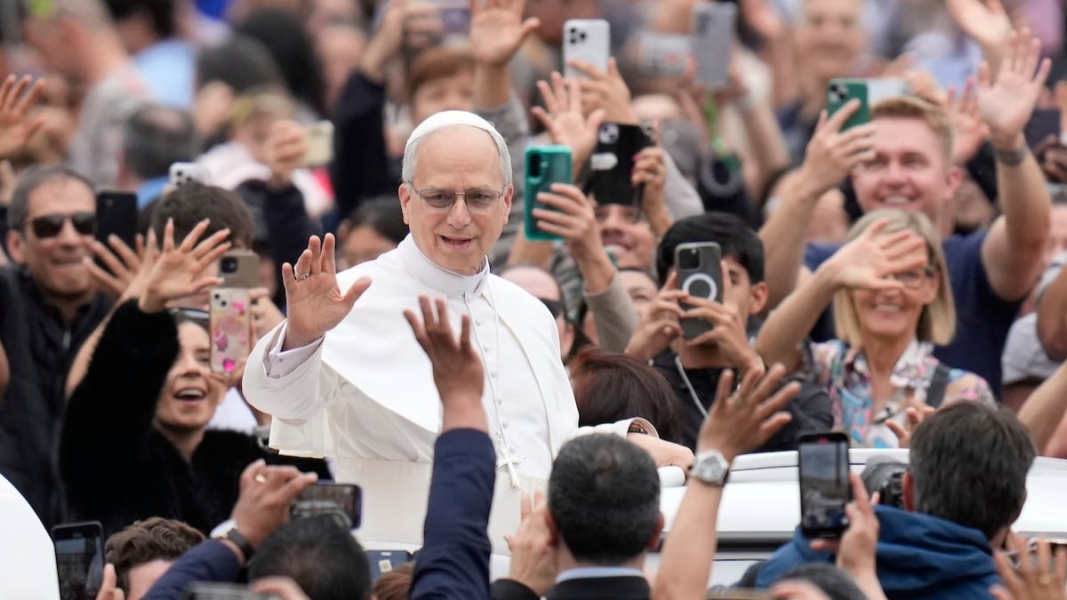
Pope Leo XIV received this Thursday students and teachers from all over the world on the occasion of the Jubilee of the Educational World, celebrated in Rome. In a speech that combined pastoral tenderness and intellectual rigor, the Pontiff invited young people to discover the beauty of learning “not only to know more, but to live better”.
“Faith does not extinguish intelligence, it illuminates it”, he affirmed emphatically, resuming one of the lines that define his magisterium: the unity between reason, faith, and culture as a path toward human fullness.
The Jubilee of Education: Faith, Reason, and Hope
The encounter was part of the 2025 Jubilee Year, dedicated to hope. In the Paul VI Hall, the Pope addressed an audience composed of students, professors, university students, and representatives of Catholic educational centers, emphasizing that educating is “an act of hope” and one of the highest forms of love.
“Education is a sowing that does not bear fruit immediately —he said—, but whoever teaches participates in the same creative work of God, helping others to grow in wisdom, freedom, and love.”
The Pope warned against “soulless education,” which forms technicians and consumers but not people, and called for recovering the sense of formation as a spiritual and cultural vocation.
The Christian Sense of Knowledge
Leo XIV reminded those present that faith does not oppose thought, but purifies it. “Believing is not renouncing thinking —he explained—, but opening the mind to a greater light, which comes from God and allows us to better understand the mystery of the world and of ourselves.”
He cited St. Augustine and St. Thomas Aquinas to emphasize that “intelligence is a gift from God, but it needs to be guided by love and oriented toward the good.” In this sense, he insisted that the Catholic university and school must be “laboratories of truth,” not places of ideological indoctrination or spaces of political confrontation.
An Integral Education Open to Transcendence
In his message, the Pope encouraged young people not to let themselves be trapped by utilitarianism or individualism: “Do not study only to earn money or to stand out, but to serve the common good.”
He underlined the importance of the spiritual dimension of education, especially in an era dominated by artificial intelligence and the consumption of information. “We need hearts that think and minds that love,” he affirmed.
Leo XIV also recalled that the true teacher is the one who teaches “not only to reason, but to hope,” who helps students find meaning and not just solutions.
The Magisterium of Hope
The tone of the speech directly links to the apostolic letter Disegnare nuove mappe di speranza, published days earlier, where the Pope outlined a new pedagogy of clarity. Both texts reflect the same conviction: Catholic culture must recover its role as a moral and spiritual guide in contemporary society.
“Educating —the Pope affirmed— is an act of faith in the future. And Christians, precisely because they believe in the resurrection, do not tire of starting anew.”
A Final Word to the Young People
Before concluding, Leo XIV exhorted young people not to let themselves be overcome by discouragement or mediocrity: “Do not be afraid to think freely, but do not fear believing either. Faith and reason are like two wings that lift us toward the truth.”
The Pope asked educators to accompany young people “not with speeches, but with witness,” and that the Catholic school always be “a house of hope, where one learns to live and to love.”
We leave below the complete message from Leo XIV:
In the name of the Father, of the Son, and of the Holy Spirit,
Peace be with you!
Dear boys and girls, good morning!
What joy to meet you! Thank you! I have awaited this moment with great emotion: your company reminds me of the years when I taught mathematics to lively young people like you. I thank you for responding this way, for being here today, to share the reflections and hopes that, through you, I deliver to our friends scattered around the world.
I would like to begin by remembering Pier Giorgio Frassati, an Italian student who, as you know, was canonized during this Jubilee Year. With his soul passionate for God and for his neighbor, this young saint coined two phrases that he repeated frequently, almost like a motto. He said: “To live without faith is not to live, but to survive”, and also: “Verso l’alto”.
They are very true and encouraging statements. I say to you too: have the audacity to live fully. Do not settle for appearances or fashions: an existence reduced to the ephemeral never satisfies us. Instead, let each one say in their heart: “I dream of more, Lord; I desire more: inspire me you!”
That desire is your strength, and it well expresses the commitment of young people who want to build a better society, of which they do not accept being mere spectators.
That is why I encourage you to constantly reach “toward the heights,” lighting the beacon of hope in the dark hours of history. How wonderful it would be if one day your generation were remembered as the “plus generation,” recognized for the extra energy it will know how to give to the Church and the world!
This, dear young people, cannot be the dream of one person alone: let us unite, then, to make it a reality, testifying together to the joy of believing in Jesus Christ.
How to achieve it? The answer is essential: through education, one of the most beautiful and powerful instruments for changing the world.
The beloved Pope Francis, five years ago, launched the great project of the Global Educational Pact: an alliance of all those who, in various ways, work in the field of education and culture, to involve new generations in a universal fraternity.
You are not only recipients of education, but also its protagonists.
That is why today I ask you to join together to open a new educational stage, in which all —young and adults— are credible witnesses to truth and peace.
For this reason I say to you: you are called to be truth-speakers and peace-makers, people of word and builders of peace. Involve your peers in the search for truth and the construction of peace, expressing those two passions with your life, with your words, and with your daily gestures.
In this regard, along with the example of St. Pier Giorgio Frassati, I want to join a reflection from St. John Henry Newman, a scholarly saint who will soon be proclaimed a Doctor of the Church.
He said that knowledge multiplies when shared, and that it is in the dialogue of minds where the flame of truth is kindled.
Thus, true peace is born when many lives, like stars, unite and form a pattern. Together we can form educational constellations, which guide the path of the future.
As a former professor of mathematics and physics, allow me to do a small calculation with you.
Do you have a math exam coming up soon? Let’s see…
Do you know how many stars there are in the observable universe? It is an impressive and wonderful number: a sextillion stars, a 1 followed by 21 zeros. If we divided them among the 8 billion inhabitants of the Earth, each person would correspond to hundreds of thousands of millions of stars.
To the naked eye, on clear nights, we can distinguish about five thousand. Although there are thousands of billions of stars, we only see the closest constellations; but those indicate a direction, like when navigating at sea.
Since always, travelers have found their way by following the stars.
Sailors followed the North Star; Polynesians crossed the ocean memorizing star maps. According to Andean peasants —whom I met when I was a missionary in Peru— the sky is an open book that marks the seasons of sowing, shearing, and the cycles of life.
Even the Magi followed a star to reach Bethlehem and adore the Child Jesus.
Like them, you too have guiding stars: parents, teachers, priests, good friends; compasses so as not to get lost in the joys and sorrows of life.
And like them, you are called to become in turn luminous witnesses for those around you.
But, as I said, a single star remains isolated; united with others, instead, it forms a constellation, like the Southern Cross. That is how you are: each one is a star, and together you are called to guide the future.
Education unites people in living communities and organizes ideas into constellations of meaning.
As the prophet Daniel writes: “Those who lead many to righteousness shall shine like the stars forever” (Dn 12:3).
What a wonder! We are stars, yes, because we are sparks of God. To educate means to cultivate that gift.
Education, in fact, teaches us to look toward the heights, always higher.
When Galileo Galilei pointed the telescope at the sky, he discovered new worlds: the moons of Jupiter, the mountains of the Moon.
That is what education is: a telescope that allows us to look beyond, to discover what we could not see alone.
Do not stop looking at the smartphone and its super-fast fragments of images: look at the Sky, look toward the heights.
Dear young people, you yourselves have pointed out the first of the new tasks that commit us in our Global Educational Pact, expressing a strong and clear desire: “Help us to educate ourselves for interior life.”
That request impressed me deeply.
It is not enough to have great knowledge if afterward we do not know who we are or what the meaning of life is.
Without silence, without listening, without prayer, even the stars fade.
We can know much about the world and yet ignore our own heart.
You too will have felt at times that sensation of emptiness, of restlessness that does not leave one in peace.
In the most serious cases, we witness episodes of malaise, violence, bullying, domination, and even young people who isolate themselves and no longer want to relate to others.
I think that behind those sufferings is also the emptiness caused by a society incapable of educating the spiritual dimension of the human being, limiting itself to the technical, the social, or the moral.
As a young man, St. Augustine was a brilliant boy, but deeply unsatisfied, as he himself recounts in his Confessions. He sought everywhere —in his career, in pleasures— and tried everything, without finding either truth or peace, until he discovered God in his own heart.
Then he wrote a phrase that applies to all of us: “My heart is restless until it rests in You”.
That is what educating for interior life means: listening to our restlessness, not fleeing from it or trying to fill it with what does not satisfy.
Our desire for the infinite is the compass that tells us: “Do not settle; you are made for something greater. Do not survive: live.”
The second of the new educational tasks is a daily challenge in which you are true masters: digital education.
You live immersed in it, and it is not something bad: it offers enormous opportunities for study and communication.
But do not allow the algorithm to write your story.
Be the authors: use technology with wisdom, but do not allow technology to use you.
Artificial intelligence is also a great novelty —one of the rerum novarum of our time—; but it is not enough to be “intelligent” in virtual reality: one must be human with others, cultivating emotional, spiritual, social, and ecological intelligence.
That is why I say to you: educate yourselves to humanize the digital, building it as a space of fraternity and creativity, not as a cage to lock oneself in, nor as a dependency or an escape.
Instead of tourists of the net, be prophets in the digital world!
In this sense, we have a very current example of holiness: St. Carlo Acutis.
A young man who did not become a slave to the net, but used it skillfully for good.
St. Carlo united his beautiful faith with his passion for computing, creating a site about Eucharistic miracles and thus making the Internet an instrument of evangelization.
His initiative teaches us that the digital is educational when it does not enclose us in ourselves, but opens us to others; when it does not put you at the center, but orients you toward God and toward others.
Dearest ones, we finally arrive at the third great task that I entrust to you today and which is at the heart of the new Global Educational Pact: education for peace.
You see well how much our future is threatened by war and by the hatred that divides peoples.
Can that future be changed? Certainly!
How? With an unarmed and disarming education for peace.
It is not enough to silence the weapons: hearts must be disarmed, renouncing all violence and vulgarity.
Thus, a disarming and unarmed education creates equality and growth for all, recognizing the equal dignity of every boy and every girl, without ever dividing young people between a few privileged ones who access very expensive schools and many who have no access to education.
With great trust in you, I invite you to be builders of peace, first of all where you live: in the family, in school, in sports, among friends, approaching those who come from other cultures.
To conclude, dearest ones, do not fix your gaze on shooting stars, to which fragile wishes are entrusted.
Look even higher, toward Jesus Christ, “the sun of justice” (cf. Lk 1:78), who will always guide you along the paths of life.