


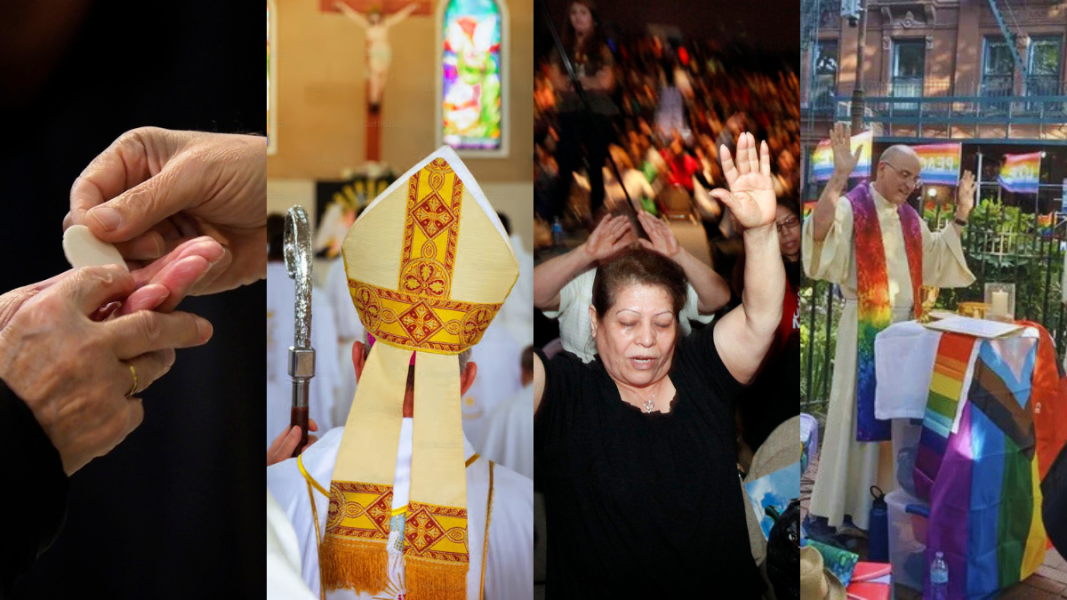
In recent years, a large part of the ecclesial discourse has focused on worldly matters such as climate change, migration policies, or interreligious dialogue. These are relevant topics, but they often displace the center of gravity of the Church’s life. While synods, conferences, and documents on superficial issues are organized from Rome, there is hardly any talk of what is the root of everything else: faith, grace, sin, liturgy, and the salvation of souls.
There are silent problems, deeply spiritual ones, that lately do not appear in pastoral plans or in the supposedly active synodal teams, but that undermine the very heart of the Church. Classifying them into four is an insufficient, simplistic, and imprecise reduction, but I believe that in a confused context, concretizing ideas can be something useful.
1. The widespread sacrilegious communion
In thousands of parishes, an almost identical scene is repeated: long lines to receive Communion, and empty confessionals. The idea that one must be in a state of grace has been diluted until it disappears. People receive Communion out of habit, without an examination of conscience, as if the external gesture were enough. Many priests have stopped talking about mortal sin or judgment, and the result is a routine Communion, sometimes sacrilegious.
The remedy is simple and concrete: that in homilies the need for sacramental confession before receiving Communion if one is in mortal sin be reminded; that mortal sin be explained; that visible confessors be available before and after Masses. There is no need to harden, but to teach with clarity and charity. The faithful have been infantilized, but the reality is that people are prepared to hear a demanding proposal for life. Out of fear of sounding harsh or generating rejection, many priests hardly preach about sin. Is that the way to save souls?
2. The lack of faith among bishops and priests
The second problem is not visible from the outside, but its effects are devastating. Many priests and bishops do not believe in the God who becomes incarnate. They comply, manage, organize, live a sort of simulation, but they have lost the inner certainty of the supernatural. Therefore, they celebrate without deep conviction, preach without fervor, govern as if the Church were just another institution among many. Clericalism no longer consists only in the abuse of power, but in the spiritual emptying of the ministry.
The solution lies in restoring to the clergy their spiritual root. Perhaps a radical plan would be good that allows priests to retreat to the desert for a month a year. A demanding plan for following their spiritual life. Seminaries with more filters, real discernment of vocations, more silence and prayer… A priest who prays little ends up believing little. And when the shepherds lose faith, the flock scatters.
3. Sectarian movements
Many movements that grew up in the post-conciliar period have ended up turning into closed circles with sectarian dynamics. They all share a salvific vision: the Church would have made great mistakes from Constantine until their arrival, and their charism is better than the tradition and secular doctrine of 1700 years. The group becomes the end; the founder, an untouchable figure; obedience, a form of control. Through fraternal talks or scrutinies, knowledge of the member’s sin and weakness becomes not only its perverse element of cohesion, but a pseudo-sacramental deformation that is sacrilegious and abusive.
The Church cannot look the other way. Real vigilance is necessary: diocesan reviews, limitation of mandates, doctrinal and economic transparency, external accompaniment of spiritual practices.
4. The banalization of the liturgy
Perhaps a damage interconnected directly with all the others is the loss of the sense of the sacred in the liturgy. In too many places, the Mass has been transformed into an improvised spectacle. The prayer is changed, anything is sung, the altar is theatricalized, the tabernacle and the Most Blessed Sacrament are reduced to a decorative element. What is sold as an attempt at closeness results in a total loss of mystery and in throwaway emotivist products.
The liturgy does not need creativity or emotivity, but fidelity and beauty. It is the language of faith: if it is deformed, what we believe is also deformed. True reform is not returning to the past, but anchoring oneself to the timeless. Remembering that in the Mass God Himself is present. Where the liturgy is respected, faith flourishes; where it is banalized, it fades.