


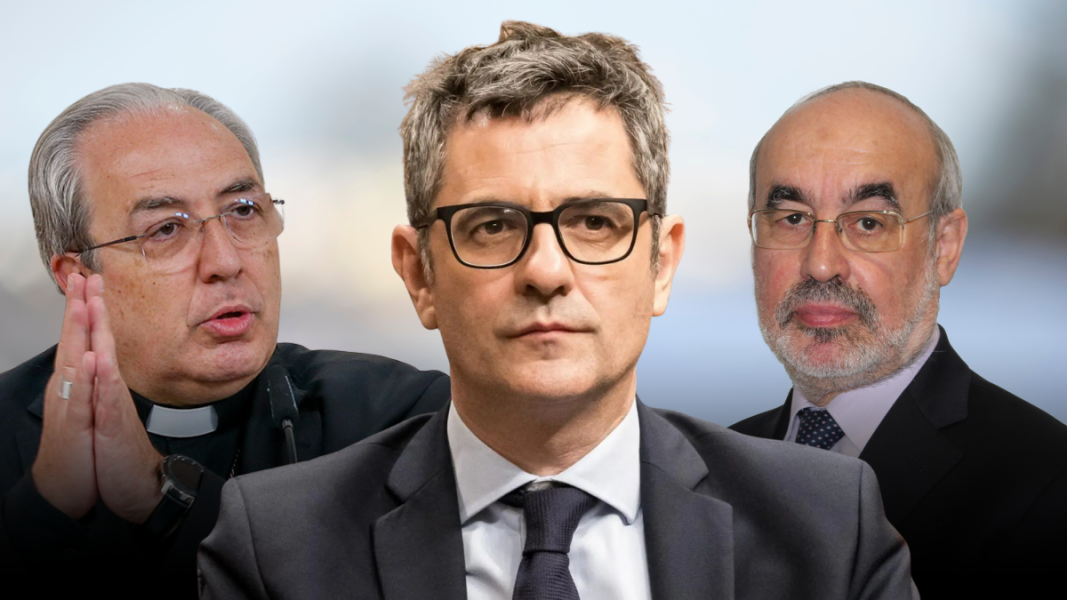
The Catholic Church in Spain and the Government are on the verge of closing an agreement that will allow the opening of a common compensation pathway for victims of sexual abuse. According to information from Vida Nueva, following the technical meeting held on October 29 at La Moncloa between ecclesiastical representatives and the team of the Minister of the Presidency, Justice and Relations with the Cortes, Félix Bolaños. Although the minister could not attend, he gave his approval to move forward with the plan.
The understanding seeks to address a problem that has pitted the Church and the State against each other for years. However, behind the conciliatory tone lies an evident political game: the Government pretends to demand accountability while designing a model that avoids assuming compensations itself. For its part, the Church, instead of facing the drama with humility and courage, seems willing to negotiate on the most sensitive issue: the truth and the memory of its own history.
A new pathway for reparation
The proposal under consideration would allow victims who rejected the Integral Reparation Plan (PRIVA) —created by the Church to address prescribed cases or those with deceased aggressors— to access a new compensation instance under external supervision. To date, a hundred people have approached PRIVA, but some associations consider it insufficient because it depends on ecclesiastical structures.
The Church has agreed to study this new framework, on the condition that it be supervised by the Ombudsman, Ángel Gabilondo, a figure who enjoys credibility among victims’ associations. And from La Moncloa, they have committed to sending a draft to the Episcopate before the November Plenary Assembly. The measure, seemingly balanced, leaves one question unresolved: who will pay the compensations and how will it be ensured that the victims are truly repaired.
Institutional collaboration with caution
On behalf of the Church, Bishop César García Magán, general secretary of the CEE, and religious Jesús Miguel Zamora, general secretary of CONFER, participated, along with Cristina Guzmán and Salesian Samuel Segura from the PRIVA commission. Representing the Government were Alberto Herrera, undersecretary of the Presidency; Mercedes Murillo, director general of Religious Freedom; and Paloma Martínez Aldama, head of the technical cabinet of the undersecretary. Sources from both sides describe the meeting as “cordial” and “constructive.”
But the friendly tone should not obscure the essential: the State seeks a political agreement, not a moral reparation, and the Church fears the media wear more than the judgment of its conscience. Both sit at the table with different objectives: La Moncloa to control the narrative; the Church, to close a wound without exposing it too much to the sun of truth.
From disagreements to agreement
The evolution of the negotiations is significant. In July 2024, Bolaños went so far as to write to the then president of the CEE, Msgr. Luis Argüello, warning him that he would not accept “a unilateral formula” on compensation matters. Even so, the Church maintained its plan: to date, it has resolved 39 of 89 requests, with indemnities ranging from 3,000 to 100,000 euros. The Government, on the other hand, has gone more than a year without implementing its own plan approved by the Council of Ministers in April 2024, which envisaged a mixed State-Church fund and a statute for victims. None of those measures have been implemented.
Read also: PRIVA resolves 39 abuse cases in its first year of work
Contacts in Rome
Minister Bolaños met on October 24 in the Vatican with Cardinal Pietro Parolin, Secretary of State, accompanied by ambassador Isabel Celaá. The lightning visit, focused on abuses and the resignification of the Valley of the Fallen, demonstrates that the Government intends to involve the Holy See in its strategy of “symbolic management” of religious issues.
Between prudence and moral risk
The new mechanism, if finalized, could represent a step toward institutional coordination. But it can also become another instrument of delay and makeup. The supervision by the Ombudsman provides confidence, but the core of the issue remains intact: who assumes the cost, economic and moral, of what happened.
Spain does not need a political negotiation over pain, but an integral reparation based on truth. And the Church, if it wants to preserve its moral credibility, must face with fortitude what many inside and outside it still consider an unclosed page. Procedures and protocols are not enough; penance, justice, and clarity are needed.
The Government pretends to demand accountability from the Church while granting it room to assume not a single euro in compensations. And the Church, instead of facing the drama with humility and courage, has chosen to negotiate on what hurts the most: the soul of its historical memory.