


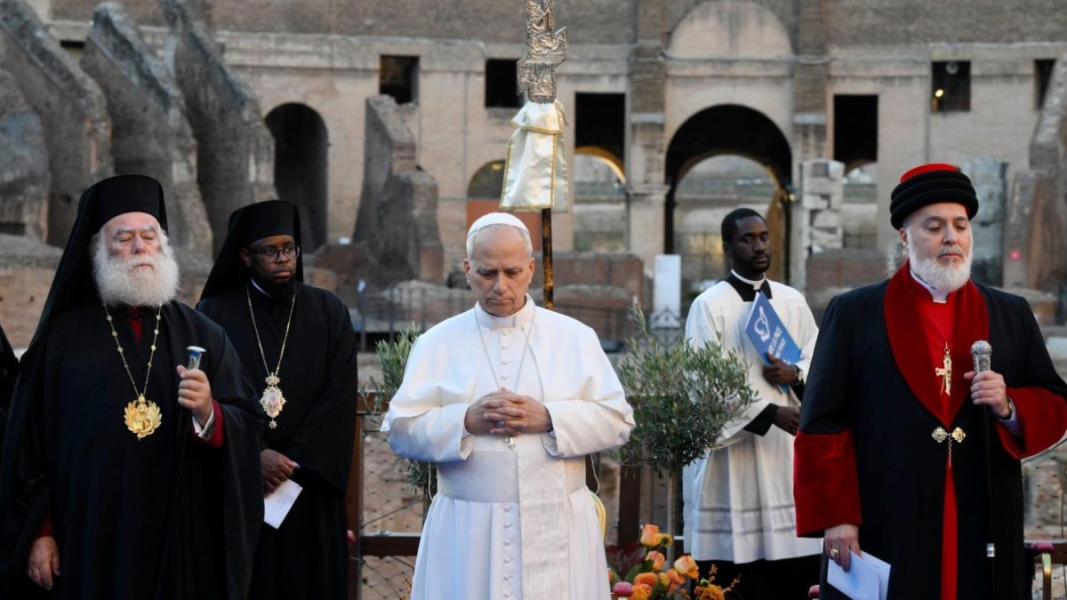
This Tuesday, October 28, from the Colosseum in Rome, before Christian leaders and representatives of the world’s major religions, Pope Leo XIV issued an urgent call for an end to wars: “Enough! War is never holy, only peace is holy, because it is the will of God.”
The gathering, promoted by the Community of Sant’Egidio under the motto “Osare la pace” (“Dare to peace”), coincided with the 60th anniversary of the declaration Nostra aetate from the Second Vatican Council, which opened a new stage of dialogue between the Catholic Church and the world’s religions. The event is part of the spiritual journey toward the 2025 Jubilee, which has hope as its central axis.
A Worldwide Meeting for Peace
The international event “Osare la pace” took place in Rome from October 26 to 28, 2025, with various dialogue tables at the Auditorium Parco della Musica and the final ceremony at the Colosseum. It brought together more than 10,000 people from all continents, including religious leaders, diplomats, academics, and young people committed to peace.
The gathering revived the spirit of the meetings initiated by St. John Paul II in Assisi in 1986, under the motto “Praying together for peace.” On this occasion, Pope Leo XIV wanted to return to the original gesture, asking the world’s religions to pray “not against one another, but alongside one another.”
The theme “dare to peace” reflects the conviction that peace requires courage, not resignation, and that interreligious dialogue cannot remain in words but must translate into concrete gestures of reconciliation, welcome, and forgiveness.
“War Is Never Holy”
In his speech, Leo XIV spoke firmly and without euphemisms: “War is never holy, only peace is holy, because it is the will of God.” He recalled that human history is wounded by too many wars and that we cannot accept violence becoming a habitual companion of humanity.
“With the strength of prayer, with bare hands raised to the sky and open toward others, we must ensure that this stage marked by the arrogance of force ends soon and a new history begins,” he affirmed. And he added: “We cannot accept becoming accustomed to war as a normal companion of human history. Enough! It is the cry of the poor and the cry of the earth.”
The Pope also warned against the abuse of religion: “Whoever does not pray abuses religion, even to kill.” With these words, he rejected any ideological instrumentalization of faith and recalled that “prayer is the great force of reconciliation” and that “peace is the priority of any politics.”
Prayer, the Engine of History
Leo XIV emphasized that prayer is not a passive gesture but a force that transforms history. “The world thirsts for peace,” he said, “and prayer can open paths where politics is blocked.” He invited religious leaders to “offer the world the treasures of their ancient spiritual traditions” to overcome hatred and sow reconciliation.
In harmony with Nostra aetate, the Pope recalled that “we cannot invoke God the Father of all if we refuse to act fraternally with some men, created in the image of God.” For this reason, he insisted that religions, “as sisters,” must help peoples treat each other as brothers and not as enemies.
A Culture of Encounter for the Jubilee
The “Osare la pace” gathering is part of the spiritual itinerary of the 2025 Jubilee and seeks to renew the culture of encounter and fraternity in a world fractured by conflicts. Among the participants were also representatives from the political and cultural worlds, who shared experiences of dialogue, mediation, and reconstruction after war.
The motto “dare to peace” expresses the step that Leo XIV proposes to the religions: not to limit themselves to condemning war, but to commit actively to building a stable peace. “Peace,” said the Pope, “is the non-negotiable duty of all political leaders before God.”
He also quoted the venerable Giorgio La Pira, who dreamed of “a different history of the world: the history of the era of negotiation.” Leo XIV made those words his own, proposing that human history finally enter that new era.
A Reading from the Catholic Tradition
The Pope’s message is inscribed in the continuity of the Church’s social magisterium: peace as the fruit of justice, dialogue, and truth. His speech combines moral clarity and spiritual depth, without falling into ambiguity or sentimentality.
From a traditional perspective, Leo XIV reaffirms the Church’s mission as a mediator of peace and defender of the order willed by God. Interreligious dialogue, understood in this way, does not relativize faith but makes it fruitful in the human realm: defending life, promoting fraternity, and rebuilding the common good.
The Pope does not propose a naive peace, but an exacting peace, born of sacrifice and forgiveness. “We must dare to peace,” he repeated, like someone calling for an act of faith in the possibility of a reconciled world.
A Voice That Challenges the World
The Roman day leaves a powerful image: the Colosseum, a symbol of ancient violence, transformed into a stage for prayer and commitment to peace. From there, Leo XIV traced a moral route for 21st-century humanity: pray, dialogue, and act with courage.
His message is not political but profoundly evangelical. In a world accustomed to war, the Pope proposes returning to the Christian root of hope. Because—as he recalled with a firm voice—“war is never holy; only peace is, because it is the will of God.”
You can read the full message of Pope Leo XIV:
Holiness,
Beatitudes,
Illustrious representatives of the Christian Churches and the great religions of the world:
We have prayed for peace according to our different religious traditions and now we have gathered to issue together a message of reconciliation. Conflicts are present everywhere there is life, but it is not war that helps to face them or resolve them. Peace is a permanent path of reconciliation. I thank you for coming here to pray for peace, showing the world how decisive prayer is. The human heart must dispose itself to peace; in meditation it opens, and in prayer it goes out of itself. To turn to oneself to go out of oneself. This is what we witness, offering contemporary humanity the immense treasures of ancient spiritual traditions.
The world thirsts for peace; it needs a true and solid era of reconciliation that puts an end to arrogance, the display of force, and indifference to law. Enough of wars, with their painful accumulations of dead, destructions, and exiles! Today we, together, express not only our firm will for peace but also the awareness that prayer is a great force of reconciliation. Whoever does not pray abuses religion, even to kill. Prayer is a movement of the spirit, an opening of the heart. It is not shouted words, nor exhibited behaviors, nor religious slogans used against God’s creatures. We have faith that prayer changes the history of peoples. May places of prayer be tents of encounter, sanctuaries of reconciliation, oases of peace.
On October 27, 1986, St. John Paul II invited the world’s religious leaders to Assisi to pray for peace: never again against one another, but alongside one another. It was a historic moment, a turning point in relations between religions. In the “spirit of Assisi,” year after year, these encounters of prayer and dialogue have continued, creating a climate of friendship among religious leaders and embracing many requests for peace. Today, the world seems to have taken the opposite direction, but we start again from Assisi, from that awareness of our common task, from that responsibility for peace. I thank the Community of Sant’Egidio and all organizations, not only Catholic ones, that, often going against the current, keep this spirit alive.
Prayer in the “spirit of Assisi,” for the Catholic Church, is based on the solid foundation expressed in the Declaration Nostra aetate of the Second Vatican Council, that is, in the renewal of the relationship between the Catholic Church and the religions. And precisely today we celebrate the sixtieth anniversary of its promulgation, which took place on October 28, 1965.
Together we reaffirm our commitment to dialogue and fraternity, desired by the conciliar fathers, which has borne so much fruit. With these words the Second Vatican Council teaches: “We cannot invoke God, Father of all, if we refuse to act fraternally with some men, created in the image of God” (Nostra aetate, 5). All believers are brothers. And religions, as “sisters,” must foster peoples treating each other as brothers, not as enemies. Because “all peoples form a community, they have a common origin” (ibíd., 1).
Last year you gathered in Paris and Pope Francis wrote to you on the occasion of that meeting: “We must keep religions away from the temptation to become instruments for fueling nationalisms, ethnicisms, populisms. Wars are intensifying. Woe to those who try to drag God into participating in wars!” [1] I make these words my own and repeat with force: war is never holy, only peace is holy, because it is the will of God!
With the strength of prayer, with bare hands raised to the sky and open toward others, we must ensure that this stage of history marked by war and the arrogance of force ends soon and a new history begins. We cannot accept that this moment prolongs itself further, that it shapes the mentality of peoples, that we become accustomed to war as a normal companion of human history. Enough! It is the cry of the poor and the cry of the earth. Enough! Lord, hear our clamor!
The venerable Giorgio La Pira, a witness to peace, while working politically in difficult times, wrote to St. Paul VI that what was needed was “a different history of the world: the history of the era of negotiation,” the history of a new world without war.” [2] These are words that today more than ever can be a program for humanity.
The culture of reconciliation will overcome the current globalization of impotence, which seems to tell us that another history is impossible. Yes, dialogue, negotiation, cooperation can address and resolve the tensions that open up in conflict situations. They must do so! There are the spaces and the people to do it. “Putting an end to war is the non-negotiable duty of all political leaders before God. Peace is the priority of any politics. God will hold accountable those who have not sought peace or have fomented tensions and conflicts during so many days, months, and years of war.” [3]
This is the appeal that we, religious leaders, address with all our heart to the rulers. We echo the desire for peace of the peoples. We become the voice of those who are not heard and have no voice. We must dare to peace!
And if the world turns a deaf ear to this appeal, we are certain that God will hear our prayer and the lament of so many who suffer. Because God wants a world without war. He will deliver us from this evil!