


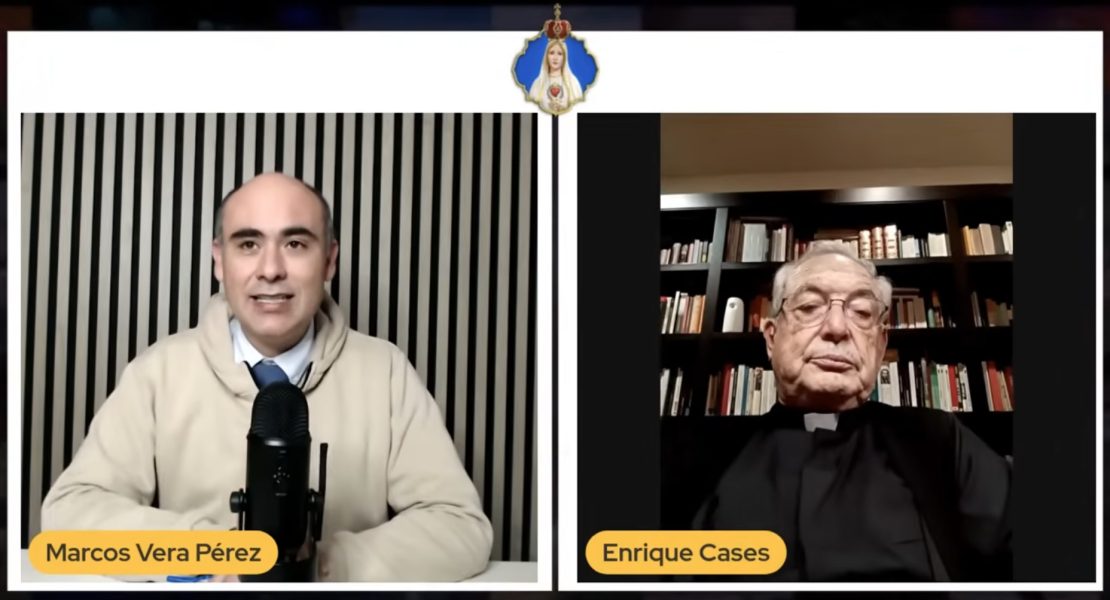
An Opus Dei priest admits that the Pope’s motu proprio “annoyed them,” but says that “God wants Opus Dei” and that “the legal form doesn’t matter”
The priest Enrique Cases, a numerary of Opus Dei for more than sixty years and doctor in Canon Law, has granted an interview to Marcos Vera for Tekton in which he tries to refute the information published by InfoVaticana about the future of the prelature. However, his own words confirm, point by point, the diagnosis of this medium: Opus Dei considers itself a divine work outside any legal form, ecclesiastical authority, or pontifical reform.
Cases, who claims to have known San Josemaría Escrivá personally, states that Francisco’s motu proprio—drafted by the Jesuit cardinal Gianfranco Ghirlanda—“didn’t please us” and “annoyed us a bit,” because “it was done from a hierarchical mentality” and “doesn’t understand the mission of the laity.” “I’m not happy,” he admits, “because they don’t understand our charism.” But then he makes it clear that the prelature does not depend on that decision of the Pope, nor on his successor Leo XIV, because—as he says verbatim—“what matters is that God wants Opus Dei to exist” and that “this is not a human setup, but something God made visible” to Escrivá in 1928.
The priest even goes so far as to say that, even if the legal figure is changed, “that changes nothing,” because “the legal clothing is the least of it” and “we will continue doing the same thing.” In his opinion, Opus Dei is “a divine mission that cannot be abolished,” and the Roman reforms “do not affect the essential.”
During the interview, the host reads aloud the InfoVaticana news titled “Opus Dei on the verge of ceasing to exist”, and the priest responds angrily: “That’s what InfoVaticana says, and it’s not true.” But in the same dialogue, he admits that Pope Leo XIV is carrying out the reform initiated by Francisco and that he has not yet read the new document, limiting himself to trusting that “they don’t abandon the laity to the wolves.”
“Tell the gentleman who wrote this to confess his sins. Because he says many sins, lies, calumnies…” the priest even affirms about me, without providing a single argument to refute the information from this medium.
At another moment, the priest himself confesses with a tone of candor that reveals the central contradiction of the entire work: “I couldn’t care less about Banco Popular, and I don’t have a dime. But this is God’s will, not a setup by a young priest.” The idea, repeated several times, is that the existence of Opus Dei does not depend on Canon Law but on a direct divine election, even against the authority of the Pope.
The result is that, in trying to defend obedience and orthodoxy, the priest reproduces the underlying argument that InfoVaticana has been pointing out in its investigations: that Opus Dei, after the motu proprio and the loss of its privileged structure, takes refuge in an almost mystical conviction of spiritual superiority, according to which neither the norms, nor the statutes, nor the ecclesiastical hierarchy alter its mission.
The video, available below, is the best demonstration that Opus Dei today lives a dissonance between its rhetoric of obedience and its practical autonomy. What Cases describes with theological serenity—that no Pope or legal garb matters a damn—is, at bottom, the same diagnosis that InfoVaticana has documented with writings, simple notes, and statutes: an institution that no longer legally belongs to the Church, but continues to function as if it had a divine mission above it.
https://www.youtube.com/live/84q5-FkUWc0?si=YMPQN1jhqcq8WClv