


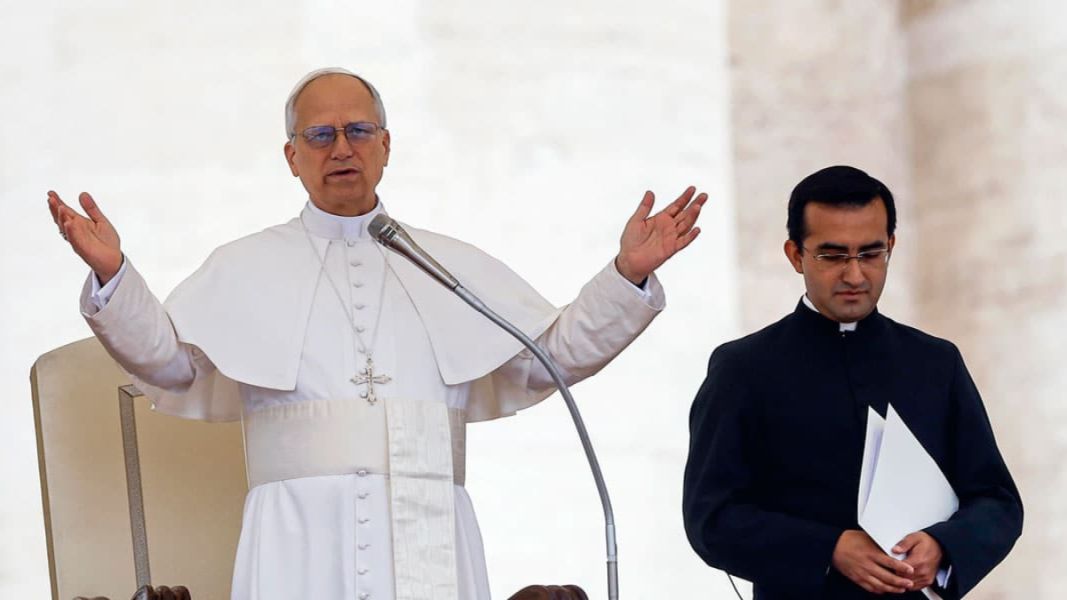
In the general audience held in St. Peter’s Square, Pope Leo XIV dedicated his catechesis to the 60th anniversary of the conciliar declaration Nostra aetate, a key document of the Second Vatican Council on the Church’s relations with non-Christian religions.
The Pontiff emphasized that authentic interreligious dialogue does not mean doctrinal confusion, but rather a sincere search for truth and reciprocal openness from faith, in recognition of our common human dignity.
“God is spirit, and those who worship him must worship in spirit and truth,” the Pope recalled, quoting the Gospel of Saint John (4:24), comparing the dialogue with the Samaritan woman to the Christian’s vocation to overcome cultural and religious barriers.
The legacy of Nostra aetate and the bond with Judaism
Leo XIV evoked the origins of the conciliar declaration, signed on October 28, 1965, when the Church—under the impetus of Saint John XXIII—sought to renew dialogue with the Jewish world.
“The Church of Christ cannot forget that the beginnings of its faith and its election are already found in the Patriarchs, in Moses and the prophets,” the Pope affirmed, recalling that the Christian community “shares with the Jewish people the memory and the expectation of the day of the Lord.”
The Pontiff insisted that Nostra aetate was a spiritual opening of horizons, which teaches Christians to honor differences without denying the truth of the Gospel, and to recognize in every sincere religious search “a reflection of the one divine Mystery that embraces all creation.”
Against fundamentalism and the misuse of religion
Leo XIV warned of the contemporary risks of religious fundamentalism and the abuse of God’s name.
“We must be vigilant against the abuse of God’s name, of religion, and of dialogue itself,” he exhorted, underscoring that authentic faith “affirms service to humanity at all times.”
He also called for addressing the development of artificial intelligence in an ethical manner, warning that if it is conceived apart from human dignity, it can “neutralize man’s fundamental responsibilities.”
Religion, a force for peace and hope
In the final part of his catechesis, Leo XIV affirmed that all religions have a common mission: to promote peace and human dignity.
“Religion can play a fundamental role in restoring hope to our personal lives, families, and communities,” the Pope stated. “This hope is supported by our religious convictions, in the certainty that a new world is possible.”
The Pope concluded the audience by inviting the faithful to a moment of silent prayer, recalling that “prayer has the power to transform our thoughts, our words, and our actions.”
We leave below the complete message from Leo XIV:
Dear brothers and sisters, pilgrims in the faith and representatives of the various religious traditions: good morning and welcome!
At the center of our reflection today, in this General Audience dedicated to interreligious dialogue, I wish to place the words of the Lord Jesus to the Samaritan woman: “God is spirit, and those who worship him must worship in spirit and truth” (Jn 4:24).
This encounter reveals the essence of authentic religious dialogue: an exchange that is established when people open themselves to one another with sincerity, attentive listening, and mutual enrichment. It is a dialogue born of thirst: the thirst for God in the human heart and the human thirst for God.
At the well of Sychar, Jesus overcomes barriers of culture, gender, and religion, inviting the Samaritan woman to a new understanding of worship, which is not limited to a particular place but is carried out in spirit and truth.
This moment captures the same meaning of interreligious dialogue: to discover the presence of God beyond every border and the invitation to seek him with reverence and humility.
Sixty years ago, on October 28, 1965, the Second Vatican Council, by promulgating the declaration Nostra aetate, opened a new horizon of encounter, respect, and spiritual hospitality.
This luminous document teaches us to encounter followers of other religions not as strangers, but as companions on the journey in truth; to honor differences while affirming our common humanity; and to discern, in every sincere religious search, a reflection of the one divine Mystery that encompasses all creation.
Let us not forget that the first impetus of Nostra aetate was toward the Jewish world, with which Saint John XXIII wished to restore the original bond.
For the first time in the history of the Church, a text was elaborated that recognized the Jewish roots of Christianity and repudiated every form of antisemitism.
Today we look with gratitude at all that has been achieved in Jewish-Catholic dialogue over these sixty years. Not only thanks to human effort, but to God’s assistance, who is in himself dialogue.
Certainly there have been misunderstandings and conflicts, but the path of dialogue was never interrupted. Even today we must not allow political tensions or injustices to divert us from friendship and cooperation.
The spirit of Nostra aetate continues to illuminate the Church’s path. It recognizes that all religions can reflect “a ray of that truth which enlightens all men” and that seek answers to the great mysteries of human existence.
Dialogue must be not only intellectual, but deeply spiritual. The declaration invites everyone—bishops, clergy, consecrated persons, and laity—to commit sincerely to dialogue and collaboration, recognizing and promoting everything that is good, true, and holy in the traditions of others.
In a world marked by mobility and diversity, Nostra aetate reminds us that true dialogue is rooted in love, the foundation of peace, justice, and reconciliation.
Sixty years after its promulgation, we can ask ourselves: what does Nostra aetate ask of us today? It asks us not to remain in words, but to serve humanity every day.
We must be vigilant against the abuse of God’s name, of religion, and of dialogue itself, and against the dangers of fundamentalism and extremism.
We must also address the development of artificial intelligence with responsibility: if it is conceived apart from human dignity, it can gravely violate it.
Our traditions have a great contribution to offer to the humanization of technology and to the protection of fundamental human rights.
Our religions teach that peace begins in man’s heart. For this reason, religion can play a fundamental role: we must restore hope to our lives, families, communities, and nations.
That hope is supported by our religious convictions and by the certainty that a new world is possible.
Nostra aetate, sixty years ago, brought hope to the postwar world. Today we are called to renew that hope in a world wounded by war and environmental degradation.
Let us collaborate, because if we are united, everything is possible. Let us make sure that nothing divides us. And let us transmit this spirit of friendship and cooperation also to future generations, because it is the true pillar of dialogue.
Now, let us pause for a moment in silent prayer: prayer has the power to transform our thoughts, our words, and our actions.