


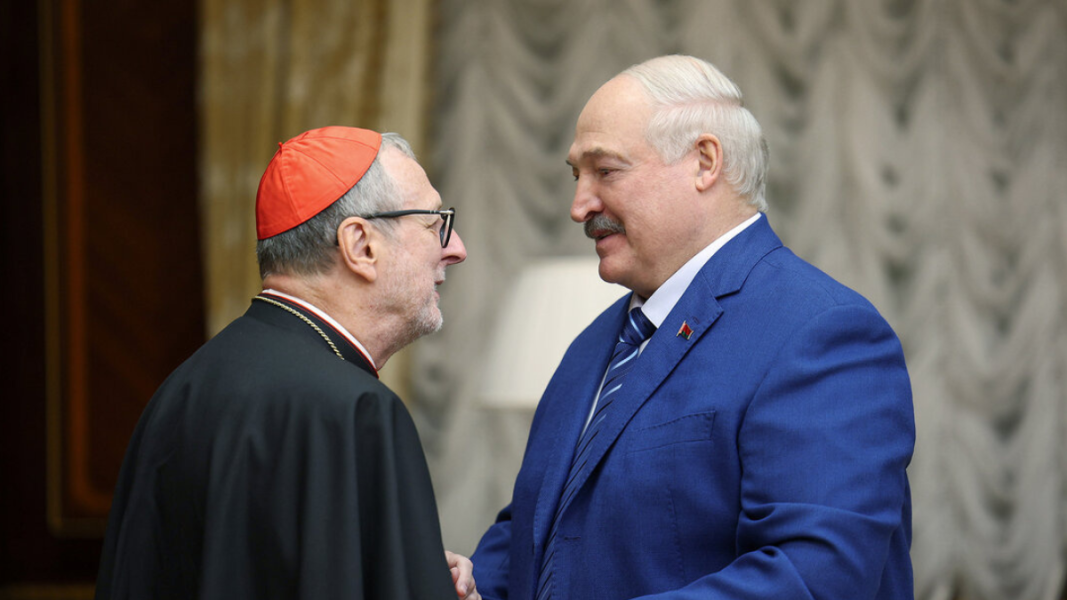
The Prefect of the Dicastery for the Eastern Churches, Cardinal Claudio Gugerotti, met on October 27 with the President of Belarus, Alexander Lukashenko, at the Independence Palace in Minsk, in a meeting that marks a new chapter in the delicate relations between the Holy See and the Belarusian regime, as reported by The Pillar.
Lukashenko himself, in power since 1994 and noted for his repression of the Catholic Church since 2020, expressed his desire to address “all the issues that have accumulated in our relations.” A video released by the state agency Belta showed a cordial atmosphere between the leader and the Italian cardinal.
The cardinal criticizes Belarus’s international isolation
After the meeting, Cardinal Gugerotti questioned the isolation policies imposed by the West, stating that “the isolation of peoples and countries is a suicidal policy that only causes harm.”
“All people of good will must cooperate to end the war,” he added, referring to the conflict in Ukraine, in which Belarus has been an ally of Moscow and a platform for operations since 2022.
The prefect also regretted that international sanctions “affect the population above all” and “do not contribute to dialogue or development.”
Formal invitation from the Belarusian episcopate to the Pope
Cardinal Gugerotti’s visit coincided with a period of intense contacts between the Holy See and Belarus. On October 16, Archbishop Iosif Staneuski of Minsk-Mohilev delivered to Pope León XIV an official invitation to visit the country, on the occasion of the 35th anniversary of the restoration of ecclesiastical structures after the fall of communism.
“The time has come for the Pope to visit the faithful of our homeland,” the prelate declared.
To date, no pontiff has visited Belarus, a nation with an Orthodox majority and a Catholic minority close to 15% of its 9 million inhabitants.
A visit marked by pastoral gestures
Cardinal Gugerotti, who was apostolic nuncio in Belarus between 2011 and 2015, returned to the country as the Pope’s special envoy for the centenary of the Diocese of Pinsk. During a Mass in the local cathedral on October 25, he conveyed the Pope’s affection and exhorted the faithful not to feel “isolated or forgotten by the world.”
“God loves everyone and desires that they live in joy. This desire comes to you from 1.4 billion Catholics,” he stated to the youth in Brest.
Repression and persistent tensions
Despite the diplomatic gestures, the Church in Belarus remains under pressure. In September, the Polish Carmelite Brother Grzegorz Gaweł, 27 years old, was arrested on suspicion of “espionage,” a charge that Warsaw called “absurd.” The Catholic journalist Ihar Losik was also released after five years in prison, as part of an exchange promoted by Washington.
Another priest, Father Henryk Okołotowicz, continues to serve a 11-year sentence for “high treason”. In a message disseminated from prison, he assured that he finds strength in the rosary and in the example of Cardinal Kazimierz Świątek, former archbishop of Minsk-Mohilev, who suffered a decade in Soviet camps.
Since the 2020 protests, Belarus has experienced systematic repression against dissidents and clergy, under the pretext of combating “extremism.” In that context, the then Archbishop Tadeusz Kondrusiewicz was prevented from returning to the country after traveling to Poland, a situation that was only resolved after the Vatican’s intervention.
A delicate diplomatic balance
Cardinal Gugerotti’s visit highlights the Vatican’s effort to keep dialogue open even with authoritarian regimes, in a context of international tensions and latent religious persecution. Although the Holy See’s diplomacy seeks to avoid isolation, the reality on the ground continues to show a Church monitored and limited in its pastoral freedom.