


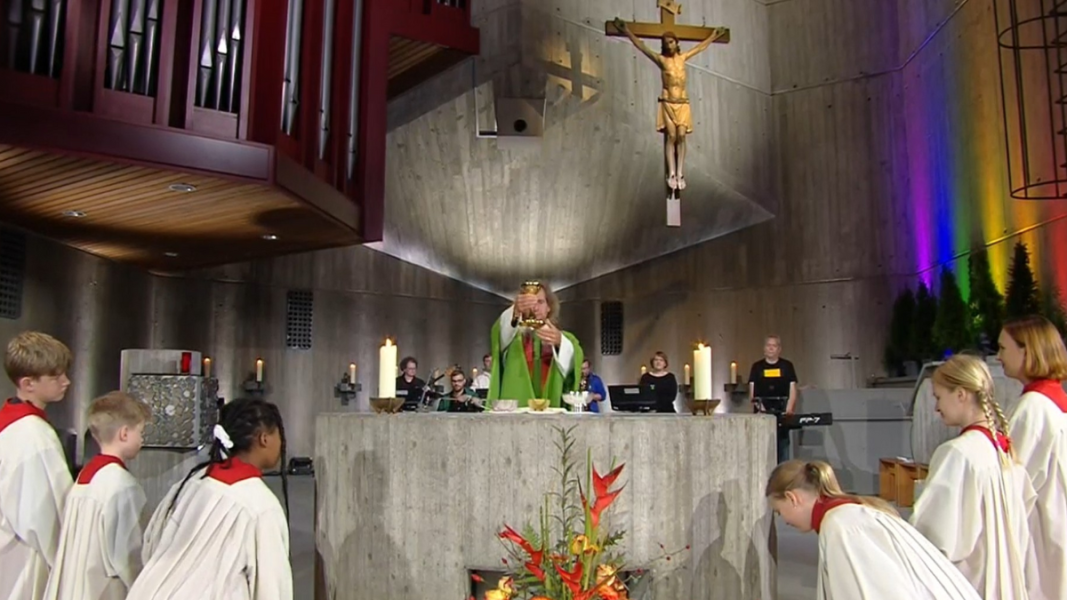
The German public television ZDF recently broadcast a celebration presented as “Catholic Queer Mass” —a “queer Catholic mass”— held in St. Lambert’s Church, in the Diocese of Münster. The event was presided over by Father Burkhard Hose, known for his activism in favor of the LGBTQ+ community within the Church. The liturgy was presented as a space of “inclusion” and “acceptance,” where sexual diversity was celebrated with rainbow candles and colored spotlights.
During the broadcast, testimonies from participants were included who claimed to “live their faith without renouncing their identity.” The program was announced as an example of a “Church open to all.”
The Drift of the German Synodal Way
This “queer mass” does not come out of nowhere. It is the fruit of a broader process within the German Church, marked by the Synodal Way, which for years has promoted the revision of sexual morality, priestly celibacy, and the hierarchical structure of the Church. Despite repeated warnings from Rome, several German bishops continue to approve practices that blur doctrine and sacramental discipline.
What began as a supposed pastoral dialogue has led to a laboratory of theological experiments. The liturgy, in this context, becomes a testing ground for new narratives, far from the spirit of worship and reverence that defines Catholic worship.
It Is Not Just a Local Episode
This event is a mirror of the spiritual moment the Church is experiencing: the temptation to replace redemption with self-celebration. In the face of it, the response must be one: return to Christ Eucharist, source of grace, truth, and hope.
Let us judge by the fruits: Does this liturgy bring men closer to God or leave them complacent in their own image? If the fruit is not conversion, worship, and holiness, it does not come from the Holy Spirit. In this time of confusion, maintaining fidelity to the liturgy and doctrine is not rigidity, but true love for the Body of Christ.
Doctrinal and Moral Confusion
The Church has always taught that every person, without exception, is called to conversion and to a life of grace. But that teaching cannot be confused with the approval of acts or lifestyles objectively contrary to the moral order. “Inclusive” liturgies that bless or celebrate habitual sin situations directly contradict the Gospel.
As St. Paul VI recalled, true charity does not consist in confirming man in his error, but in leading him toward the truth that liberates. Mercy cannot be separated from truth without becoming a caricature of itself. And a liturgy that eliminates the call to conversion ceases to be Catholic to become a political gesture.