


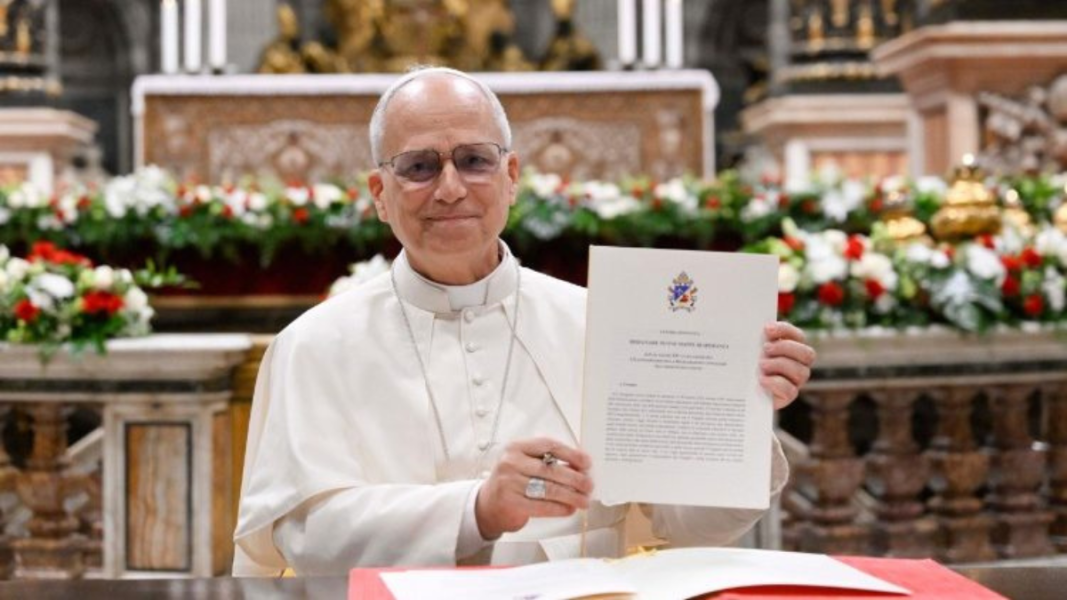
Education as the Church’s Mission
The text, extensive and carefully written, reminds us that education is not a secondary task, but the concrete way in which the Gospel becomes culture and relationship. Leo XIV claims a “cosmology of Christian paideia,” that is, an integral vision of education that unites faith and reason, thought and life, knowledge and justice.
In times of crisis and fragmentation, the Pope invites us to recover the roots of Christian pedagogy: the desire for truth, the discipline of the soul, and the search for the good. He evokes St. Augustine, the monks, the founders of teaching orders, and medieval universities as examples of a Church that knew how to teach while evangelizing.
A New Map for a Confused Time
The letter does not idealize the past: it starts from the diagnosis of an educational world that is “complex, digitalized, and confused,” where the transmission of meaning is diluted. In response, the Pope proposes “redrawing the maps of hope,” that is, offering orientation and clarity amid cultural disorientation.
The text recognizes the fruitfulness of Gravissimum Educationis, but points out the need to renew the educational mission in the face of the intellectual and moral poverty of our time. “The world is hungry for hope,” writes Leo XIV, recalling that educating is one of the highest expressions of Christian charity.
Continuity Without Rupture
In contrast to the expansive and symbolic style of the previous pontificate, Leo XIV adopts a pedagogy of depth. Where Francis spoke of openness and encounter, he speaks of formation, truth, and coherence. He does not deny the pastoral spirit, but subjects it to a more reflective and doctrinal structure.
This reformed continuity—a sort of hermeneutic of clarity—seeks to rebalance the Church’s educational discourse, restoring its intellectual and spiritual density without renouncing mercy or dialogue.
An Augustinian Heart
Leo XIV imprints on the text a strong Augustinian mark: educating is not just transmitting knowledge, but accompanying the soul in the search for interior truth. The authentic teacher— he says—does not impose, but awakens the desire for God and teaches how to read the signs of His presence in history.
This spirituality of the magisterium—more interior than institutional—can mark an epochal change in Catholic education: from pastoral activism to formative contemplation; from educational marketing to the integral formation of the heart and intelligence.
Relevance for Today
In a world that reduces education to mere technical training, Leo XIV revalues the Catholic school as a “laboratory of humanity.” He calls on educators to value teaching truth and beauty, even if the world does not understand them.
The letter thus becomes a compass for universities, congregations, and movements: a call to return to the sources of Christian thought, to teach from Christ, and to rebuild a culture that unites faith, reason, and hope.
A Pedagogy for the 21st Century
Disegnare nuove mappe di speranza is, in short, a programmatic text: it opens a stage in which the Church wants to think of education not as a social strategy, but as a spiritual vocation.
In times of cultural confusion, Leo XIV offers a path: educate from truth, form in freedom, teach with charity. Redraw the maps, yes, but without changing the north: Christ, teacher and hope of the world.
You can read the full Apostolic Letter «Disegnare nuove mappe di speranza» here