


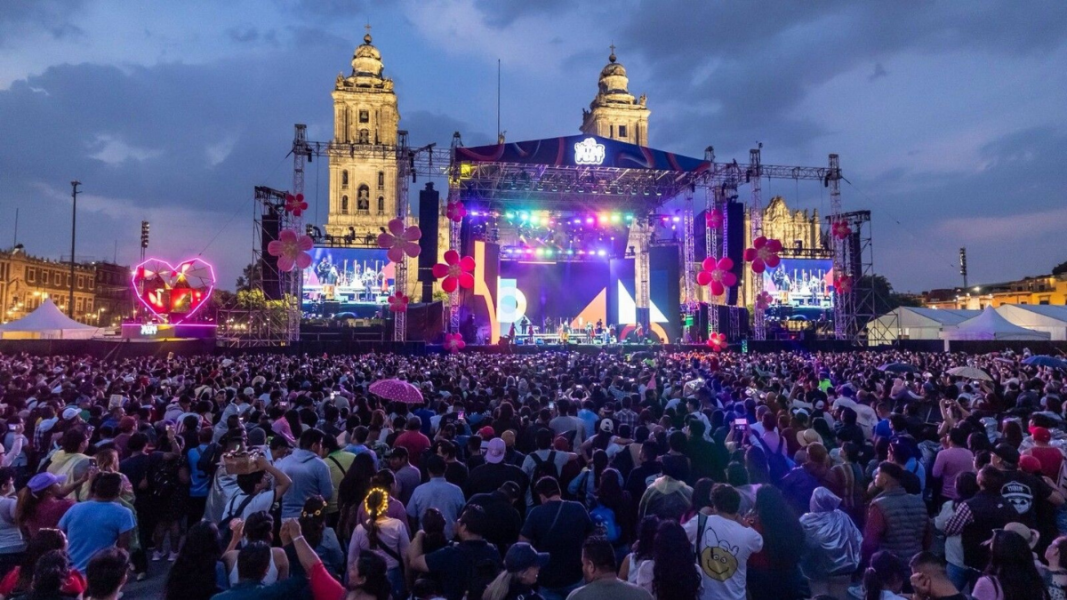
Rome once again became a stage for lights, screens, and youthful music with the Vitae Fest 2025, an event promoted by the Vitae Global Foundation and endorsed by the Vatican as part of the Jubilee 2025. The gathering, held on October 25 at the Parco Schuster, brought together thousands of young people under the motto “Don’t burn bridges, become one” (“Don’t burn bridges, become one”). In practice, a festival with a concert aesthetic and spiritual rhetoric, presented as the Church’s big bet to reach the so-called Generation Z.
Among the invited artists, Benji & Fede, Aka 7even, Settembre, Mimi, Lowrah, W1nk0, and the Brazilian priest DJ Padre Guilherme stood out, who animated the stage by mixing electronic music with messages about peace and unity. During the event, a “chain of hearts” —catena di cuori— was proposed as a symbol of union between people and cultures. The atmosphere was one of enthusiasm and celebration, closer to a summer concert than to a day of spiritual reflection.

The Gospel under the spotlights
The festival director summed it up with sincerity: “It’s a festival for young people, for Generation Z, those under 30. It’s the only festival focused on non-believers… In this polarized world, we want to propose a message of reconciliation”.
As he explained, the project was born in 2012 with a group of believers who sought “to put the message of Jesus in a language that non-believers could understand.” Before arriving in Rome, the Vitae Fest had already taken place in Mexico in May, and its organizers intend to take it to various countries.
The intention may seem noble, but the method raises serious questions. Does the Gospel need to be reinvented to be understood? Isn’t it enough to preach Christ clearly and without adornments?
The problem is not talking about Jesus on a stage: the problem is turning Him into part of the spectacle. The Catholic faith has always evangelized through beauty, but not through banality. It doesn’t need smoke, neon lights, or choreographies to touch the human heart. Christ did not call His own with electric guitars, but with the power of the truth that sets free.
The pastoral of spectacle
Since the macro-event “Grace for the World” in September, it seems that the Vatican has taken a liking to the formula: a big stage, renowned artists, generic messages about peace, inclusion, and fraternity. Everything carefully packaged with an international festival aesthetic.
But behind that display hides a disturbing confusion: evangelization is confused with religious marketing. The announcement of sin and redemption is replaced by emotional slogans. Catechesis is swapped for the show.

This is the new pastoral of spectacle, which seeks to be modern at all costs and measures its success in terms of audience and social media. But a Church that tries to compete with the world on its own turf —image, emotion, and novelty— is doomed to lose. Because its strength is not in visual impact, but in the silent power of Truth.
No need to reinvent the wheel
The Church does not need “new languages” to evangelize. What it needs is to trust again in the only language that converts: Jesus Christ Himself, the living and eternal Word.
Every attempt to “update” the Gospel message to make it more attractive ends up weakening its content. It seeks to adapt it to the tastes of the public, when in reality the human soul does not need entertainment: it needs salvation.
Instead of trying to reinvent the wheel, the Vatican would do well to remember that Truth does not go out of style. Truth —Christ— does not need scenery. A willing heart, a confessional, a reverent Mass, a clear and faithful homily are enough. That transforms lives. The other only entertains for a while.
The risk of emptying the message
The Vitae Fest 2025 was, without a doubt, a demonstration of good will. But also a worrying symptom of the cultural drift affecting the contemporary Church: the temptation to seem relevant at the cost of losing depth.
In the name of “reconciliation,” talk of repentance is avoided; in the name of “inclusion,” the call to conversion is silenced; in the name of “youth spirituality,” the Cross is replaced by choreography.
And so, little by little, what makes the Catholic faith unique is diluted: its ability to touch the soul, not with fireworks, but with grace.