



A new report from the Public Religion Research Institute (PRRI), titled “2024 PRRI Census of American Religion”, confirms a trend that has been consolidating for years: Christian identity in the United States continues to decline, while the number of people without religious affiliation steadily increases.
According to the study—based on a national survey of more than 40,000 adults—, 65% of Americans identify as Christian today. Although it remains a clear majority, it represents a decline from previous years, especially among young people. In contrast, those who declare themselves “without religion” or “unaffiliated” now reach 28%, the highest level recorded to date.
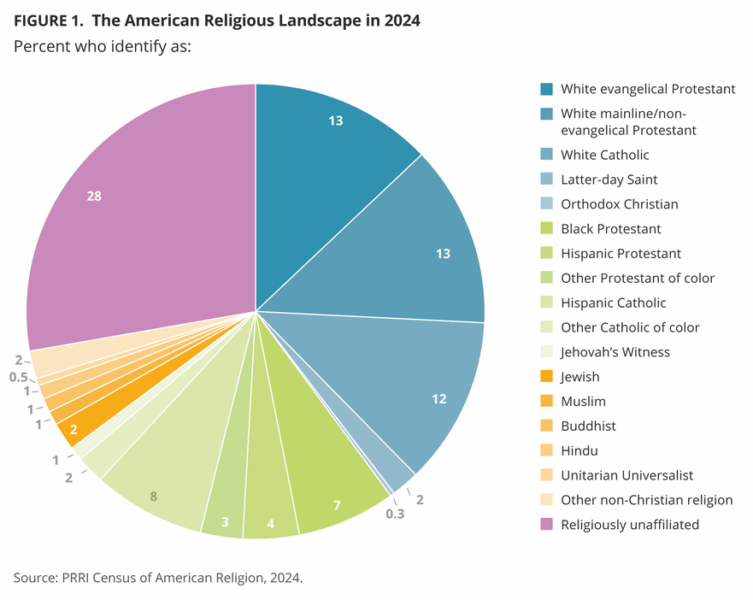
The Decline of White Christianity*
The report highlights that white Christians—a category that, according to the study*, groups non-Hispanic Catholics, Protestants, and evangelicals—have gone from 47% in 2013 to 40% in 2024. This reduction marks a historic shift in the country’s religious composition, where ethnic and cultural diversity is also reflected in the practice of faith.
Among Christians of color (African Americans, Hispanics, and Asians), the proportion remains more stable, hovering around 25%. Overall, the data indicate that Christianity remains the majority reference, but it is losing cohesion and social weight in the face of the expansion of secularism.
The “Nones,” the New Dominant Minority
The group of so-called nones—people who do not belong to any religious community—now approaches 30% of the population. In just one decade, this sector has gone from being a cultural minority to becoming one of the most influential social forces in the country.
Among young people aged 18 to 29, the phenomenon is even clearer: only 54% identify as Christian, while 38% say they have no religion. This generation, known for its distrust of traditional institutions, seems to be moving away not only from churches but also from any organized form of spirituality.
The PRRI notes, however, that this youth is not necessarily “atheist.” Many describe themselves as “spiritual but not religious,” which reflects an inner search disconnected from ecclesiastical structures.
Political Polarization and Faith
The study also shows a strong correlation between religious affiliation and political orientation. Among Republican voters, 84% identify as Christian; among Democrats, only 58%, and 34% declare themselves unaffiliated. In other words, religion remains a political and cultural marker in American public life.
This division poses an evident pastoral challenge: Christianity, especially in its most visible branch, runs the risk of being perceived not as a universal faith, but as a partisan flag.
Beyond the Statistics
The PRRI Religious Census does not only provide figures; it also hints at a profound change in the way Americans understand faith. Religion, once the axis of national identity, is increasingly relegated to the private or emotional realm.
Traditional churches—both Catholic and Protestant—face a generational transmission crisis: many parents continue to declare a Christian faith, but their children no longer assume or practice it.
For the Catholic Church, the challenge is twofold: to preserve doctrinal fidelity and, at the same time, offer a witness that does not depend on religious marketing or sentimentalism. The data confirm that, while some communities strive to “modernize” their message to attract young people, what is really lacking is conviction and coherence.
Faith or Spectacle: The True Crisis
The underlying diagnosis is not new, but it is becoming increasingly evident: the United States is experiencing a spiritual crisis more than an institutional one. The PRRI figures are merely the symptom of a deeper change—the loss of transcendent meaning—that no sociological strategy can reverse if the truth of the Gospel is not proclaimed with force again.
The so-called “Generation without religion” does not move away from faith out of boredom, but because it has not found credible witnesses. In a world saturated with stimuli and emptied of certainties, young people do not need a more “updated” Christianity, but a faith that convinces, that touches the soul, that shows the beauty of Truth.