


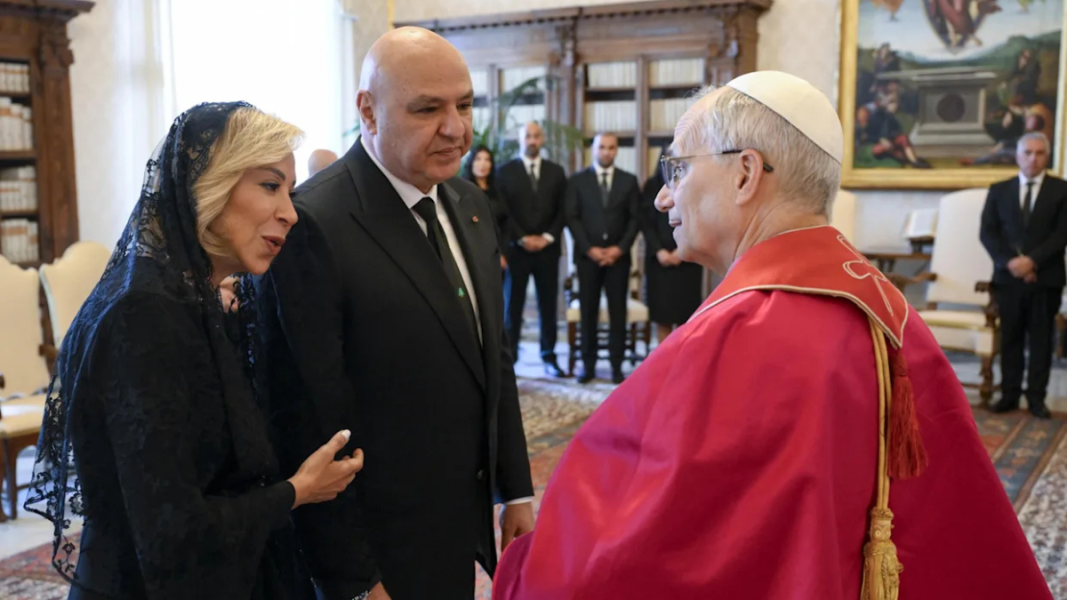
On Saturday, October 25, 2025, Pope León XIV received in a private audience at the Apostolic Palace in the Vatican the Prime Minister of Lebanon, Nawaf Salam, and the Deputy Prime Minister, Tarek Mitri, in an official visit focused on the political, social, and religious situation of the country and on the stability of the Middle East.
The day also had a strong spiritual significance: that same day the Church celebrated the solemnity of the Virgin Mary Queen of Palestine and the Holy Land, an invocation that invites prayer for peace in the region and the protection of the peoples who inhabit it.
A high-level meeting in an atmosphere of mutual respect
The meeting took place in an atmosphere of diplomatic cordiality and reciprocal trust. According to the Holy See Press Office, after the private audience with the Holy Father, the Lebanese leaders held a conversation with Cardinal Pietro Parolin, Secretary of State, and with Monsignor Paul Richard Gallagher, Secretary for Relations with States.
During the conversations, the good level of bilateral relations between the Holy See and Lebanon was emphasized, a country that the Church has always considered a point of encounter between East and West, between Christians and Muslims. Both parties expressed their common desire to promote national dialogue, religious coexistence, and economic reconstruction of the country, deeply affected by the financial crisis and political instability.
Lebanon, the Christian heart of the East
Lebanon, where Christians still make up nearly 30% of the population, is considered by the Holy See a pillar of Christianity in the Middle East. In recent years, the economic crisis, institutional corruption, and regional tensions have weakened national cohesion, causing the emigration of thousands of Christian families.
During the audience, Pope León XIV reaffirmed his closeness to the Lebanese people, encouraging political leaders to act with courage and a sense of the common good to preserve the country’s unique character. The Pontiff reiterated that “Lebanon is not just a country, but a message of coexistence and hope for the entire Middle East”.
A gesture of closeness: the announcement of the papal trip
During the meeting, it was officially confirmed that Pope León XIV will make an apostolic journey to Lebanon from November 30 to December 2, 2025, with the aim of “bringing a message of peace, hope, and unity” to all the communities of the country. The visit is framed within the 2025 Jubilee and will be the first by a Pontiff to the country since that of Francis in 2019.
Vatican diplomatic sources indicate that this trip seeks to reaffirm Lebanon’s role as a model of religious and cultural coexistence, in the midst of a region marked by prolonged conflicts and forced displacements.
The Virgin Mary, Queen of Palestine and the Holy Land
October 25, the day of the audience, coincided with the solemnity of the Virgin Mary Queen of Palestine and the Holy Land, instituted in 1927 by the Latin Patriarch of Jerusalem and approved by Pope Pius XI in 1933. The feast recalls the maternal protection of the Virgin over all the peoples of the Middle East and is a day of prayer for peace in the region.
In this spiritual context, the Pope’s meeting with the Lebanese leaders also had a prophetic dimension: to reaffirm that Vatican diplomacy is not limited to the political, but is rooted in faith and in the search for a peace founded on the Gospel.
A message of hope for the Middle East
At the end of the audience, the Vatican highlighted the common commitment to peace, justice, and coexistence between religions. The Pope reiterated his prayer for Lebanon and asked Christians around the world not to forget the Eastern communities, “witnesses of a faith that has resisted persecutions, wars, and poverty”.
The October 25 audience is part of a long tradition of constant attention from the Pope to the Middle East, and particularly to Lebanon, a country that the Vatican continues to consider key to the future of Christianity in the region.