


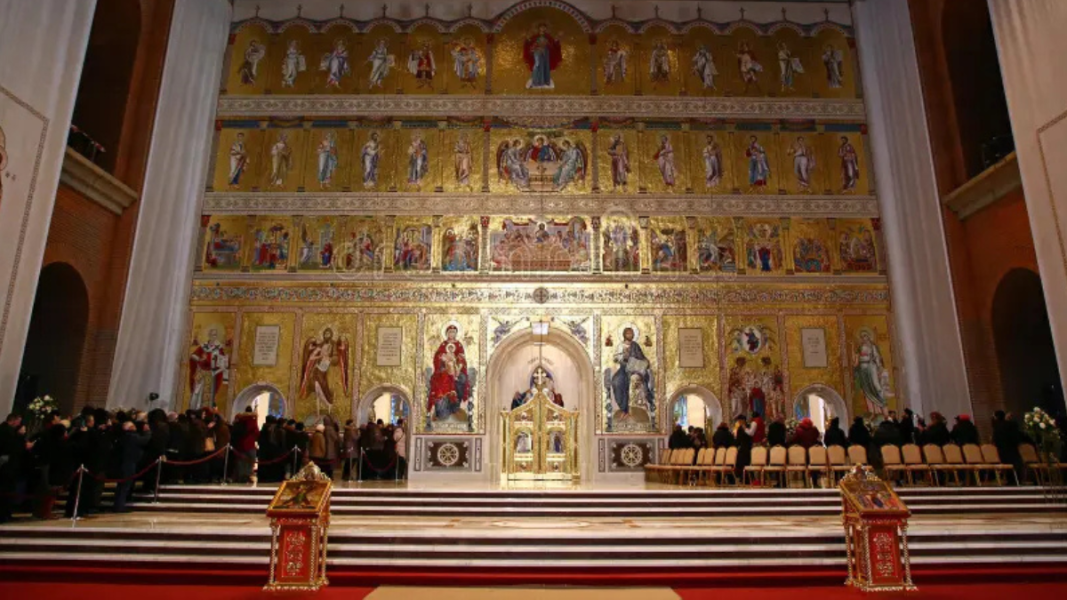
Thousands of faithful gathered on Sunday in Bucharest, capital of Romania, to participate in the consecration of the paintings and mosaics of the People’s Salvation Cathedral, also known as the National Cathedral, considered the largest Orthodox church in the world. The ceremony marked the culmination of fifteen years of construction and was experienced as a moment of national pride for this country with a deep Christian tradition.
The largest Orthodox cathedral in the world
According to data from the Romanian Orthodox Patriarchate, the People’s Salvation Cathedral is currently the largest Orthodox cathedral in the world. The building rises to more than 125 meters and has capacity for 5,000 faithful. Inside it is the largest iconostasis in the world, with 407 m², completely covered with golden icons and Byzantine-style mosaics. Its main bell, weighing 25 tons, is the largest in Europe.

The mosaics and frescoes, which cover more than 17,800 m², were created under the direction of the artist Daniel Codrescu, who explained that the project was a collaboration between the Church, art historians, and contemporary artists. “I hope that this church has a very important impact on society, because it is a public space,” he declared.
The ceremony was presided over by the Patriarch Daniel and attended by President Nicusor Dan, the Prime Minister Ilie Bolojan, and thousands of faithful who followed the liturgy from screens installed outside.
A project awaited for a century
The idea of a “national cathedral” emerged at the end of the 19th century, but the world wars and the communist dictatorship prevented its realization. Construction finally began in 2010, behind the Palace of the People, built by the communist dictator Nicolae Ceaușescu. The main altar was consecrated in 2018, and although the temple is operational, some works remain.
Romania, with about 19 million inhabitants, is one of the most religious countries in Europe: nearly 85% of the population identifies as Orthodox. The Church describes the new cathedral as a symbol of national and spiritual unity, a visible expression of the faith that survived communist persecution.
The relics of the Apostle Andrew
One of the most significant spiritual elements of the new temple is the presence of the relics of Saint Andrew the Apostle, spiritual patron of Romania. The relics—the fibula and patella of his right leg—were a gift from the Church in Italy, as a sign of communion between the Orthodox and Catholic Churches. The Patriarch Daniel blessed the reliquary on October 23 and announced that Saint Andrew will be the co-patron of the new cathedral.
Saint Andrew is venerated as the “Apostle of the Romanians,” for according to tradition he preached the Gospel in the region of Dobruja. His figure has historically been a point of union between national identity and Christian faith.
The gesture of Saint John Paul II and the remembrance of Pope Francis
During his visit to Romania in 1999, Saint John Paul II offered a donation of 200,000 dollars to Patriarch Teoctist, intended to support the cathedral project. Patriarch Daniel later acknowledged that the Polish pontiff was one of the main benefactors of the work, and explained that that sum was used for the manufacture of the bells, whose total cost amounted to half a million euros.
Twenty years later, in 2019, Pope Francis visited Romania and was received at the Orthodox Cathedral of Bucharest. In his speech, the pontiff highlighted the importance of common prayer and shared witness among Christians.
The People’s Salvation Cathedral is today a point of reference for world Orthodoxy: at the same time a space of worship, a historical testimony, and a monumental work of art.