


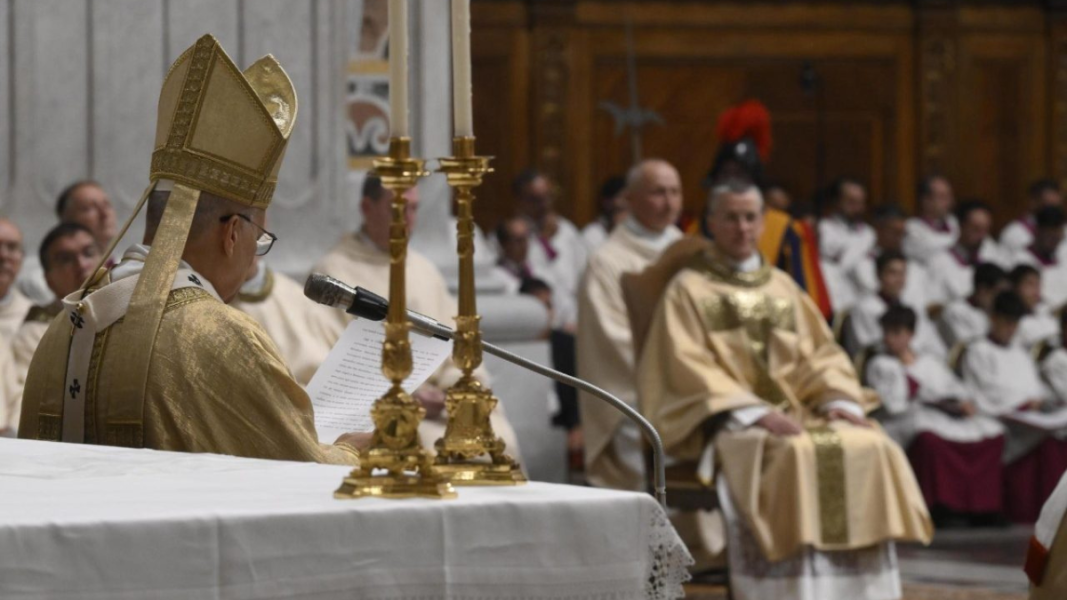
The bishop, sign of reconciliation and humility
Taking as a starting point the episcopal motto of the new nuncio —Gloria Deo, Pax Hominibus (“Glory to God and peace to men”)—, Leo XIV explained that the episcopal ministry consists in making God’s glory visible through peace and reconciliation. “It is the program of every Christian life,” affirmed the Pontiff, “to always seek that God’s glory shines in the peace among men.”
The Pope recalled that the vocation of the bishop is to continue Christ’s reconciling mission, bringing God’s mercy to souls and promoting the unity of the Church. “To make visible, with one’s own life, the praise of God and his desire to reconcile the world to himself,” he emphasized, quoting the Second Letter to the Corinthians (5,19).
Humility and service, foundations of the episcopate
Commenting on the Gospel of the day (Lk 18:9-14), the Holy Father contrasted the attitude of the Pharisee with that of the tax collector to recall that “it is not merits that justify man before God, but the contrite heart.” In that key, he exhorted bishops to avoid spiritual self-sufficiency and to live with interior humility: “Not the humility of words, but the one that dwells in the heart of the one who knows he is a servant, not a master; shepherd, not owner of the flock.”
Leo XIV described the bishop as a man of prayer and penance, who intercedes for his people from the truth of his smallness. His authority —he said— does not come from power, but from grace that manifests itself in meekness and fidelity.
The bishop, custodian and sower of hope
The Pope used a deeply symbolic image: the bishop as God’s farmer, called to sow with patience and to wait with hope. “From contact with the earth we learn that fruitfulness is born from waiting and fidelity,” he noted, explaining that the episcopal mission is not measured by visible results, but by constancy in service. “The bishop is a custodian, not an owner; a man of prayer, not of possession.”
Spiritual fruitfulness —he affirmed— is measured in terms of holiness and self-giving. “The Lord entrusts the bishop with a mission so that he may care for it with the same dedication with which the farmer cares for his field: every day, with faith and perseverance.”
Fidelity in the midst of trial
Inspired by the words of Saint Paul —“I have fought the good fight, I have kept the faith” (2 Tm 4:7)—, the Pope recalled that the life of the pastor is a continuous spiritual combat. “The true enemy is not others, but the temptations of discouragement, calculation, and pride,” he warned. For that reason, he insisted that fidelity is the virtue that sustains the ministry, a fidelity that does not seek success or recognition, but perseverance in duty and the truth of the Gospel.
Diplomacy as a witness of faith
Addressing the new apostolic nuncio, the Pope thanked him for his service in the Secretariat of State and in the pontifical representations, recalling that the diplomacy of the Holy See “is not based on human interests, but on the truth of the Gospel.” The nuncio, he said, is called to be “father, shepherd, and witness of hope” in a land marked by pain and the desire to be reborn. “The fidelity of the bishop —he added— is not that of one who seeks power, but of one who serves with respect, discretion, and professionalism illuminated by faith.”
Quoting Saint Paul VI and his apostolic letter Sollicitudo omnium Ecclesiarum, Leo XIV recalled that the nuncio represents the solicitude of the Successor of Peter for all the Churches, and that his main mission is to promote unity, dialogue, and peace.
The Church in Iraq: faith that resists persecution
The Pope evoked the apostolic roots of Christianity in Mesopotamia, where —according to tradition— Saint Thomas brought the Gospel after the destruction of the Temple of Jerusalem. “In that region, prayer is still offered in the language Jesus spoke: Aramaic,” he recalled, highlighting the heroic fidelity of the Christians of the East, whose faith has resisted violence and martyrdom.
In reference to Pope Francis’s visit to Iraq in 2021, Leo XIV placed his exhortation in continuity with recent magisterium, calling to continue “the path of fraternity and dialogue,” but always anchored in the truth of Christ. “The diplomacy of the Holy See is born of the Gospel and nourished by prayer,” he affirmed.
A call to pastors
In a final deeply spiritual tone, Leo XIV asked the new bishop to be “a man of communion and silence, of listening and dialogue,” and that in his gaze “the people recognize the peace of Christ.” He entrusted his mission to Mary, Queen of Peace, and to the saints of the ancient Eastern Church, wishing him that “God’s glory may illuminate his path and Christ’s peace may dwell where he sets his step.”
With this homily, the Pope offered an authentic catechesis on the episcopal ministry, reminding the whole Church that the bishop’s authority is not measured by his power or influence, but by his capacity to serve, pray, and love. “The bishop —he said— is above all a sign of reconciliation and a witness of hope.”
We leave below the full homily:
Dear brothers and sisters:
Today the Church of Rome rejoices together with the universal Church, exulting over the gift of a new bishop: Mons. Mirosław Stanisław Wachowski, son of Polish soil, titular archbishop elect of Villamagna di Proconsolare and apostolic nuncio to the dear people of Iraq.
The motto he has chosen —Gloria Deo Pax Hominibus— resonates like the echo of the angels’ Christmas song in Bethlehem: “Glory to God in the highest, and on earth peace to men whom he loves” (Lk 2:14). It is the program of an entire life: to always seek that God’s glory shines in the peace among men. This is the profound meaning of every Christian vocation and, in a particular way, of the episcopal vocation: to make visible, with one’s own life, the praise of God and his desire to reconcile the world to himself (cf. 2 Cor 5:19).
The Word of God that we have just proclaimed offers us some essential traits of the episcopal ministry. The Gospel (Lk 18:9-14) shows us two men who pray in the temple: a Pharisee and a tax collector. The first presents himself with confidence, enumerating his works; the second stays at the back, not daring to raise his eyes, and entrusts everything to a single invocation: “O God, have mercy on me, a sinner!” (v. 13). Jesus says that in reality it is he, the tax collector, who receives God’s grace and salvation, because “everyone who exalts himself will be humbled, and he who humbles himself will be exalted” (v. 14).
The prayer of the poor pierces the clouds —the Sirach reminds us—: God hears the plea of the one who entrusts himself totally to Him (cf. Sir 35:15-22).
This is the first lesson for every bishop: humility. Not a humility of words, but the one that dwells in the heart of the one who knows he is a servant, not a master; shepherd, not owner of the flock.
I am moved to think of your humble land, which in Mesopotamia has risen for centuries like incense toward God. It is the same land where Abraham was born, the father of obedience, who in silence and with faith said: “O God, have mercy on me, a sinner.” His prayer rises to heaven, and today the Church entrusts to that same silence and that same heart that, with confidence, pierce the clouds and touch the heart of God.
Dear Monsignor Mirosław, you come from a land of lakes and forests. In those landscapes, where silence is master, you learned to contemplate; among the snow and the sun, you acquired sobriety and strength; in a farming family, fidelity to the land and to work. The mornings that begin early taught you the discipline of the heart, and love for nature revealed to you the beauty of the Creator.
These roots are not just a memory to preserve, but a permanent school. In contact with the earth you learned that fruitfulness is born from waiting and fidelity: two words that also define the episcopal ministry. The bishop is called to sow with patience, to cultivate with respect, to wait with hope. He is a custodian, not an owner; a man of prayer, not of possession. The Lord entrusts you with a mission so that you may care for it with the same dedication with which the farmer cares for his field: every day, with constancy and faith.
At the same time, we have heard the apostle Paul, who looking at his own life says: “I have fought the good fight, I have finished the race, I have kept the faith” (2 Tm 4:7). His strength does not come from pride, but from gratitude, because the Lord has sustained him in labors and trials.
So also you, dear brother, who have walked a path of service to the Church in the Pontifical Representations in Senegal and in your Poland, in the International Organizations of Vienna and in the Secretariat of State, as a minutante and then subsecretary for Relations with States, have lived diplomacy as obedience to the truth of the Gospel, with discretion and competence, with respect and dedication, and for that I thank you.
Now the Lord asks you that this gift become pastoral paternity: to be father, shepherd, and witness of hope in a land marked by pain and the desire to be reborn. You are called to fight the good fight of faith, not against others, but against the temptation to tire, to enclose yourself, to measure results, always trusting in the fidelity that is your distinctive trait: the fidelity of the one who does not seek himself, but serves with professionalism, with respect, and with a simplicity that illuminates without ostentation.
Saint Paul VI, in the Apostolic Letter Sollicitudo omnium Ecclesiarum, recalls that the pontifical representative is a sign of the solicitude of the Successor of Peter for all the Churches. He is called to consolidate unity, to promote dialogue with civil and religious authorities, and to foster peace.
In Iraq, the land of your mission, this service assumes a special meaning. There the Catholic Church, in full communion with the Bishop of Rome, lives in diverse traditions: the Chaldean Church, with its Patriarch of Babylon of the Chaldeans and the Aramaic language of the liturgy; the Syro-Catholic, Armenian-Catholic, Greek-Catholic, and Latin Churches. It is a mosaic of rites, cultures, and histories of faith that asks to be welcomed and guarded in charity.
The Christian presence in Mesopotamia is very ancient: according to tradition, it was the apostle Saint Thomas who, after the destruction of the Temple of Jerusalem, brought the Gospel to that land; and it was his disciples Addai and Mari who founded the first communities. In that region, prayer is offered in the language Jesus spoke: Aramaic. This apostolic root is a sign of continuity that neither violence, manifested with ferocity in recent decades, has been able to extinguish. Even more, the voice of those who in those lands were brutally deprived of life has not been extinguished. Today they pray for you, for Iraq, for peace in the world.
For the first time in history, a Pontiff has traveled to Iraq. In March 2021, in fact, Pope Francis arrived there as a pilgrim of fraternity. In that land, where Abraham, our father in faith, heard God’s call, my predecessor recalled that “God, who created human beings equal in dignity and rights, calls us to spread love, benevolence, and concord.” Also in Iraq, the Catholic Church desires to be a friend to all and, through dialogue, to collaborate constructively with other religions for the cause of peace. (Francis, Address to the Authorities, Civil Society, and the Diplomatic Corps, March 5, 2021).
Today you are called to continue that path: to guard the shoots of hope, to foster peaceful coexistence, to show that the diplomacy of the Holy See is born of the Gospel and nourished by prayer.
Dear Monsignor Mirosław, always be a man of communion and silence, of listening and dialogue. Carry in your word the meekness that builds and in your gaze the peace that consoles. In Iraq, the people will recognize you not by what you say, but by how you love.
We entrust your mission to Mary, Queen of Peace, to the saints Thomas, Addai, and Mari, and to the many witnesses of faith in Iraq. May they accompany you and be light on your path.
And so, while the Church, in prayer, welcomes you into the College of Bishops, we pray together that God’s glory may illuminate your path and Christ’s peace may dwell there where you set your steps.
Gloria Deo, Pax Hominibus. Amen.