


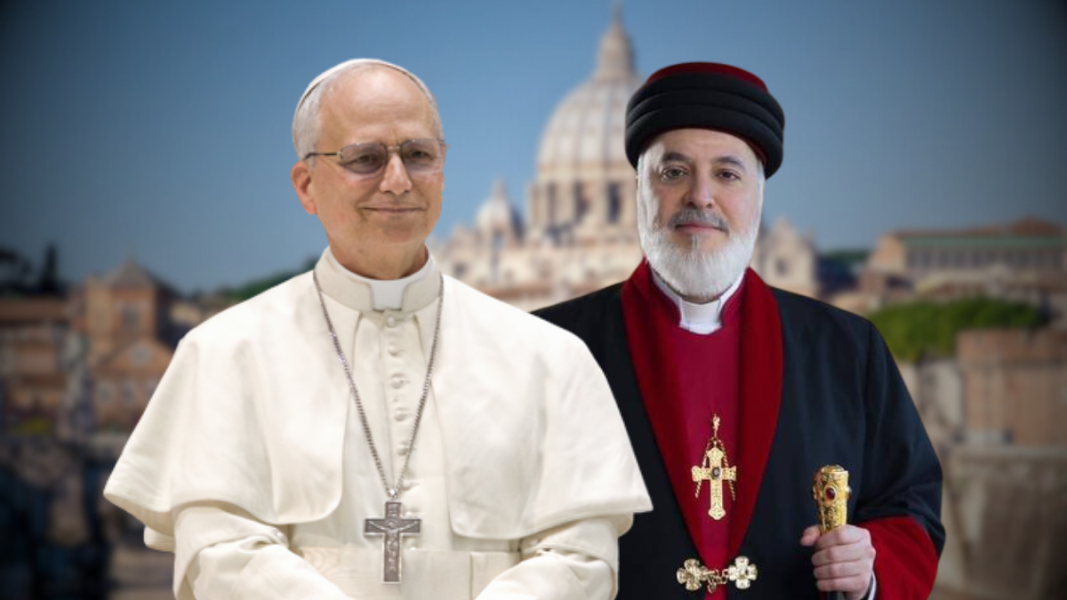
The Pope Leo XIV received this Monday October 27, 2025 in the Vatican His Holiness Mar Awa III, Catholicos-Patriarch of the Assyrian Church of the East, along with the members of the Mixed Commission for Theological Dialogue between the two Churches. The meeting is framed within a long ecumenical collaboration and aimed to strengthen the path toward full ecclesial communion.
A consolidated fraternal relationship
In his speech, the Holy Father expressed his joy at the patriarch’s visit and at the continuity of a dialogue that has borne visible fruits in recent decades. «I welcome you as brothers in Christ,» said the Pope, recalling that this meeting reaffirms the common will to walk together in faith. The Pontiff also thanked the theologians of the commission for their «valuable contribution and shared effort.»
Leo XIV emphasized that these encounters «are an expression of the love that already unites our Churches» and that theological dialogue and the dialogue of charity are «constitutive elements of the path toward unity.».
Thirty years of dialogue and visible fruits
The Pope recalled that the visit of Mar Awa III in 2024 marked the thirtieth anniversary of the official dialogue between the Catholic Church and the Assyrian Church of the East, initiated in 1994 with the Common Christological Declaration signed by St. John Paul II and Mar Dinkha IV. Since then, the dialogue has advanced toward mutual recognition of the sacraments and the possibility of a certain communicatio in sacris between the two Churches.
The Pope expressed his desire that the current phase of the dialogue, centered on the constitution of the Church, help deepen the understanding of ecclesial communion without implying «uniformity or domination,» but rather «exchange of gifts between our Churches.».
Unity, synodality, and the future of ecumenism
Leo XIV highlighted that the path of synodality constitutes today a promising path also for ecumenical dialogue. He quoted the words of Pope Francis during the visit of Mar Awa III to the Vatican in 2022: «The path of synodality undertaken by the Catholic Church is and must be ecumenical, just as the ecumenical path is synodal.»
The Pontiff expressed his hope that the 1700th anniversary of the Council of Nicaea, celebrated in 2025, will impel Christian Churches to «put into practice forms of ecumenical synodality» that promote the visible unity of the disciples of Christ.
Shared faith and the saints of the East
In the final part of his speech, the Pope evoked the figure of St. Isaac of Nineveh, monk and bishop of the Assyrian Church of the East, whose name was incorporated into the Roman Martyrology in 2024 as a sign of spiritual communion between the two traditions. «May his intercession strengthen the witness of Christians in the Middle East and hasten the day when we celebrate together the same Eucharistic sacrifice,» he affirmed.
We leave below the full message from Leo XIV:
Your Holiness,
dear friends in Christ:
«Grace and peace to you from God our Father and the Lord Jesus Christ» (Eph 1:2).
With these words of St. Paul, I welcome Your Holiness as a dear brother in Christ, and once again express my gratitude for your presence at the inauguration of my pontificate. I also extend my cordial greetings to the members of the Mixed Commission for Theological Dialogue between the Catholic Church and the Assyrian Church of the East.
These joint visits by the Catholicos-Patriarch of the Assyrian Church of the East, along with the members of the Commission, constitute a beautiful tradition established in recent years. They are a testimony that fraternal encounter and theological dialogue are constitutive elements of the path toward unity. The «dialogue of truth» is an expression of the love that already unites our Churches, while the «dialogue of charity» must also be understood theologically.
Your last visit, in 2024, marked the thirtieth anniversary of the official dialogue between our Churches. The progress achieved over these years has been significant, faithfully following the mandate and methodology established by our predecessors.
As stated in the Common Christological Declaration of 1994, signed by St. John Paul II and His Holiness Mar Dinkha IV, «for communion to be full and complete, unanimity is required regarding the content of the faith, the sacraments, and the constitution of the Church.»
This triptych provided the framework for the subsequent phases of our theological dialogue.
After reaching an agreement on Christological faith—thus resolving a controversy of more than 1,500 years—our dialogue advanced toward mutual recognition of the sacraments, allowing a certain communicatio in sacris between our Churches.
I wish to express my deep gratitude to each of you, the theologians of the Mixed Commission, for your valuable contributions and shared efforts, without which these doctrinal and pastoral agreements would not have been possible.
Regarding the constitution of the Church, which constitutes the current focus of the dialogue, the main challenge lies in developing a model of full communion inspired by the first millennium, responding faithfully to the challenges of our time.
As my predecessors have constantly repeated, communion must not imply domination, but promote the exchange of gifts between our Churches, received from the Holy Spirit for the building up of the Body of Christ (cf. Eph 4:12).
I look forward with interest to the fruits of your continued theological dialogue on this theme, carried out «together, of course,» as St. John Paul II fervently desired in his encyclical Ut Unum Sint (n. 95).
On this path toward full communion, synodality presents itself as a promising path.
During Your Holiness’s visit in 2022, Pope Francis coined an expression later included in the Final Document of the Synod on Synodality of the Catholic Church, where he stated:
«The path of synodality undertaken by the Catholic Church is and must be ecumenical, just as the ecumenical path is synodal.»
In the spirit of that Synod, I sincerely hope that the 1700th anniversary of the Council of Nicaea, which we will celebrate in 2025, will impel us to «put into practice forms of synodality among Christians of all traditions» and inspire us with a new «ecumenical synodal practice.»
May we continue this pilgrimage strengthened by the prayers of all the saints of our Churches, especially St. Isaac of Nineveh, whose name was added last year to the Roman Martyrology.
Through his intercession, may Christians in the Middle East always bear faithful witness to the Risen Christ, and may our dialogue hasten the blessed day when we celebrate together at the same altar, sharing the same Body and the same Blood of our Savior, «that the world may believe» (Jn 17:21).
United in prayer with our Savior, I now invite you to pray together the Lord’s Prayer:
Our Father…