


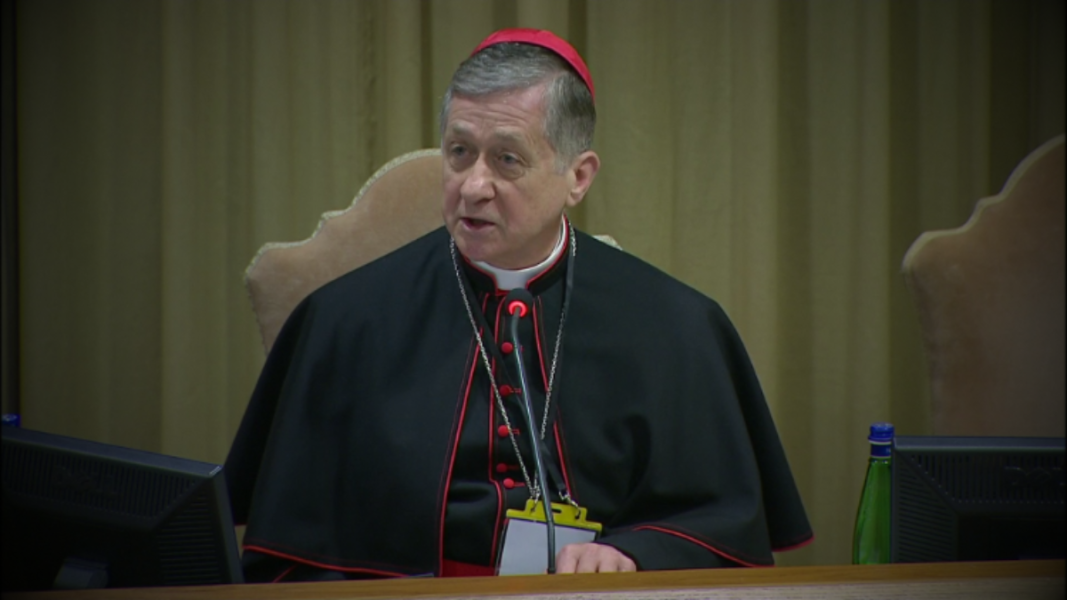
Cardinal Cupich has spoken again, and as always, he does so to explain to the faithful that the liturgy is not about God, but about the poor. His comment in Vatican News on the exhortation Dilexi te by Leo XIV is yet another demonstration of that modern disease that turns the altar into a sociological stage and the Eucharist into an instrument of moral engineering. Cupich says that the Second Vatican Council was a “milestone” in understanding the place of the poor in the Church, and that this awareness also inspired the liturgical reform. Translated: that the Mass should stop looking like worship of God and become an assembly among equals.
For him, the “noble simplicity” of Sacrosanctum Concilium consisted in shedding the signs of transcendence, the sacred language, silence, orientation toward the Lord. All that seems “spectacular” to him, because deep down he doesn’t believe that anything happens at the altar. And when one stops believing in the Real Presence, all that’s left is choreography. If Christ is not really there, if there is no sacrifice, if the altar is not Calvary, then the Mass becomes a charitable gathering, a symbolic gesture, a “project of solidarity with humanity,” as he himself says.
Cupich speaks of “purifying the liturgy of spectacular elements.” But what he calls spectacle is precisely what the Church has always called worship. The genuflection, the incense, the singing, the silence: everything that points toward God makes him uncomfortable because it reveals what he cannot bear to admit, that the Mass is a divine act, not a human one. In his theology, the poor displace Christ; in that of the Church, the poor are loved by Christ. It is a difference of faith, not of sensitivity.
That’s why he insists that the liturgy must be “a school of peace” and “a project of solidarity.” He doesn’t realize that he says this as a bishop with a chauffeur, surrounded by marble and microphones, while despising the silent piety of the faithful who pray the rosary and attend the rite that he would abolish if he could. His Church of the poor is that of satisfied clerics who live off pastoral sentimentalism and state subsidies.
No, Eminence: the Mass is not a school of coexistence, nor a workshop of social justice. The Mass is the Sacrifice of Christ, offered to the Father for the salvation of the world. And precisely because we believe in the Real Presence, because we know that Bread is God, poor and rich Catholics, wise and ignorant, kneel before Him. If Cupich and his ilk do not do so, it is not out of humility: it is because they do not believe there is anyone before whom to kneel.
The liturgy was not made to appear simple, but to be sacred. And the poverty that matters is not the sociological one, but that of the spirit, that of the publican who does not dare to lift his eyes to heaven. If Cupich truly believed that Christ is at the altar, he would not speak of “noble simplicity” but of holy fear. But it is easier to talk about the poor than about the Mystery.
That’s why his article is not a reflection, but an involuntary confession: the confession that he has lost faith in the Real Presence. Those of us who do believe that the Body of Christ is there will continue to worship on our knees, even if it seems too “spectacular” to Cupich.