


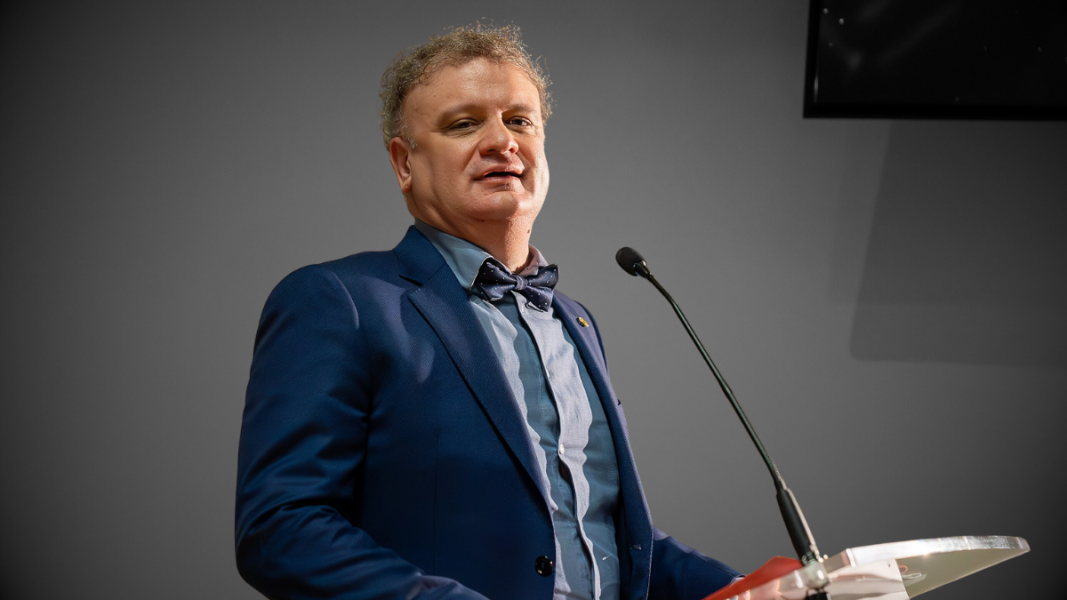
The Spanish thinker Miguel Ángel Quintana Paz believes that the Christian world cannot remain on the sidelines of the so-called “culture war,” that clash of ideas in which the future of Western civilization is at stake today. In an extensive interview granted to Aleteia, the philosopher warns that if the Catholic Church does not assume a more active role, the public space will be occupied by ideologies that deny reason, truth, and the transcendent meaning of the human being.
Professor of Ethics for more than a decade at the Universidad Europea Miguel de Cervantes, Quintana Paz will now direct the Instituto Superior de Sociología, Economía y Política (ISSEP) in Madrid, a leadership school that seeks to train new intellectual elites with a critical vision. His goal, he explains, is to “articulate and update the Christian legacy” amid a cultural climate that openly questions it.
“We have removed God from the center, and the world is wobbling”
The philosopher argues that the current crisis in the West is not only political or social, but deeply spiritual and intellectual. “What we are experiencing now is that, when we remove from the scene the rational God that sustained the Western project, it wobbles,” he states.
In his view, contemporary culture lives under the dominance of emotivism and relativism, where feelings replace reason and morality is diluted. “Today what matters is feeling good,” he notes. “Evil is conceived as something that can be eradicated, as if human perfection were achievable through empathy and education, and that is madness.”
In response, he proposes recovering forgotten categories such as forgiveness, love, and beauty, which he says are essential pillars of Christian thought. “The problem is that forgiveness has been eliminated, which is the basis of coexistence. Without forgiveness, redemption is not possible.”
Rite and community against individualism
Quintana Paz also emphasizes the importance of rite and communal life in the Catholic faith. He criticizes the loss of liturgical sense in today’s Catholicism and the modern obsession with “spontaneity.” “The rite is not something I do; it happens. It frees me from the ego,” he explains. “Today many believe that only the improvised is authentic, but that is false. The Mass has no practical value: it is valuable in itself.”
Against religion turned into emotivity or mere spectacle, he defends the rite as an antidote to the fatigue of the modern self. “We are tired of being subjects; we need spaces where we can be part of something bigger: a community, a whole.”
The cultural battle and the role of the Church
On the cultural level, Quintana Paz denounces that the Christian legacy is being expelled from the public space and replaced by ideological sentimentalism and “do-goodism”: a sweetened version of morality that eliminates effort, demand, and truth. “The Christian message has been dumbed down to bring it closer to the world,” he quotes, recalling words from the American bishop Robert Barron. “Do-goodism is not goodness; it is its caricature. And if the Church wants to defend true goodness, it must learn to distinguish them.”
The thinker calls for a more active presence of the Church in intellectual and educational life, including schools and media. “The Christian legacy is very powerful, but there need to be people who articulate it and update it,” he insists. “In the Church there are very cultured people, but locked away in their offices. Others, on the other hand, become superficial in their attempt to be popular. We need to find the middle ground.”
A warning to Catholics: “Nothing is assured”
For Quintana Paz, the Christian faith remains one of the last solid pillars of our civilization, but he warns that nothing guarantees its permanence. “It is profoundly evangelical to think that a time may come when we are just a handful of people,” he affirms. “But do we really want that? Do we want to renounce the missionary effort that built Europe?”
“It’s not about going back to the 13th century —says Quintana Paz—, but about taking seriously again what those who thought in the 13th century said.”