


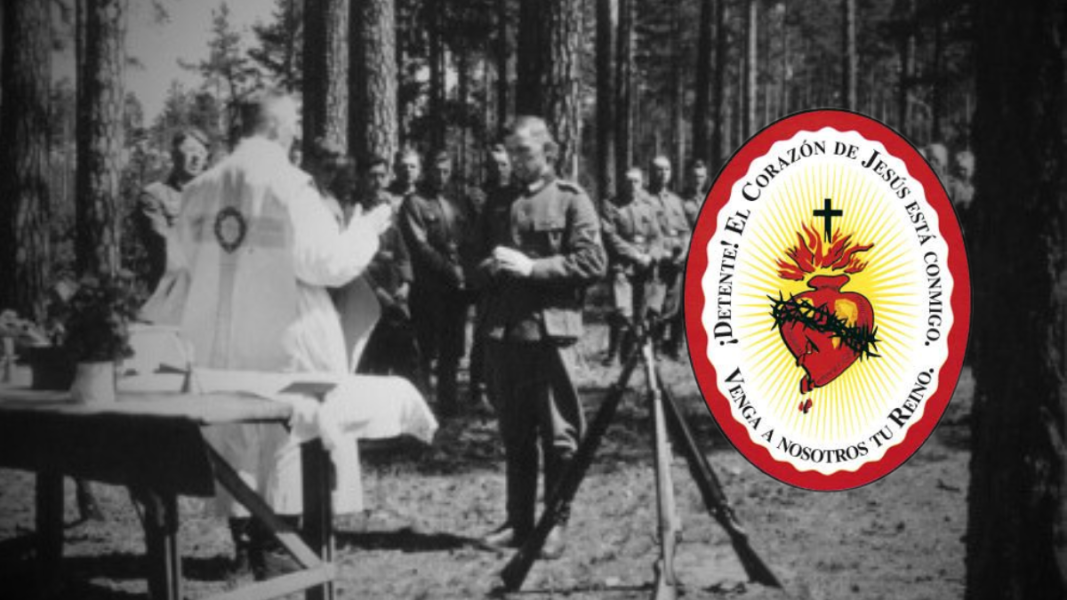
The bullet stopper —also known simply as detente— is a small badge or scapular with the image of the Sacred Heart of Jesus, usually accompanied by the inscription:
Stop! The Heart of Jesus is with me.
Its appearance can vary: embroidered on fabric, metallic, or printed, but its meaning is always the same: a visible expression of trust in the protection of Christ’s Heart, especially in moments of physical or spiritual danger.
Origin of the detente: a devotion born in the 18th century
The origin of the bullet stopper dates back to the 18th century, in the context of the spread of devotion to the Sacred Heart of Jesus, promoted by Saint Margaret Mary Alacoque after the revelations received in Paray-le-Monial (France).
It was the saint herself who began distributing small images of the Heart of Jesus with the phrase:
“Stop! The Heart of Jesus is with me, may your Kingdom come to us”.
The intention was not magical or superstitious, but spiritual and theological: it was about reminding the believer that those who sincerely trust in Christ have nothing to fear, neither sin, nor persecution, nor death.
The “bullet stopper” in Spanish history
The popular name bullet stopper became established during the Spanish War of Independence (1808-1814). Catholic soldiers began carrying these small scapulars sewn onto their uniforms or chests, as a sign of spiritual protection against the dangers of combat.
Over time, the detente was also adopted during other conflicts —especially in the Carlist Wars and in the Spanish Crusade of 1936-1939—, where thousands of combatants carried it convinced that the Heart of Jesus sheltered them.
During the Civil War, there are countless testimonies from soldiers, religious, and laity who attributed their survival to carrying a detente. In many cases, bullets became embedded in the scapular or medallion without penetrating the body, which was interpreted as a miraculous protection. Post-war Catholic press collected dozens of these accounts, in which the detente was not presented as an amulet, but as a visible sign of faith and consecration to the Sacred Heart, in an era when that faith was tested by blood and fire.
Spiritual meaning: the Heart that stops evil
The bullet stopper is not a talisman or a superstitious object. The Church considers it an external expression of an interior devotion. Its effectiveness does not depend on the piece of fabric, but on the living faith and love for the Heart of Jesus.
The verb “stop” is not directed at the bullet or the danger, but at evil itself:
“Stop, enemy of the soul! The Heart of Jesus is with me”.
It is, therefore, a sign of personal consecration and filial trust in Christ, which recalls the words of the Gospel:
“Do not fear those who kill the body but cannot kill the soul” (Mt 10:28).
Iconography and dissemination
The classic design of the detente depicts the Sacred Heart of Jesus surrounded by flames, crowned with thorns and with the cross at the top. At the bottom or on the reverse side is the characteristic invocation.
In many Spanish and Latin American Catholic families, especially during the 19th century and the first half of the 20th, it was customary to place a detente on the door of the house or in the children’s cradle, as a sign of protection and blessing.
Even today, the tradition of gifting a detente to soldiers, police, or people facing risks is preserved, as a gesture of faith in divine providence.
Theological teaching and current relevance of this devotion
The bullet stopper reminds us that Christianity does not promise immunity from suffering, but companionship amid danger. It is a tangible sign of the motto that Pope Leo XIII consecrated to the world in 1899:
“The Heart of Jesus will reign”.
In times of secularism and fear, the detente retains a surprisingly symbolic power. It is a simple but powerful affirmation:
Christ is the center, his love is the shield, and his Heart, a sure refuge.
Carrying a bullet stopper is not a matter of ancient custom or popular superstition, but of faith and memory. It is a permanent reminder that the Heart of Jesus is present in the daily battle, whether external or internal.