


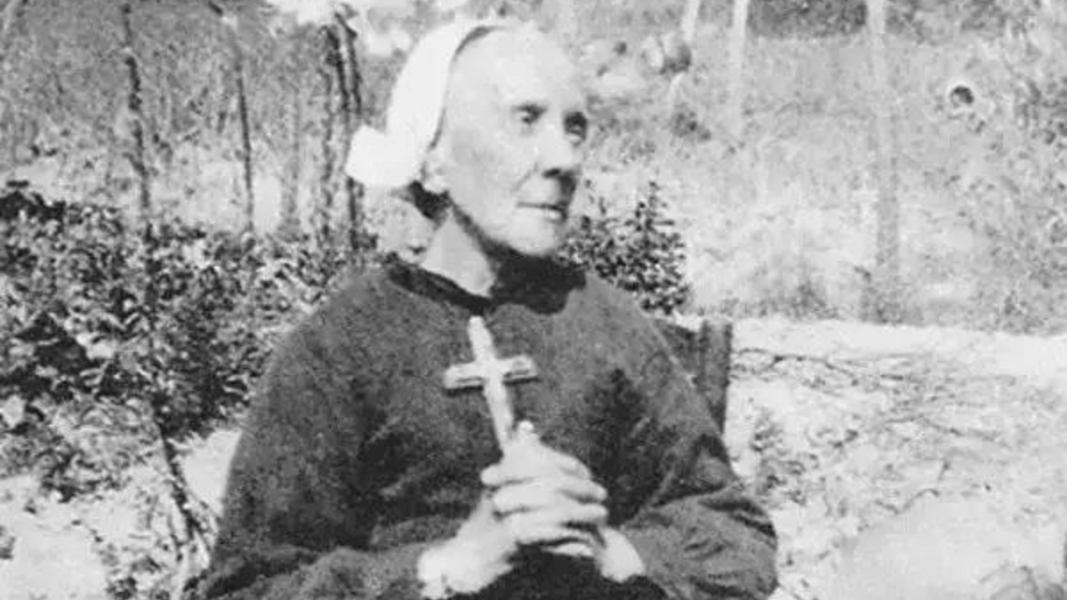
In times of doctrinal confusion and ecclesial crisis, the words of those who, long before us, seemed to foresee what we now witness with our own eyes resurface with force. One of those privileged souls was Marie-Julie Jahenny, a Breton mystic born in 1850 and died in 1941, considered by many as the great prophetess of France.
Educated in the living faith of the Breton people, she entered the Franciscan Third Order at a very young age and offered her life in reparation for the sins of the world. At twenty-three years old, she received the stigmata of Christ, which she would keep until her death, along with other signs of redemptive suffering: the wounds of the crown of thorns, the marks on her shoulders, and the wounds of the scourging. For decades, according to multiple medical testimonies, she survived solely on the Holy Eucharist.
Marie-Julie was also a prophetic voice. She accurately announced the two world wars, the election of St. Pius X, the persecution of the Church, and the punishments that France would suffer for its apostasy. But her gaze did not stop at her century: she delved, with chilling precision, into what seem to be our days.
The warning: a darkened Church
Among her most famous visions is the dialogue between Christ and Lucifer, in which the enemy declares his purpose: to attack the Church, topple the cross, and promote the denial of the Catholic religion. St. Michael the Archangel revealed to her that “Satan will take possession of all earthly things for some time” and that “all benevolence, faith, and true religion will be buried as in a tomb.”
The French mystic describes a spiritual and doctrinal darkness that would cover the world, leaving the faith almost erased and even the faithful confused. But she also adds the promise of final victory: after the apparent triumph of evil, Christ will gather his scattered sheep and make the humiliated Church rise again.
The prophecy of the “new ritual”
On November 27, 1902, and May 10, 1904, Marie-Julie claimed to have received from Heaven a revelation about a “new Mass”. According to her words, the enemies of the faith “are working to structure, under the influence of the enemy of souls, a new Mass that contains concepts hateful to my designs.”
She was shown a time when many priests would celebrate “without Me,” while others, faithful, would resist. She even prophesied that a Pope would try to rectify at the last moment, but would not be obeyed: bishops and clergy would demand greater “freedom” until reaching open rebellion. Then, she wrote, “a horrible religion will replace the Catholic religion.”
Her words about the liturgy are especially striking: she spoke of “new dispensers of new sacraments”, “new baptism,” and “new religious orders” created by Satan. What seemed impossible at the beginning of the 20th century today is perceived as a warning about the liturgical and doctrinal self-demolition that the Church is suffering.
The martyrdom of the Pope
“I see white birds carrying in their beaks shreds of his flesh dripping with blood… I see the hands of Peter pierced by nails like those of God… I see his garments turned into claws…”
Thus she described, in an ecstasy on November 4, 1880, the suffering of the Pope as a reflection of the martyrdom of the Church itself: torn from within and abandoned by many of its children.
The three days of darkness
Along with Anna Maria Taigi and Padre Pio of Pietrelcina, Marie-Julie spoke of the famous three days of darkness: a physical and spiritual catastrophe during which “the demons will be unleashed and will execute all the enemies of Christ.”
According to her vision, the darkness will cover the world on Thursday, Friday, and Saturday—days of the Most Holy Sacrament, of the Holy Cross, and of the Virgin Mary—and only blessed beeswax candles will give light. No one should look outside or open windows. “The sky will catch fire, the earth will tremble, and the seas will rise,” she wrote. Three-quarters of humanity will perish, and only those who have remained faithful will proclaim the glory of the Cross afterward.
A message for today
More than a century after her revelations, the words of Marie-Julie Jahenny seem to resonate with new force. Doctrinal confusion, liturgical profanation, the lukewarmness of the clergy, and the mockery of the sacraments seem to have reached their peak.
And yet, her prophecies are not an announcement of despair, but of purification: after the night will come the dawn, and the Church, hidden and humiliated, will rise purified so that Christ may reign again. Perhaps it is time to turn our eyes to the prophets who warned us not to frighten us, but to call us to conversion and fidelity.