


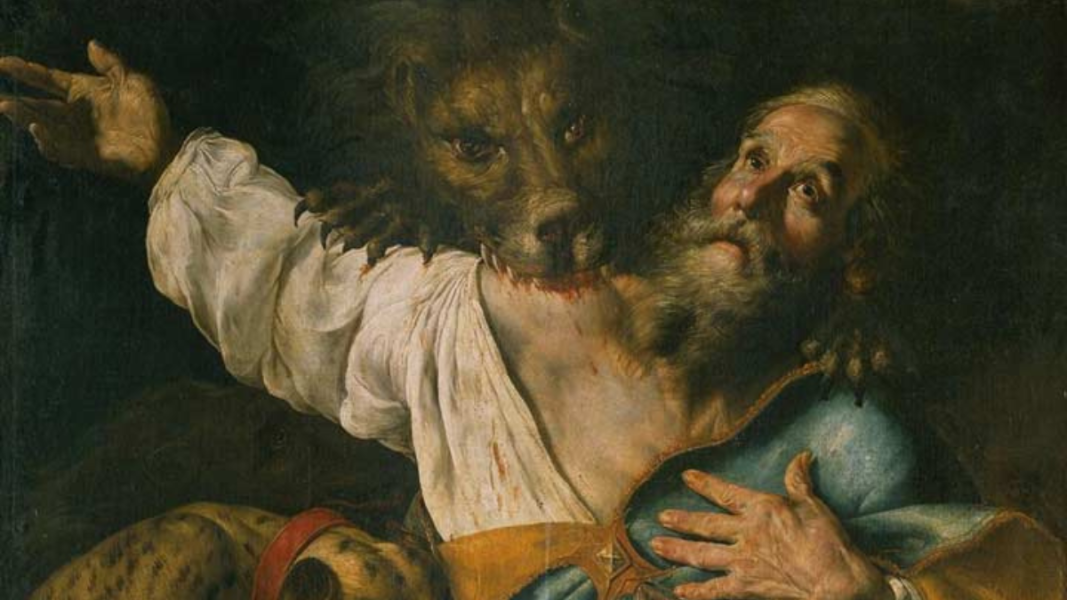
The story of Saint Ignatius of Antioch —bishop, martyr, and one of the most venerated Apostolic Fathers of the early Church— is wrapped in the grandeur of the first witnesses to the Gospel. However, an ancient and pious tradition holds an even more endearing detail: that Ignatius was one of the children who personally knew Jesus, and that he would have been the very one whom the Lord placed in the midst of the apostles when He said to them:
“Truly I tell you, unless you change and become like little children, you will never enter the kingdom of heaven” (Mt 18:3).
A tradition from the early centuries
This identification comes from some testimonies of the early Fathers and ancient hagiographic compilations that gathered oral traditions preserved in Antioch and Jerusalem. According to these accounts, Ignatius was originally from Syria and would have been presented before Jesus when he was a young child. The Lord, according to the evangelical scene, took the child, placed him in the midst of His disciples, and taught them humility as the path to the Kingdom of God.
The tradition holds that that child would have been Ignatius, who later became bishop of Antioch, second successor to Saint Peter in that see, and one of the great witnesses of primitive Christianity. Although the identification cannot be historically verified, the Fathers of the Church recognized in it a profound spiritual truth: that Ignatius, a direct disciple of the apostles, embodied in his adult life the same humility and filial trust that Christ taught that day.
From child in the arms of Christ to martyr in the Colosseum
Saint Ignatius was a disciple of the apostle Saint John, and possibly also knew Saint Peter and Saint Paul. During his episcopate in Antioch, he firmly defended the apostolic faith against the first heresies and wrote seven letters of the highest theological value, in which the expression “Catholic Church” appears for the first time to designate the universal community of believers.
Arrested under Emperor Trajan, he was condemned to die in Rome, devoured by wild beasts in the Colosseum around the year 107. During his journey to martyrdom, he wrote his famous epistles to the communities of Asia Minor and Rome. In them is reflected the ardor of one who longed to unite fully with Christ:
“I am God’s wheat, and I am to be ground by the teeth of wild beasts, so that I may become the pure bread of Christ” (Letter to the Romans, IV).
Thus, the image of the child in the arms of Jesus is fulfilled in the martyr who gives his life with total abandonment, like a trusting child who returns to the Father’s bosom.
The symbol of humility made testimony
The tradition that identifies Ignatius with the child of the Gospel does not claim to be a literal biography, but a spiritual lesson: faith matures only if it preserves the humility of the soul that knows it is loved and dependent on God. Saint Ignatius, who knew Christ through the preaching of the apostles and sealed his faith with his blood, represents the living continuity between the Gospel and the Church: from the child who was an example of simplicity to the bishop who offered himself as a witness to Love.
The Eastern Church venerates him with the title of Theophoros —“God-bearer”—, a name that, according to some commentators, alludes to that moment when Jesus took him in His arms. He was not only carried by Christ in his childhood, but in his maturity he carried Christ in his heart until martyrdom.
A message for Christians today
In a time when faith is measured by power or influence, the figure of Saint Ignatius of Antioch invites us to recover the simplicity of the Gospel: the humility that trusts, the love that does not impose itself, and the obedience that bears fruit in holiness.
The tradition that links him to that child of the Gospel is not an unimportant pious detail; it is a living metaphor of what Christ expects from every believer: that the maturity of faith never erase the purity of the heart.