


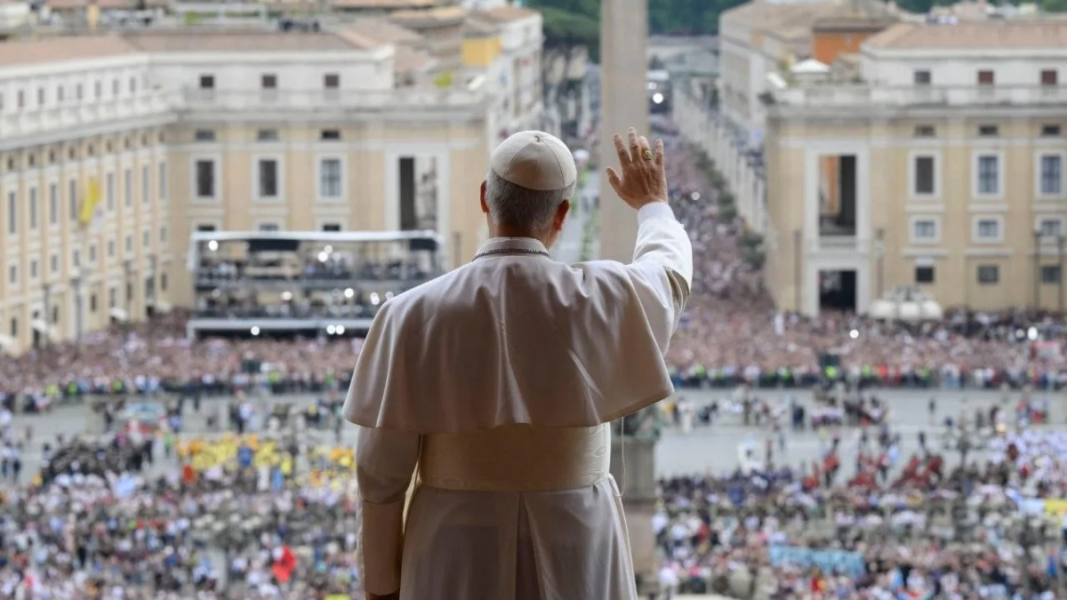
In his Angelus message this Sunday, October 26, 2025, Pope Leo XIV reflected on the parable of the Pharisee and the tax collector (Lk 18:9-14), inviting the faithful to cultivate humility, sincerity, and trust in God’s mercy. The Holy Father emphasized that it is not through personal merits that man is justified before the Lord, but through the attitude of a contrite heart that seeks forgiveness and grace. He also asked to pray for the victims of wars and a recent flood in Mexico, reminding that the Kingdom of God belongs to the humble and not to the proud.
Full Angelus Message of Leo XIV
St. Peter’s Square — Sunday, October 26, 2025
Dear brothers and sisters, good Sunday!
Today’s Gospel (cf. Lk 18:9-14) presents us with two characters, a Pharisee and a tax collector, who pray in the Temple.
The first boasts of a long list of merits. The good works he performs are many, and for that reason he feels superior to others, whom he judges with contempt. He stands with his head held high. His attitude is clearly presumptuous: it denotes an exact observance of the Law, yes, but poor in love, made of “having” and “possessing,” of debts and credits, lacking in mercy.
The tax collector is also praying, but in a very different way. He has much for which to ask forgiveness: he is a tax collector in the service of the Roman Empire who works under a public contract, which allows him to speculate on revenues to the detriment of his own compatriots. However, at the end of the parable, Jesus tells us that, of the two, it is precisely he who goes home “justified,” that is, forgiven and renewed by the encounter with God. Why?
First of all, the tax collector has the courage and humility to present himself before God. He does not shut himself up in his world, he does not resign himself to the evil he has done. He leaves the places where he is feared, secure, protected by the power he exercises over others. He goes to the temple alone, without an escort, even at the cost of facing harsh looks and severe judgments, and he places himself before the Lord, at the back, with his head bowed down, uttering a few words: “God, have mercy on me, a sinner!” (v. 13).
Thus, Jesus gives us a powerful message: it is not by flaunting our merits that we are saved, nor by hiding our mistakes, but by presenting ourselves honestly, as we are, before God, before ourselves and before others, asking for forgiveness and trusting in the Lord’s grace.
In commenting on this episode, St. Augustine compares the Pharisee to a sick person who, out of shame or pride, hides his wounds from the doctor, and the tax collector to another who, with humility and wisdom, shows the doctor his wounds because he wants them to be healed. And he concludes: “It is not strange, then, that the tax collector left more healed, who did not hesitate to show what hurt him” (Sermon 351,1).
Dear brothers and sisters, let us do the same. Let us not be afraid to acknowledge our mistakes, weaknesses, and sins, placing them before the Lord and entrusting them to God’s mercy. In this way, His Kingdom can grow in us and around us, which belongs not to the proud but to the humble, and which is cultivated, in prayer and in life, through honesty, forgiveness, and gratitude.
Let us ask Mary, model of holiness, to help us grow in these virtues.
Words after the Angelus
Dear brothers and sisters:
I wish to express my closeness to the populations of eastern Mexico, who have been affected in recent days by a flood. I pray for the families and for all those who suffer because of this calamity, and I entrust to the Lord, through the intercession of the Holy Virgin, the souls of the deceased.
We continue to pray insistently for peace, particularly through the communal recitation of the holy Rosary. Contemplating the mysteries of Christ together with the Virgin Mary, we make our own the suffering and hope of children, mothers, fathers, and the elderly who are victims of wars. From this prayer of the heart arise many gestures of evangelical charity, of concrete closeness, of solidarity. To all those who, every day, with confident perseverance, carry forward this commitment, I repeat: “Blessed are the peacemakers.”
I extend a greeting to all of you, Romans and pilgrims who have come from Italy and many parts of the world, in particular those from Logroño in Spain, San Pedro de Paraguay, Recreio (Brazil), and the Cubans residing in Europe.
I also greet the faithful from Ginosa, Genoa, Corato, Fornovo San Giovanni, Milan, San Giovanni Ilarione, Porto Legnago, the young people from Scicli, and those who have received the sacrament of confirmation in the Diocese of Saluzzo, the Reparatrix Sisters of the Sacred Heart, the Communion and Liberation group from Pavia, and the Polyphonic Choir of Milazzo.
Thank you all and have a happy Sunday.