


By Dominic V. Cassella
In Herodotus’s Histories, written in the 430s B.C., we read about a wise Greek philosopher and political thinker, Solon. While traveling, Solon met the king of Lydia, Croesus, known for his immense wealth. Croesus asked the philosopher what he thought of his great riches and whether such abundance meant that he, Croesus, was the happiest man in the world.
To this, Solon replied that one can «not call any man happy until he has died».
Solon’s point is that as long as someone is alive, even if they may be happy today, fortunes change, and bad decisions are made that can lead to the downfall even of the most prosperous and powerful.
Now we must ask ourselves: Was Solon right? Can we only call the dead happy?
To this, the Christian responds «yes». It only depends on how one is dead. Because if you are dead to sin (Romans 6:11; 1 Peter 2:24), having been crucified with Christ (Galatians 2:20), then your true life is hidden with Christ in God (Colossians 3:3). This is so because, if we die with Christ, «we will also live with Him» (2 Timothy 2:11), and in this life in Christ we find true happiness.
But what does all this mean concretely? How can we live this new life in Christ? And what does it mean to take up the Cross (Matthew 16:24; Mark 8:34; Luke 9:23) and be crucified with Him?
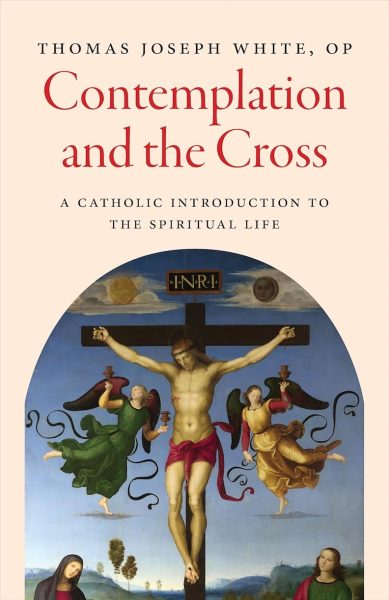
In the new book by Fr. Thomas Joseph White, Contemplation and the Cross: A Catholic Introduction to the Spiritual Life, we are offered a complete answer to these questions. Originally conceived as a spiritual retreat for a Catholic religious order, Contemplation and the Cross also serves as a sequel to an earlier work by the same author, The Light of Christ: An Introduction to Catholicism (reviewed by Robert Royal here).
In this new book, the same clarity and depth as in the previous one are present. Fr. White—Dominican and currently Rector Magnificus of the Pontifical University of St. Thomas (Angelicum) in Rome—has written with the express purpose of offering the reader two distinct resources, evident in the body of the text and in the notes. It is a book that can be read both for its luminous exposition of the Catholic tradition and consulted for its rich references to authors like St. Thomas Aquinas, the Fathers and Doctors of the Church, and modern magisterial texts.
Each chapter identifies and explores a “cause” of Catholic spiritual life. The first and efficient cause of spiritual life is God Himself. Therefore, the first chapter begins with the “final cause”, the “why” or “end” of spiritual life. In this unusual opening, we immediately see the difference that contemplating things in the light of Christ makes.
Man, by nature, gropes in shadows while seeking the truth. In the Old Testament covenant, the Law served as a railing to prevent God’s chosen people from clinging to what is self-destructive. With the arrival of the Light, who is Jesus Christ, we are no longer in darkness, but «grace and truth» has been offered to us (John 1:16-17; 17:17).
But what is this spiritual life and what are the means by which we live it? Here we find the relevance of the Cross, which as the new tree of our redemption, repairs the damage caused by the ancient tree in the Fall. By emptying Himself, the Son of God has assumed the poverty and servitude of human nature and has become obedient «even to death on a cross» (Philippians 2:7-8). It is through His incarnation and crucifixion that He redraws “the lines of our humanity from within and reorients us toward God again”.
The Cross, then, is where we find the perfect model of obedience to God. By contemplating Christ crucified, we find in Him the example of the virtues of justice. And in Mary, His Mother, we see the example of what it means to live with one’s gaze fixed on the Cross. In grace and truth we possess the means by which we unite ourselves to Christ and become recipients and servants of divine mercy.
The central axis of Fr. White’s book is the fact that everything we are comes from God, and everything we are returns to God. Everything is in His hands, we owe everything to Him, and we depend on Him for everything. Taking note of this truth is especially timely today, when every day politicians and publicists, like Croesus before them, tell us that our exaltation is in the creature and not in the Creator. Everywhere we are being persuaded that human devices—the Government, “Science,” this or that product—are the true means of our fulfillment, and that we do not need God to be happy.
Fr. White’s book is a demanding and enriching introduction to Catholic spiritual life, which rewards careful reading. In it we are introduced to what it means to detach ourselves from the apparent wealth and power of this life and contemplate the true source of happiness: God made man. Our Lord tells us that no one can enter Heaven except the one who came down from Heaven (John 3:13-17). He has made His Cross a passageway through which we can enter into communion with Him and pass from the visible world to the invisible.
We cannot raise ourselves to Heaven on our own. Rather, as Fr. White invites us to understand, if we unite ourselves to Christ, we are raised by Him on the Cross.
About the author
Dominic V. Cassella is a husband, father, and doctoral student at The Catholic University of America. Mr. Cassella is also an editorial and online assistant for The Catholic Thing.