


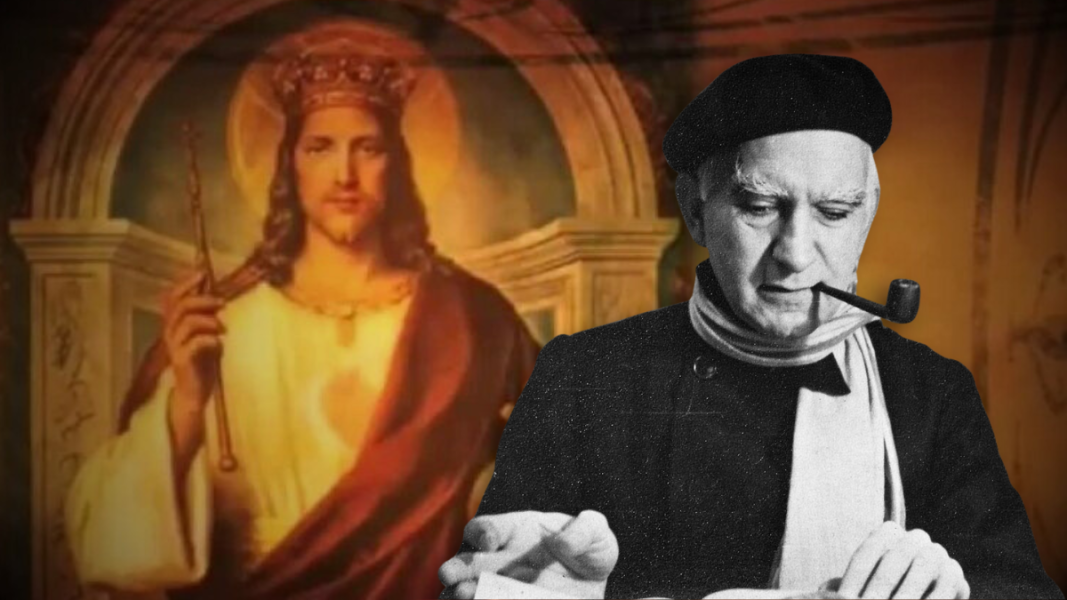
By: Yousef Altaji Narbon
Those who follow or know the traditional calendar within the Holy Mother Church keep in mind that the last Sunday of the month of October celebrates the Feast of Christ the King, since we are soon finishing seeing the mysteries of the life of Our Savior. The paternal words of Pope Pius XI resound in the famous Encyclical Quas Primas when he establishes the feast: “…It also seemed to Us that the last Sunday of October would be much more suitable for this feast than any other, because in it the liturgical year almost comes to an end; thus it will happen that the mysteries of the life of Christ, commemorated during the year, end and receive their crowning in this solemnity of Christ the King, and before celebrating the glory of All Saints, the glory of Him who triumphs in all the saints and elect will be celebrated and exalted.” The desire to highlight the kingship of Christ in the temporal plane is a palpable lack in this wasteland of prevailing Naturalism that seeks the self-destruction of the Catholic Church, in order to deify man as the sublime pinnacle of all creation.
A world that shows, with the passing of the hours, the unfathomable inanition it suffers for having chosen the devil before God; for this notorious reason, it makes the need arise to reiterate incessantly the perennial Magisterium of the Mystical Body of Jesus Christ on these topics of vital importance for all. There are truths that are part of the Catholic Faith that today are pushed to the peripheries of the public arena because they are considered: triumphalist, medieval, rigid, incompatible with modern reality, or simply, of little relevance to modern man; one of these doctrines hidden maliciously is that of Christ the King. We only have to ask ourselves: When was the last time a massive homily was heard on the obligation to establish the Social Reign of Christ through Christendom? Except for the scarce exceptions, this is not preached publicly and proudly from the parishes, this is as grave as stopping teaching about Transubstantiation. The respected Father Leonardo Castellani, with his usual clarity, does not withhold even the smallest crumb of truth about Christ the King. His words warm us in a welcoming way in the inextinguishable fire of the Deposit of Faith, to be able to understand Christ the King in the current crisis that Christendom is going through. Let us read carefully this august exegesis:
Today we celebrate the feast of Christ the King, a first-class feast. Christ before Pilate affirmed three times that He was King, in the same sense that Pilate understood it. “So in short, are You a King? – You have said it; that is, ‘you are right.’ It is true that He said: “My Kingdom is not of this world”; but He did not say: “my Kingdom is not here”. He used the adverb “hinc” which indicates movement and does not exist in Spanish: it exists in German. That adverb “hinc” meant three things together: “My kingdom does not proceed from this world; my Kingdom is in this world; my Kingdom goes from this world to the other Kingdom”.
He is an apparently “poor King”, who today does not reign much, since if He reigned, the world would be better. A large part of the world does not even know Him; another part knows Him and denies Him, like the Jews: “Nolumus Hunc regnare super nos” – we do not want this one to reign over us; finally another part recognizes Him in words and denies Him practically in deeds; who are the cowardly Christians. But there is this that Christ also noted: that if a King’s vassals rebel against him, he does not cease to be King as long as he retains the power to punish them and subdue them again. If he does not have that power, it is something else. And so today the modernist heretics admit that Christ is King “in a certain sense”, but deny the Second Coming of Christ. Then yes, He would be a poor King. The modernists either completely change the meaning of the Parousia, turning it into SOMETHING ELSE (like Teilhard de Chardin) or they say that He will come in 18 million years – which is like saying “never”.
Pius XI instituted the feast of Christ the King against “Liberalism”; precisely Liberalism is a kind of cowardice. Liberalism denies the Kingship of Christ, His power of right over human society. This current Christian heresy is complicated, it has like three sections, economic Liberalism, political Liberalism and religious Liberalism; and it would seem that they are not so bad, and that economic Liberalism has nothing to do with religion, it is an economic system; but it is not so, because that system is based on the heretical theological idea that “man is naturally good, it is society that makes him bad”; therefore, by giving omnipotent freedom to every man (and in the economic, on the contrary, to commerce and capital), man automatically becomes good, better, very good and saintly. It thus denies the elevation of man to the supernatural state, the fall of man, and the need for man’s redemption. Nothing less. And with that it denies the Kingship of Christ…
Liberalism eliminated the Kingship of Christ by saying something innocent: that religion was a private matter, that therefore nations should respect all religions and that the Church should not get involved in matters of eleven yards – that is, in public affairs. The great German philosopher Josef Pieper observes that if we make God a private matter (a matter of the interior of each one’s conscience), by the same token we make the State God and we turn Jesus Christ and the Eternal Father into sub-gods. Indeed, the State is a public matter, and therefore, religion is inferior and must submit to it, since the public is much superior to the private, and the private must submit to it. Indeed, History soon showed that the “liberal secularism” was in reality true hostility; and it ends up deifying, divinizing the State; which soon organized itself into a monstrous and idolatrous philosophical system: “statolatry”, the system of Hegel and Karl Marx.
I don’t have time to talk about the other heresy that denies the Kingship of Christ perhaps more radically; modernism that was born from liberalism; and it is the newest heresy, which is now fighting within the Ecumenical Council [Vatican II]. I must say something about the bad soldiers of King Christ, that is, the cowardly Christians. Nothing abhors a King as much as cowardice in his soldiers; if his soldiers are cowards, the King is ready.
Christians who have a kind of inferiority complex about being Christians do not honor King Christ. What Christian would a Catholic Minister of Education be who hands over the Argentine University to the communists, for example? Or two Catholic rulers who go to look for precisely an atheist and blasphemous writer, enemy of Christ, to put him as Director of the National Library (J.L. Borges), and thus show themselves magnanimous? If that anti-Christian writer were the most competent, more apt than any Catholic, perhaps the thing could be justified by saying: “We should not look at religion, we should look at competence.” But in fact the case was that the chosen one was incompetent, little competent, less competent than many others: the only advantage he had over the others was being impious. A professor from La Plata told me: “Being leftist pays dividends; because leftists are helped by leftists and by Catholics, out of ‘magnanimity’. Catholics reserve their wrath and their desire to fight for their brothers in religion”.
Not so much as that: here in Argentina it will be cowardice, but it is rather a good dose of stupidity. A lady asked me: “How is it possible that So-and-so, who is Catholic and owner of the magazine Such and Such, has put a leftist as director, who is ruining the magazine?” I told her: “Madam, Catholics put leftists in high positions, even if they are incompetent, to convert them!”.
Not in vain was the sin of St. Peter cowardice. Christ reproached the Apostles as “cowards” during the Storm; and He felt the cowardice of St. Peter so much that He forced him to repent publicly. “Peter – He said to him with irony – do you love Me more than these?”, because Peter before the sin had said “Even if all these abandon You, I will not abandon You!” Peter took good care not to repeat his bravado and say: “Yes, I love You more than all these!”, although it may have been true then. He said humbly: “Lord, You know everything; You know that I love You…” – period.
For Christ to be truly King, at least in us, we must overcome fear, cowardice, pusillanimity; not be “men for little”, as St. Teresa said, and woe to the one to whom she applied it! And how can we overcome fear? Fear is a giant!
“Have you forgotten that I was with you?”
Source: Leonardo Castellani Th. D – Domingueras Prédicas – Ed. Jauja – 1997 – Pgs. 327-332.