


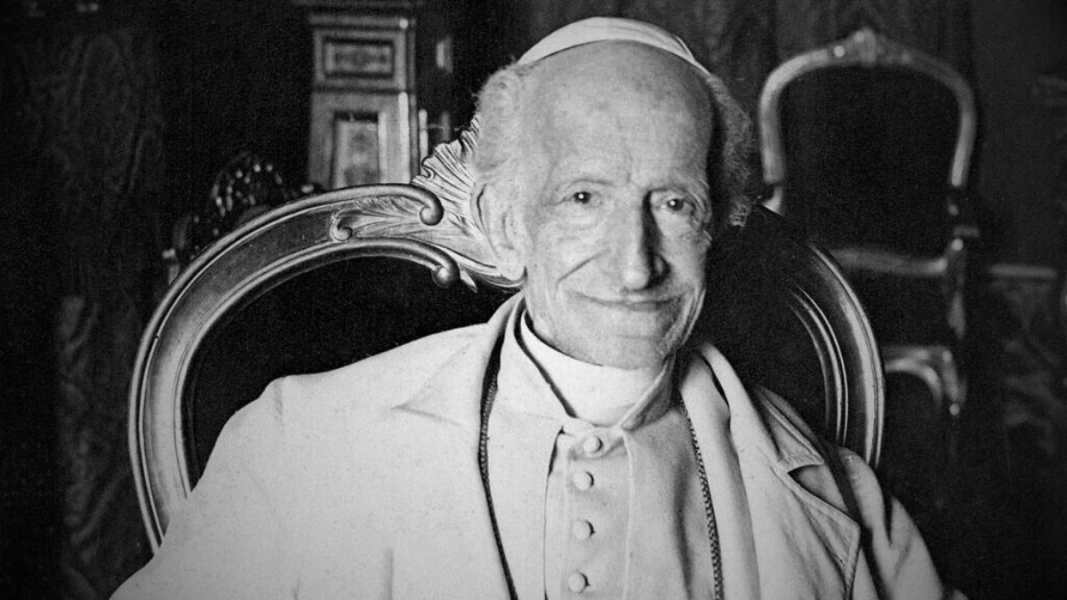
On September 13, 1896, Pope Leo XIII published the apostolic letter Apostolicae curae, a document that put an end to centuries of controversy by declaring that the ordinations performed according to the Anglican rite are “null and invalid”.
The text was not a mere theological opinion, but the result of an exhaustive investigation ordered by the Pope and conducted by a young diplomat of exceptional talent: Rafael Merry del Val, future cardinal and Secretary of State to St. Pius X.
The Commission of Leo XIII and the Mission of Merry del Val
At the end of the 19th century, in the context of the emerging ecumenical movement, attempts multiplied among some Anglican bishops to obtain recognition from Rome for their priestly orders. Leo XIII, prudent and pastoral, decided not to respond politically but doctrinally, creating a commission of theologians and historians to rigorously examine the Anglican rite of ordination introduced under Edward VI.
The person in charge of coordinating the documentary work was Rafael Merry del Val, then secretary of the papal legation in London. His role consisted of gathering the texts of the Edwardine Ordinal, comparing its formulas with the ancient Catholic rites, and drafting the doctrinal synthesis that, after twelve sessions of study, would be presented to the Pope.
The result of the report, reviewed and approved by Leo XIII, served as the basis for the final drafting of Apostolicae curae.
“The ordinations performed according to the Anglican rite are absolutely null and completely invalid (irritas prorsus fuisse et esse, omninoque nullas),” the pontifical document concludes.
Why Rome Declared Anglican Orders Invalid
The work of the commission led by Merry del Val focused on three essential aspects of the sacrament of Holy Orders: matter, form, and intention.
-
Defect of form: the Anglican rite suppressed the formulas that expressed the power to “consecrate and offer the true Body and Blood of Christ”.
For Rome, this omission altered the sacramental essence, since the “form” no longer manifested the intention to confer a priesthood with power over the Eucharistic sacrifice. -
Defect of intention: the Anglican Ordinal was conceived, according to the commission, with a theological intention opposed to the Catholic one, expressing a purely pastoral and non-sacrificial ministry.
As summarized in Merry del Val’s report: “The rite does not signify what the sacrament effects.” -
Loss of apostolic succession: by interrupting the chain of valid consecrations after the break with Rome and adopting a defective rite, apostolic succession was extinguished in the Anglican Communion.
The Reaction and Historical Impact
Leo XIII’s decision generated an immediate response from the archbishops of Canterbury and York, who published in 1897 the document Saepius officio in defense of the Anglican rite.
However, Rome reaffirmed its position a year later through the collective work “A Vindication of the Bull Apostolicae curae”, prepared by the Catholic bishops of England and Wales and largely structured according to Merry del Val’s notes.
Since then, the doctrine of Apostolicae curae has remained unchanged: Anglican ministers who wish to enter into full communion with the Church must be ordained again, as the validity of their previous orders is not recognized.
Leo XIII’s Method: Charity Without Ambiguity
Leo XIII did not seek to humiliate the Anglicans, but to affirm the sacramental truth without ambiguities.
His decision fits into the line of the magisterium that combines doctrinal clarity with charitable openness: the Pope maintained dialogue with the English interlocutors, but did not sacrifice the Catholic principle of the objective validity of the sacraments.
Merry del Val’s work—meticulous, logical, and theologically sound—reflected that same spirit: charity in dealings, but firmness in the face of error. It is no wonder that St. Pius X would later choose him as his principal collaborator, recognizing in him “the Roman mind” that knows how to unite faith, reason, and obedience.
The Current Validity of Apostolicae curae
More than a century later, Leo XIII’s letter remains a doctrinally binding text. Despite modern ecumenical efforts, Apostolicae curae has not been revoked or modified.
The document remains a model of magisterial clarity: it demonstrates that true Christian unity can only be built on sacramental truth and apostolic succession, not on sentimental or political consensus.
Merry del Val’s study and Leo XIII’s decree were not an act of intransigence, but an affirmation of the integrity of the faith. In times of doctrinal confusion, Apostolicae curae reminds us that charity cannot be detached from truth, and that the Catholic priesthood is not a human function, but a divine gift transmitted by uninterrupted apostolic succession from the apostles.
In the history of the Magisterium, few documents combine such erudition, serenity, and firmness as this one. And few collaborators have served the clarity of doctrine with such zeal as Rafael Merry del Val, the young diplomat who helped Leo XIII to confirm with solid reasons what the Church has always believed.