


By Luis E. Lugo
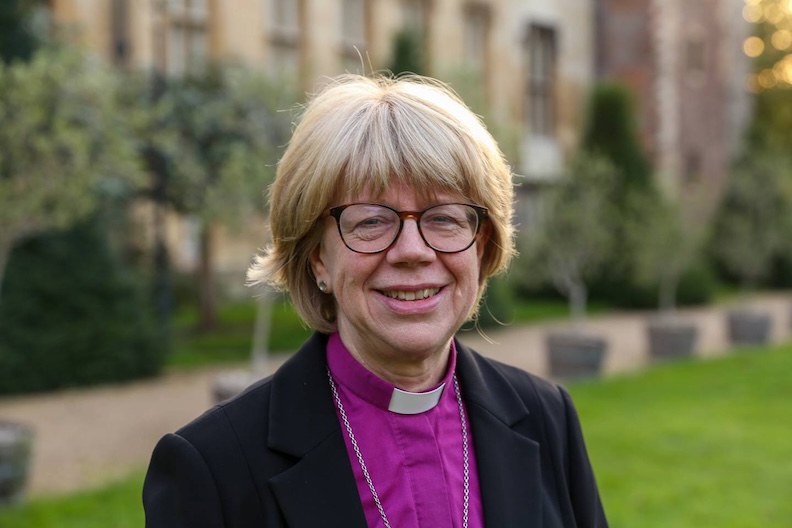
The announcement of the appointment of Sarah Mullally as the 106th Archbishop of Canterbury marks a first historic event for the Church of England (CoE), which traces its origins back more than 1,400 years, to the time of Saint Augustine of Canterbury. In addition to being the head of the CoE, the Archbishop of Canterbury also serves as the spiritual leader of the worldwide Anglican Communion, whose thriving churches in the Global South have been alienating themselves more and more from the mother church due to the drift of the latter toward theological liberalism. This appointment will surely widen that gap.
Already in the 1940s, proposals in support of the ordination of women priests were circulating in the CoE. Those early efforts prompted a 1948 essay by the well-known Anglican writer, C. S. Lewis. The arguments he presents in “Priestesses in the Church?” deserve to be revisited and seem as relevant today as when he first wrote them, both for Catholics and for Anglicans.
As Lewis makes clear from the beginning, his opposition to the ordination of women is not based on the claim that women are less capable than men with regard to the many qualifications associated with priestly ministry: «No one among those who do not like the proposal [of women’s ordination] holds that women are less capable than men of piety, zeal, knowledge, and anything else that seems necessary for the pastoral office. […] [Women] can be as “Godlike” as a man, and a given woman much more than a given man».
Lewis further asserts that the Church’s historical opposition to the practice of female ordination could not have been rooted in contempt for women’s religious capacities. And that for a simple reason. As he writes, «the Middle Ages carried its reverence for a Woman to a point where it could plausibly be argued that the Blessed Virgin became in their eyes almost a fourth Person of the Trinity». Despite this, Lewis continues, never «in all those centuries was anything like a priestly office attributed to her».
Lewis presents four arguments for his opposition.
The first concerns the nature of the priestly office. In the most traditional understanding, the priest is seen primarily as a representative; in fact, he is a double representative, who represents us to God and God to us. This latter function, in which the priest represents God to us, is something that only a man can perform: «Only someone who wears the male uniform can (provisionally, until the Parousia) represent the Lord to the Church: for all of us, corporately and individually, are feminine in relation to Him».
His second argument revolves around the authority of the Church. The practice of ordaining only men to the priesthood is something the Church has done as the bearer of divine revelation, as the guardian of the depositum fidei. If this claim to authority by the Church were false, Lewis argues, «then we do not want to make priestesses, but to abolish priests». For then the Church would have no authority to ordain anyone.
Lewis’s third argument focuses on the fact that the Church’s imagery and language reflect the correct order of things. The Church claims, for example, that in the Eucharistic celebration the priest acts in persona Christi, in the person of Christ. But the second Person of the Trinity is called the Son, not the Daughter. And the mystical marriage is between Christ the Bridegroom and the Church as his Bride; an inversion of these roles is simply unthinkable. Moreover, in the Our Father we address «Father», not «Mother».
For Lewis, this language carries great weight. Turning the masculine language into feminine (or, by extension, into some neutral) violates our understanding of God. In other religions goddesses were worshiped, but not in Christianity, he notes. Thus, feminizing (or neutralizing) the divinity is to embark on another religion. The same God, Lewis observes pointedly, «has taught us how to speak of Him».
The imagery matters, and to claim that it does not «is to say either that all the masculine imagery is not inspired, is merely human in its origin, or else that, though inspired, it is wholly arbitrary and dispensable». This is intolerable, «or, if tolerable, it is an argument not in favor of Christian priestesses but against Christianity».
Finally, Lewis considers that the drive toward the ordination of women is based on an anthropological misunderstanding —even more common in our time than in his— that sees sex as «something superficial, irrelevant to the spiritual life». Man and woman are no longer seen as an organic unity of body and soul, but as homogeneous and interchangeable parts instead of «distinct and complementary organs of a mystical body».
As Lewis writes forcefully, «we have no authority to take the living and “semitic” [seminally significant] figures that God has painted on the canvas of our nature and move them as if they were mere geometric figures».
Lewis concludes by drawing a suggestive, though somewhat fanciful, parallel between the Church and a Ball (Ball). Unlike a factory or a political party, he observes, «the Ball exists to stylize something natural that concerns the human being in his integrity: courtship». We cannot alter that arrangement without undermining its purpose, he asserts.
This applies with even greater force to the Church, «for there we deal with the masculine and the feminine not merely as facts of nature, but as living and tremendous shadows of realities entirely beyond our control and largely beyond our direct knowledge. Or rather, it is not we who deal with them but—as we shall soon learn if we meddle—they who deal with us».
In the various confusions of contemporary gender ideology, we are reaping the bitter fruit of that «meddling» against which Lewis warned so prophetically.
About the author
Luis E. Lugo is a retired university professor and former foundation executive who writes from Rockford, Michigan.