


By Brad Miner
In the museum The Frick Collection in Manhattan (entrance on Fifth Avenue, at East 70th Street), the exhibition “To the Holy Sepulcher: Treasures from the Terra Sancta Museum” is currently on display, which will be open until January 5, 2026, and it’s really worth visiting.
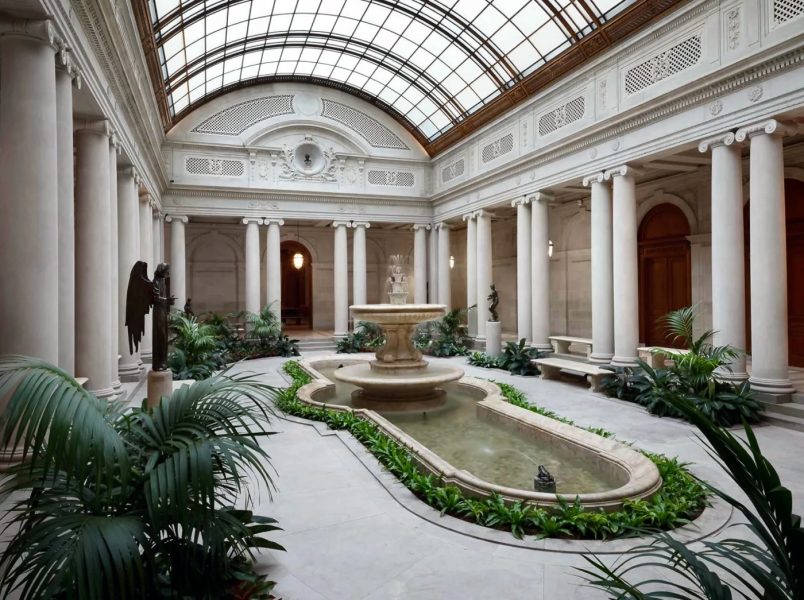
If you haven’t yet seen the recently renovated Frick headquarters, it’s a pleasant experience, although—however beautiful it may be—it has lost some of the domestic and elegant charm of the original building, which retained the air of the home of the man who built it.
Henry Clay Frick (1849–1919) was one of the so-called robber barons (robber barons). At 21 years old, he founded the Frick Coke Company, which used a beehive-type oven to transform coal into coke, later sold to steel mills. In a decade, after buying out his partners’ shares and obtaining a loan from his friend Andrew Mellon, he launched H.C. Frick & Company. The following year, he formed a partnership with Andrew Carnegie. The relationship ended in bitterness, lawsuits, and legal settlements.
To have a place to rest and fish, Frick and other millionaires bought Lake Conemaugh, a reservoir held by the earthen South Fork Dam, above the town of Johnstown (Pennsylvania). They lowered the dam’s level by about 90 centimeters to facilitate access. But on May 31, 1889, a torrential storm caused the overflow and collapse of the dam, sending more than 15 billion liters of water over Johnstown and killing more than 2,200 people. Frick was never sued, although he donated “thousands of dollars” to help rebuild the city.
As a poet of the time wrote:
«All the horrors that hell would desire, / that was the price paid… for fishing!»
By the way, the Frick Collection is today free of any stain from the union or business practices of its founder. And although it’s not clear how much personal merit Frick had in selecting the works—since he hired renowned art advisors—the man knew what he liked. He would undoubtedly have agreed with Oscar Wilde: «I have the simplest tastes: I am always satisfied with the best».
Before referring to the exhibition on the Holy Sepulcher, I must mention that, for me, the jewel of the Frick remains the counterpoint between the portraits by Hans Holbein the Younger: Sir Thomas More (1527) and Thomas Cromwell (ca. 1532–33), which hang on both sides of the fireplace in the Living Hall. Above the fireplace is St. Jerome (1590–1600) by El Greco. And, not to mention, the Frick owns three Vermeers!

The exhibition “To the Holy Sepulcher: Treasures from the Terra Sancta Museum” is small but of great impact. Like any good art and archaeology story, it encloses mystery and history.
In summary: after the Crusades, the Franciscans arrived in the Holy Land, and one of their groups assumed the custody of the Basilica of the Holy Sepulcher. It is, of course, a long and complex story—from the Resurrection to the construction of the temple by Saint Helena—, but the Franciscans founded the Custody of the Holy Land (Custodia Terræ Sanctæ), initiated by Saint Francis of Assisi in 1217. Today that custody is shared by Catholic and Orthodox communities.
As Alvar González-Palacios writes in the exhibition catalog, much of what the Franciscans and other groups have custodied remained inaccessible to the public until recently. His account of how he managed to access the Monastery of San Salvador in Jerusalem and its treasures 45 years ago—though not an Indiana Jones-worthy story—illustrates why it was important to create the coordinated Terra Sancta Museum project.
The Frick describes the current show as follows:
«This innovative exhibition presents more than forty rare objects from the Church of the Holy Sepulcher. Mostly unknown until their recent rediscovery, these opulent works range from gold and silver liturgical objects inlaid with gems to ornaments and vestments of velvet, damask, and other sumptuous materials. These treasures were donated by European Catholic monarchs and Holy Roman Emperors in the 17th and 18th centuries to the church in Jerusalem, the religious center of the Christian faith, and have been custodied and used since then by the Franciscan friars who maintain the site.»

My favorite piece among the treasures is the pair of monumental candelabra (torchères) that flank a majestic altar. Calling them “candelabra” does not do them justice: they are true silver masterpieces, 2.4 meters tall, made in the workshop of Al San Lorenzo Giustinian in Venice, in the mid-18th century. And, moreover, they come with their own historical gossip.
The relations between Christians in the Holy Land have not always been friendly:
«After the Greek-Orthodox clergy looted the Holy Sepulcher on April 2, 1757, the Custody managed to recover several damaged objects and repurchase others that had been stolen.»
Part of the recovered silver was used to create these torchères.
To this day, disputes between Catholics and Orthodox persist—some serious, others almost anecdotal. In this second group is the famous “Immovable Ladder” of the Basilica of the Holy Sepulcher. Placed there since at least the 18th century, it is “immovable” because the different Christian confessions cannot agree on who placed it. It was probably a worker, but from which rite? As Atlas Obscura explains:
«The ladder is still there today. No one dares to touch it, lest it break the status quo and provoke the wrath of the others.»

To watch a six-minute video about the Frick, narrated by comedian Steve Martin, click here.
About the author
Brad Miner, husband and father, is senior editor of The Catholic Thing and a member of the Faith & Reason Institute. He was literary editor of National Review and had a long career in the publishing industry. His most recent book is Sons of St. Patrick, written with George J. Marlin. His best-known work, The Compleat Gentleman, is available in its third revised edition and audiobook format at here. He has served on the boards of Aid to the Church in Need USA and the Westchester County, NY selective service system.