


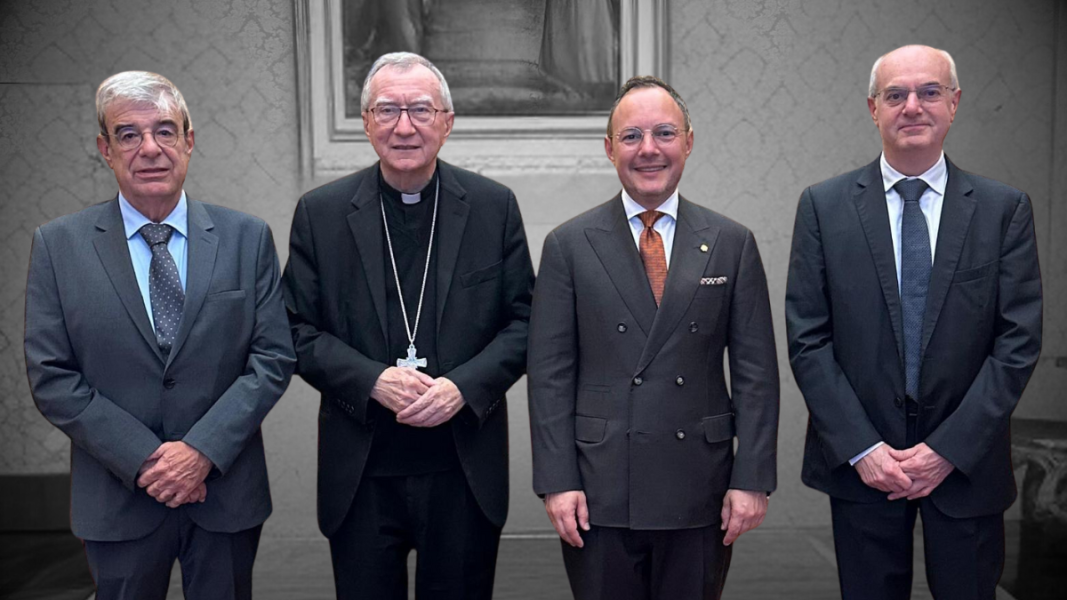
The Government of Andorra and the Holy See held this Wednesday, October 22, in the Vatican a new meeting within the institutional dialogue process on the possible decriminalization of abortion in the Principality. The meeting brought together the Head of Government, Xavier Espot, the Minister of Institutional Relations, Ladislau Baró, and the Ambassador to the Holy See, Carles Álvarez, with Cardinal Pietro Parolin, Vatican Secretary of State.
Both parties reaffirmed their “shared commitment” to continue working constructively with the aim of drafting in the coming months a legislative text proposal. According to the official statement, the issue presents a “great legal, institutional, and social complexity”, and requires a “careful” technical development, that is, meticulous and thorough.
The Government of Andorra and the Holy See expressed their desire to “find a solution that allows for reconciling the maintenance of the country’s institutional structure and progress in recognizing women’s rights”.
The background: a Catholic country facing an impossible law
The situation in Andorra is not a simple administrative matter. The episcopal co-prince, the Bishop of Urgell, exercises constitutional functions that would oblige him to sanction any law approved by the General Council, including one that decriminalizes abortion. That paradox turns the debate into a moral dilemma: either the constitutional framework is preserved, or the principle of the defense of life is sacrificed, which the Vatican itself considers non-negotiable.
And there lies the knot: Rome participates in the dialogue, but without clearly stating that abortion admits no “compatibilities”. Talk is of “balance,” of “institutional structures,” of “social complexity,” as if the right to life depended on the constitutional design of a microstate.
When language substitutes doctrine
During his 2023 visit, Cardinal Parolin had already described the issue as “very delicate” and “very complex,” insisting on addressing it with “discretion and wisdom.” Elegant expressions, no doubt, but in practice they sound like theological evasion wrapped in velvet diplomacy. Because when an issue involves the legalization of abortion, what is expected from the Pope’s chief collaborator is not discretion, but definition.
The Holy See, true to its recent style, shelters itself in dialogue, as if dialogue itself were a theological virtue. But dialogue without truth ends up being the art of talking a lot to say nothing. And in this case, the risk is not semantic, but moral: that the defense of life dissolves into carefully worded statements so that no one is offended.
The paradox of “compatibility”
The Andorran statement concludes by speaking of a “compatible solution” between the structure of the State and the recognition of women’s rights. In other words: a law that allows abortion without the bishop appearing to approve it. A squaring of the legal circle that may satisfy diplomats, but exposes a fundamental contradiction: there can be no compatibility between the right to kill and the right to live.
Abortion does not become acceptable because it is regulated with “technical complexity” nor because the Vatican accompanies it with verbal prudence. And while “compatible formulas” are sought, the incoherence grows: a country officially Catholic attempts to legalize abortion with the silent mediation of those who should remind it, with charity but with firmness, that life is not negotiable.