


By Michael Pakaluk
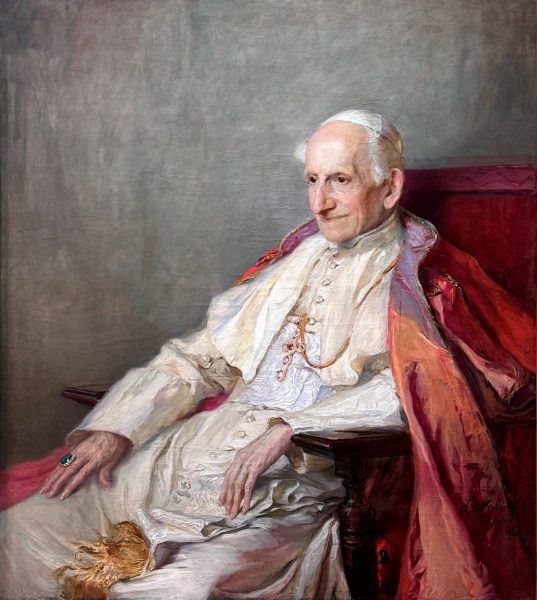
If an educated Catholic is asked what the two main teachings of the encyclical Rerum Novarum of Leo XIII (1891) are, and he knows something about this fundamental text of the modern Church’s social doctrine, he will probably say that it approves unions and formulates the principle of the just wage or “family wage”.
The doctrine of the family wage is indeed important, even if today it cannot be easily applied in the United States due to current customs and labor laws. The doctrine holds that hiring a family man is, in reality, hiring an entire family, not a mere individual, and that, therefore, he must be paid a wage sufficient to support a large family, and that also allows him to save something to acquire goods over time, assuming that his family lives modestly and prudently.
As for the workers’ associations mentioned in the encyclical, they do not exist primarily for collective bargaining, and “must pay special and primary attention to the duties of religion and morality” (n. 57).
Even though we praise Rerum Novarum as a foundational document, it can rightly be judged that both teachings have been largely abandoned.
But these are not the two main teachings of the encyclical, which are, rather, the following:
(1) Socialism is a disastrous error that suffocates the sources of wealth and destroys the family.
(2) No solution to the “problem of labor and capital,” nor to any other serious social problem, is possible without a rebirth of Christianity.
Leo XIII did not define socialism as mere “state ownership of the means of production,” but as a philosophy that denies that the individual and the family are realities prior to the State. In particular, it denies the authority of the father of the family, who—the Pope says—has over the resources of his home a right as legitimate as that of the State itself.
Leo addresses socialism in several of his encyclicals and considers it the great danger of his time. It would be naive to think that such a profound challenge to Christian civilization was resolved by Fabian-type reforms that led to the welfare state.
Rather, in our use of fiat money, in the policies of the “Great Society” (which weakened the family), and in the State’s claim to redefine marriage, we see that same socialist philosophy.
Who today holds that the limits of the State’s fiscal power are set by natural law and by the prior rights of the family as a true society? Or who considers massive wealth transfers—like Social Security—to be a gift, and not a supposed “right,” that is, a claim of retired elderly on the resources of young families?
Therefore, no, the socialism that concerned Leo XIII has not disappeared.
As for the second truly main idea, it would be difficult to claim that it conditions our interpretation of Catholic social doctrine today. I invite readers to reread paragraphs 16 to 30 of the encyclical: “No practical solution will be found without the intervention of religion and the Church,” insists Leo, “and all the efforts of men will be in vain if they exclude the Church.” (n. 16) Do we really believe that?
Leo rightly highlights the glory of the Church’s works for the poor—hospitals, schools, hospices—but emphasizes that Christian faith is essential.
Christianity teaches us that the social equality sought by modern ideologies is unattainable: “Every effort against nature is useless,” says Leo (n. 17). It also exhorts us to abandon utopian dreams, for “the pains and difficulties of life will have no end on earth; the consequences of sin are bitter and heavy, and will accompany man as long as he lives.” (n. 18)
Faith in eternal life implies relativizing material concerns: “As for riches and other goods that men call desirable—says Leo—, whether we have them in abundance or lack them, it does not affect eternal happiness.” (n. 21)
Moreover, Christianity teaches us to value correctly: “The true worth and nobility of man lie in his moral qualities, that is, in virtue. […] Virtue, moreover, is a common heritage of all men, equally within the reach of rich and poor.” (n. 24)
And Christian morality is practically necessary for the poor to escape poverty: “Christian morality, when practiced fully, leads by itself to temporal prosperity […] it makes men supply the lack of means through economy, teaches them to be content with a frugal life, and, moreover, keeps them away from the vices that devour not only small incomes, but also great fortunes.” (n. 28)
At the same time, Leo qualifies as “pagan” the attempt to replace Christian charity with “a system of assistance organized by the State.” (n. 30)
In summary, Leo XIII teaches: “When a society perishes, the wholesome counsel to give to those who want to restore it is to call it back to the principles from which it arose.” (n. 27)
That is why I am uncomfortable seeing Catholics who eagerly await a new “foundational” encyclical on topics like the “artificial intelligence revolution.” In part, I am uncomfortable because it would be too soon: Rerum Novarum came a century after the Industrial Revolution began.
The only thing I clearly foresee from the massive turn toward AI is a huge investment bubble that will probably burst in a few years.
But above all, I wonder: why do we feel so anxious to establish new foundations, when we have been so busy ignoring the first ones?

About the author
Michael Pakaluk, specialist in Aristotle and ordinary member of the Pontifical Academy of St. Thomas Aquinas, is Professor of Political Economy at the Busch School of Business at The Catholic University of America. He lives in Hyattsville, Maryland, with his wife Catherine—also a professor at the Busch School—and their children. His collection of essays The Shock of Holiness (Ignatius Press) is available, and his next book The Company We Keep will be published by Scepter Press. He also contributed to Natural Law: Five Views (Zondervan, 2024), and his most recent work, Be Good Bankers: The Economic Interpretation of Matthew’s Gospel, was released in March with Regnery Gateway.