


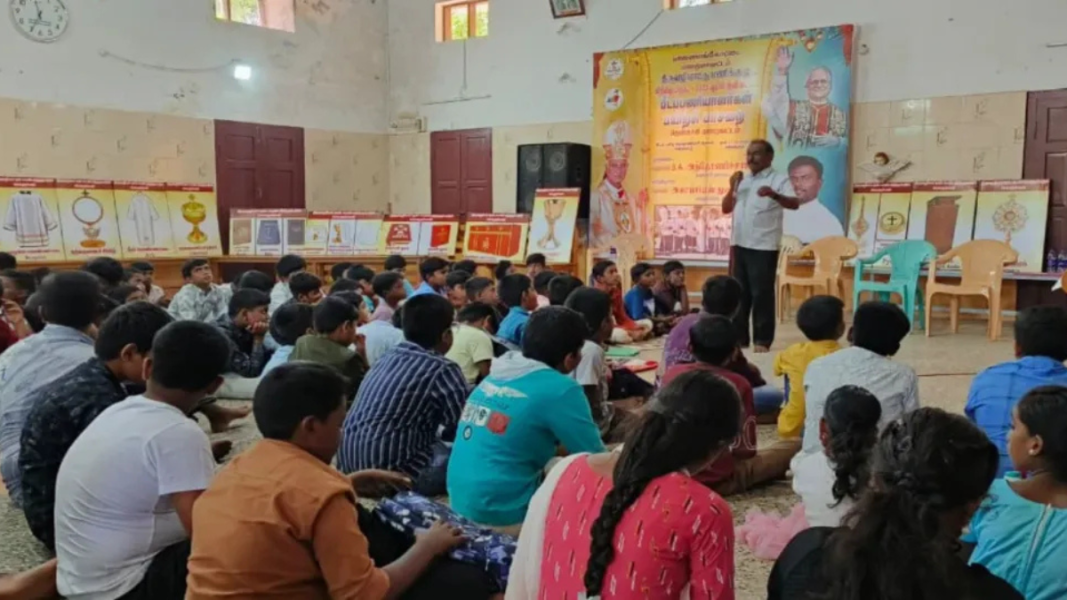
According to Catholic News Agency, the diocese of Palayamkottai, in southern India, has launched its first training program for altar boys, with the participation of 1,570 children from five parishes. The objective is simple but profound: to form altar servers who understand the value of the Eucharistic sacrifice and live their faith with reverence and discipline.
“The program has strengthened the faith and discipline of the children, and has made the parish liturgies more prayerful and meaningful,” states the diocesan pastoral letter, as cited by Catholic News Agency.
A living Church among the poorest
Palayamkottai is a diocese that reflects the reality of millions of Catholics in the Asian subcontinent. With around 138,500 faithful, its social composition is predominantly rural: 75% are landless rural workers, 15% small farmers, and 80% live on less than two euros a day.
Despite these extreme conditions, the local Church maintains a firm commitment to education and Christian formation. In its 108 educational centers, managed by the diocese and religious congregations, more than 65,000 children receive teaching, care, and human and spiritual formation.
In this context, the new altar boys’ program becomes a sign of hope. It not only seeks to teach children the proper functions at the altar, but also to cultivate in them piety, obedience, and love for the Eucharist, values that could later germinate into priestly or religious vocations.
“The altar is the heart of Christian life, and forming altar servers is forming guardians of the mystery,” expressed one of the priests responsible for the program, according to the publication.
Liturgical formation with international support
The project was developed between June and October, in collaboration with the Diocese of Columbus (Ohio, United States), which provided logistical and catechetical material support. During the sessions, the children participated in audiovisual presentations, practical demonstrations, and group discussions, in addition to receiving manuals with prayers and liturgical norms.
The purpose of the initiative was to teach young people the spiritual meaning of each gesture and movement within the Mass. In a context where poverty can limit access to religious formation, the Indian diocese sought to rekindle reverence and love for the Holy Sacrifice of the Altar.
The trainers noted that many of the participants had shown a sincere desire to continue serving, and several of them expressed interest in entering the minor seminary in the coming years.
An example of traditional pastoral care in times of confusion
From a perspective faithful to the traditional magisterium, this type of program constitutes a concrete and effective response to the faith crisis affecting much of the Catholic world. While in the West theological or ideological debates on liturgy and the role of the laity are promoted, in humble communities like those of Palayamkottai, the Church returns to the essentials: worship, prayer, and service at the altar.
“It’s not about modernizing the faith, but about rediscovering its purest meaning: serving God with humility and love,” affirmed a local catechist cited by Catholic News Agency.
The training of altar boys not only transmits external discipline, but also a silent catechesis on order, sacrifice, and the beauty of divine worship. These initiatives, small in resources but great in spiritual fruits, demonstrate that the future of the Church does not depend on globalist strategies or pastoral fads, but on fidelity to tradition and the Gospel.
A seed of vocations and hope
The Palayamkottai program could serve as a model for other rural dioceses in Asia or Africa, where the lack of priests and resources limits evangelization work. The training of altar boys represents a first step toward a solid and committed Christian life, where young people learn from childhood that serving at the altar is serving Christ himself.
In a time of growing secularization, this Indian initiative reminds us of an essential truth: the Church is renewed from the altar. And there, among the poor, far from media spotlights, vocations and souls willing to offer their lives to God are born.