


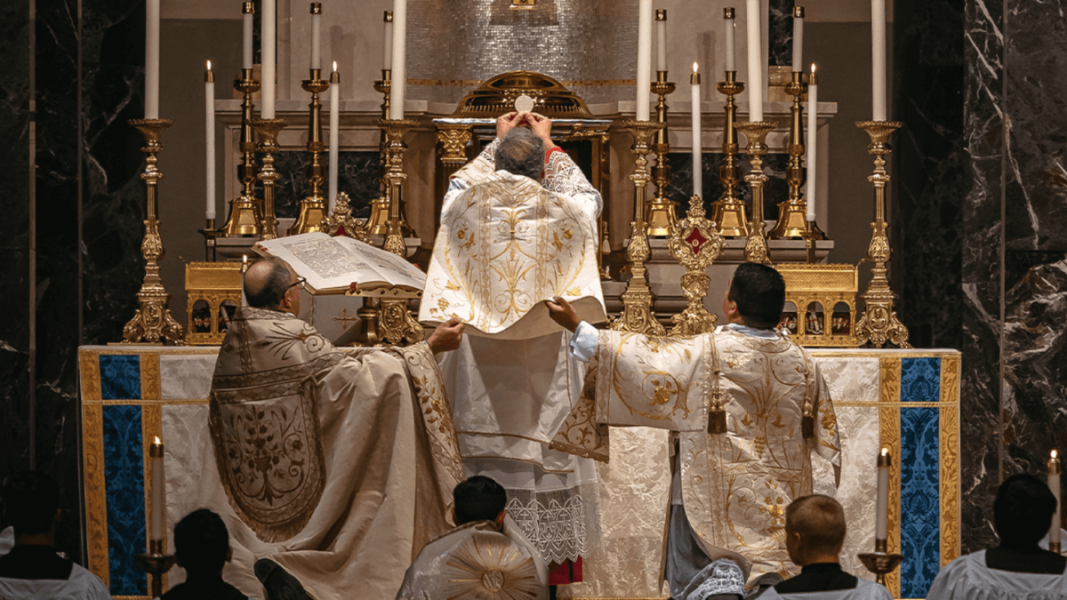
According to Catholic News Agency (CNA), the Diocese of Cleveland (Ohio, United States) has received from the Holy See a two-year extension to continue celebrating the Traditional Latin Mass in two parishes: St. Mary’s Church in Akron, and St. Stephen’s Church in Cleveland. The extension, granted by the Dicastery for Divine Worship and the Discipline of the Sacraments, allows both communities to continue using the 1962 Missal, known as the extraordinary form of the Roman Rite.
In an official statement, the diocese expressed its gratitude for the Vatican’s decision:
“The Holy See has granted a two-year extension of permission for the two remaining diocesan celebrations of the Latin Mass within the diocese,” the note stated, published on October 23, 2025.
The Traditional Mass Survives Amid Restrictions
The extension comes in a context where many dioceses in the United States have restricted or suppressed celebrations of the Tridentine Rite, in application of the motu proprio Traditionis Custodes, promulgated by Pope Francis in July 2021. The document established that Masses according to the Missal of Saint John XXIII—valid before the liturgical reform of the Second Vatican Council—can only be celebrated with express authorization from Rome and, preferably, outside parish churches.
Read also: Wave of Prohibitions on the Traditional Mass in the US: A Coordinated Movement from Rome?
While some dioceses have drastically reduced these celebrations, Cleveland has chosen to preserve its practice where consolidated communities and faithful committed to traditional liturgy exist. In contrast, dioceses like Charlotte (North Carolina) announced the total suspension of the extraordinary form starting in October 2025, a decision that has caused pain and confusion among the faithful of the ancient rite.
A Coexistence Between Tradition and Reform
The Bishop of Cleveland, Edward C. Malesic, has sought to balance respect for Vatican provisions with pastoral care for the faithful who find in the Tridentine Mass a means of profound devotion. According to the diocese, it is about “maintaining ecclesial unity” without excluding those who live their faith with attachment to traditional liturgy.
“The goal is to serve all the faithful and foster the unity of the Church, recognizing the spiritual value that many find in this liturgical form,” a diocesan spokesperson stated, quoted by CNA.
The benefited parishes are also reference points for those seeking a reverent, silent celebration centered on the Eucharistic sacrifice, traits that characterize the 1962 Missal. In both communities, a solid sacramental life is maintained, with frequent confessions and liturgical catechesis groups.
Repercussions in the Ecclesial Sphere
For many observers, this decision constitutes a gesture of pastoral prudence that avoids unnecessary tensions and preserves a legitimate space within the Church for the traditional liturgical form. However, the temporary nature of the extension—limited to two years—leaves open the possibility of future restrictions or an evaluation by the Holy See on the application of Traditionis Custodes in the diocese.
In this sense, Cleveland’s measure could be interpreted as a test phase that will allow assessing the stability, maturity, and ecclesial communion of communities linked to the Latin Mass. Some faithful fear that the permission will not be renewed; others trust that the witness of reverence and fidelity offered by traditional groups will serve to consolidate their long-term permanence.
The Value of Traditional Liturgy
Beyond the controversy, the granted extension confirms that the extraordinary form of the Roman Rite remains alive and continues to be a spiritual point of reference for thousands of Catholics. In a world marked by noise and haste, the Latin Mass offers a space of silence, adoration, and continuity with the Church’s millennial tradition.
“Traditional liturgy is a school of faith, reverence, and contemplation; not a relic of the past, but a treasure that continues to nourish souls,” comment faithful linked to the communities that keep it alive.
For many young people, especially in the United States, this liturgy represents an alternative to secularism, a return to the sacred, and a concrete form of spiritual resistance against the banalization of the divine.